Article
AI Can Help You Build Software. It Cannot Be Accountable for the Outcome.

August 26, 2026 ...

AI has made it easier than ever to start building software.
An internal team can describe a feature, generate an interface, scaffold an application, connect an API, and produce working code in a fraction of the time these tasks once required. That changes the economics of experimentation – and it should. In Using Cursor as Your AI-Assisted IDE, I described this kind of AI as a productivity amplifier rather than an autopilot. That distinction matters even more at the organizational level.
But it can also create a dangerous impression: if AI can produce the code, why hire a software consultancy at all?
The answer is that producing code was never the only reason to hire one.
Organizations hire consulting partners because important software initiatives need more than output. They need someone to establish direction, work through ambiguity, coordinate decisions, manage risk, maintain momentum, and take responsibility for reaching an outcome.
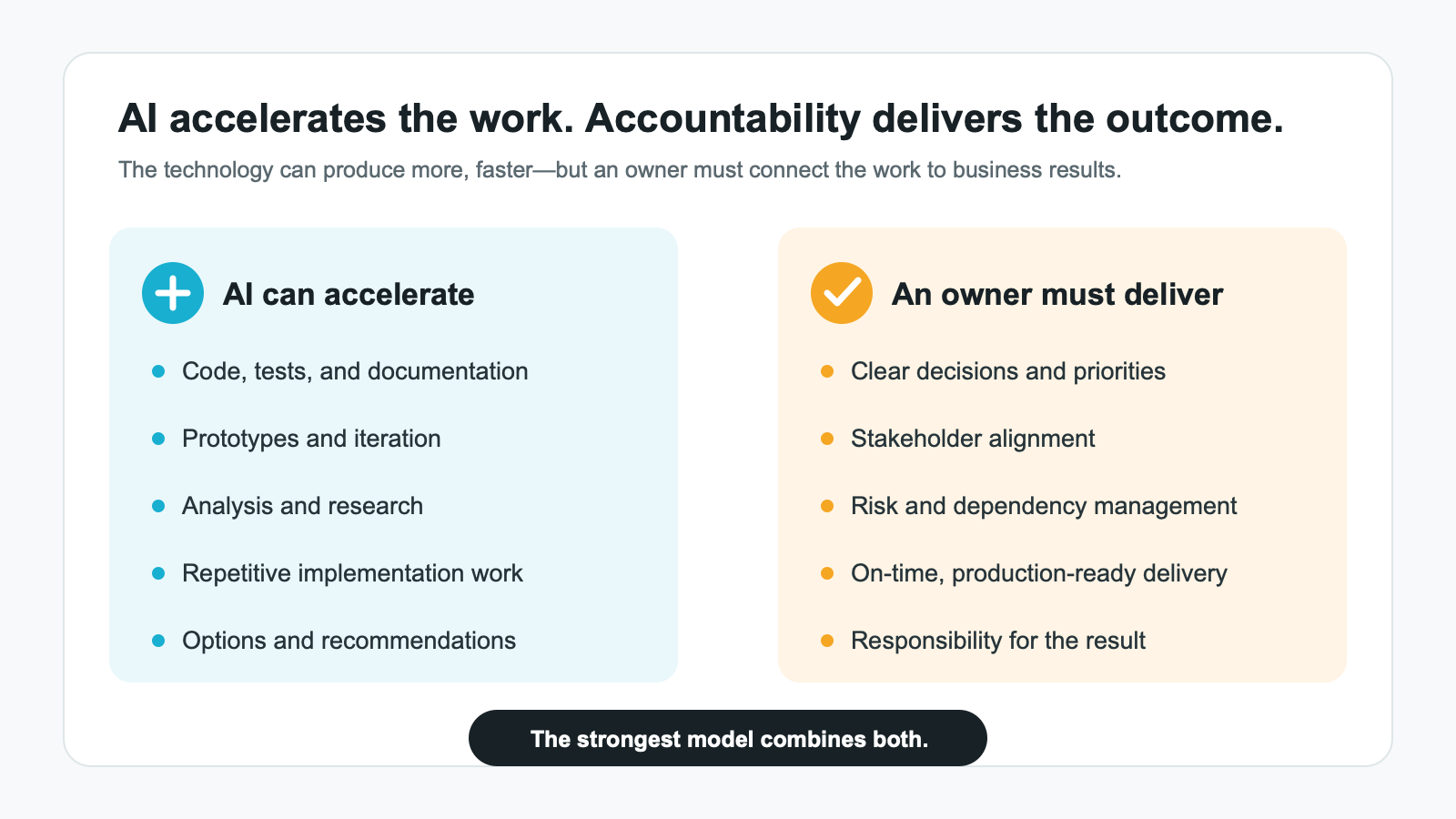
AI can help with nearly every part of that work. It cannot be accountable for it.
Code generation is not software delivery
A generated application can look surprisingly complete. The interface works. The primary workflow functions. The demonstration is compelling.
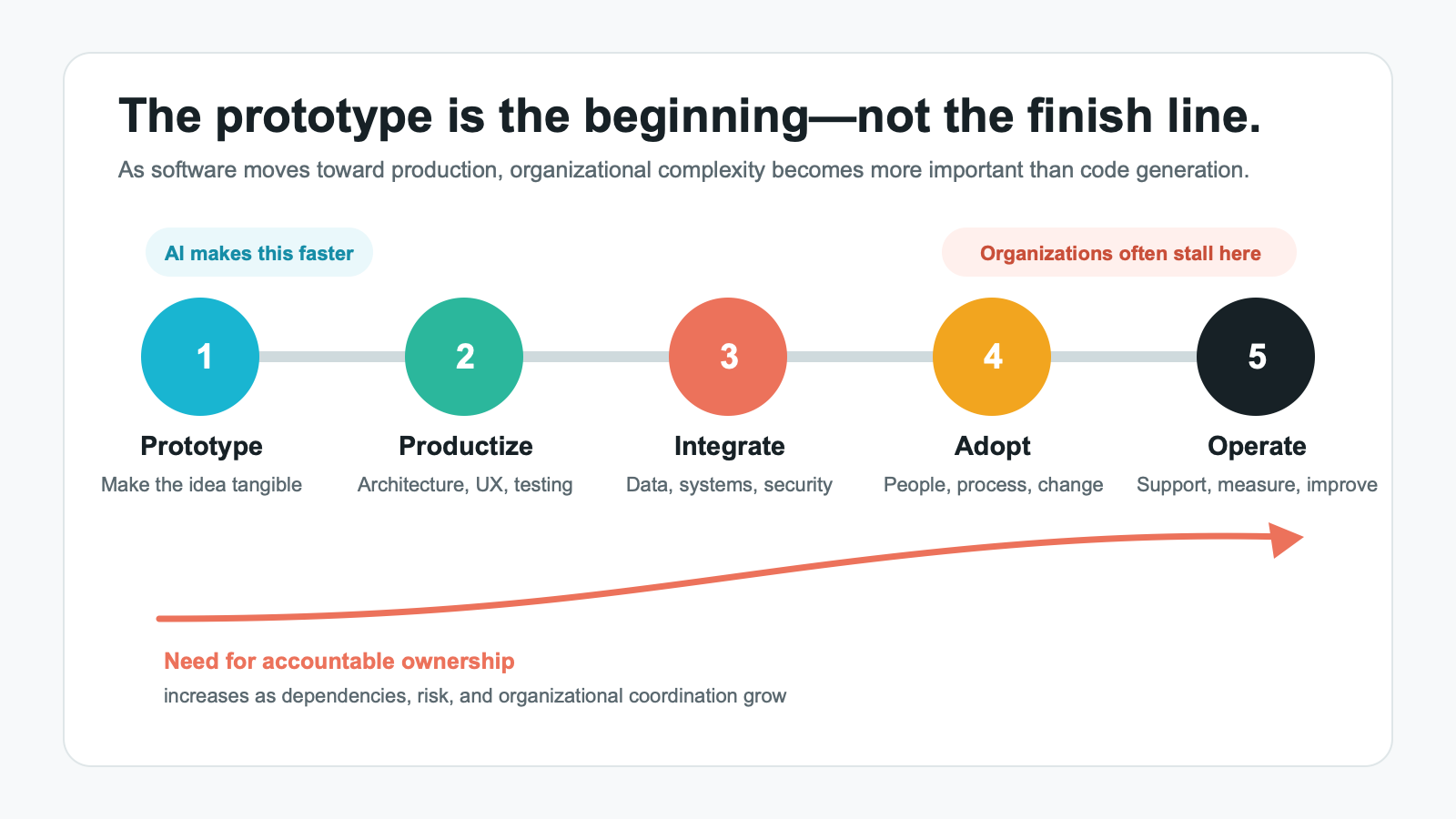
That is meaningful progress, but it is not the same as having production-ready software. I explored this gap in The AI Prototype Trap: a prototype proves that an idea can be made tangible, while a business solution must prove that it can operate reliably with real users, real information, and real organizational constraints.
Real delivery also requires decisions about:
- Architecture and long-term maintainability.
- Security, privacy, and regulatory obligations.
- Data quality, ownership, and migration.
- Integration with existing systems.
- Reliability, testing, and operational support.
- Accessibility and user experience.
- Cost, performance, and scalability.
- Adoption, training, and organizational change.
AI can assist with each item. But someone still has to decide what “good” means, recognize where the risks are, resolve competing priorities, and verify that the complete system works in the real environment.
The difference is simple:
- AI can generate artifacts.
- A delivery partner owns the path to a business outcome.
The hardest problems are often outside the codebase
Many software projects do not fail because a team cannot write the code. They stall because the organization cannot make the decisions surrounding it.
A project may depend on:
- A security review that has no clear owner.
- Data access controlled by another department.
- Conflicting requirements from business stakeholders.
- A legacy system no one wants to change.
- Procurement, legal, or compliance approvals.
- An executive decision that keeps getting deferred.
- Teams whose incentives or timelines do not align.
AI does not remove these constraints. In some cases, faster code generation exposes them sooner. This is also why spec-driven development breaks down in real projects. Requirements evolve, hidden dependencies surface, and political or operational pressure changes what the team needs to deliver. Faster implementation does not eliminate uncertainty; it shifts more of the challenge toward judgment, alignment, and adaptation.
A strong consultancy helps make these dependencies visible, brings the right people into the room, creates a decision-making structure, and keeps unresolved issues from quietly becoming missed deadlines.
That work can look less exciting than generating an application from a prompt. It is also frequently the work that determines whether the application ever reaches production.
Someone must own the deadline
When an organization decides to build with AI internally, responsibility can become fragmented.
The product team owns the idea. Engineering owns the implementation. Security owns approval. Operations owns deployment. Business stakeholders own adoption. Everyone contributes, but no one is clearly accountable for the whole result.
This creates a familiar pattern:
- A prototype is produced quickly.
- Early progress creates confidence.
- Integration and governance issues appear.
- The work competes with existing internal priorities.
- The deadline moves while ownership becomes less clear.
Hiring a consultancy creates an explicit commitment around scope, timing, staffing, risks, and results. A good partner does not merely provide more hands. It creates a delivery mechanism with a clearly accountable owner.
That accountability changes behavior. Risks are surfaced earlier. Decisions have deadlines. Dependencies are actively managed. Progress is measured against an agreed outcome rather than the amount of activity completed. As I argued in AI Leadership Blind Spots, tools do not automatically create productivity. Value appears when leaders redesign workflows, clarify outcomes, and remove the structural friction around the technology.
Accountability includes saying no
AI is designed to help move a request forward. That is useful, but organizations do not always need faster agreement.
Sometimes they need someone to challenge the request:
- Is this the right problem to solve?
- Will customers actually use this workflow?
- Are we automating a broken process?
- Is the proposed architecture appropriate for the risk?
- Should this feature exist at all?
- What are we choosing not to build?
An experienced partner brings judgment shaped by projects that succeeded, projects that struggled, and patterns observed across organizations and industries. That perspective helps a company avoid becoming more efficient at building the wrong thing.
Accountability is not simply accepting responsibility when something goes wrong. It is being willing to make the difficult decisions that reduce the chance of failure in the first place.
Internal AI development has hidden costs
The apparent cost of an AI-enabled internal project can be misleading. A small team may produce a prototype with little direct spending, but the full organizational cost includes:
- Time diverted from core responsibilities.
- Delays caused by part-time ownership.
- Rework from architectural shortcuts.
- Security or compliance issues discovered late.
- Ongoing maintenance without a clear support model.
- Knowledge concentrated in one enthusiastic employee.
- Opportunity cost while the business waits for the result.
These costs rarely appear together in a project budget. They show up across departments, calendars, and future maintenance work.
The relevant comparison is not consulting fees versus the cost of an AI tool. It is the total cost and risk of reaching a dependable outcome through each approach.
The best consultancies should use AI too
This is not an argument for ignoring AI or preserving an outdated delivery model.
Consultancies should be using AI to:
- Explore solutions faster.
- Accelerate prototyping and implementation.
- Improve test coverage and documentation.
- Analyze systems and requirements.
- Reduce repetitive development work.
- Give experienced teams more leverage.
Clients should expect those efficiencies. AI should reduce time spent on low-value work and allow more attention to go toward architecture, user needs, risk, integration, and adoption. That reflects what I found in AI Didn’t Make Me Code Faster. It Made It Easier to Help.: the most valuable change was not raw typing speed, but the ability to contribute useful work without disrupting the larger delivery system.
The choice is not AI or a consultancy. The stronger model is often an accountable consultancy amplified by AI.
When building internally makes sense
Not every initiative requires an external partner. An organization may be well positioned to build internally when:
- The problem is small and well understood.
- The system has limited operational or regulatory risk.
- The internal team has both capacity and relevant expertise.
- Ownership is clear from discovery through maintenance.
- Dependencies can be resolved without significant coordination.
- The organization can support the software after launch.
AI makes this category of work larger than it used to be. That is a positive development.
But as strategic importance, ambiguity, risk, or cross-functional complexity increases, the value of an accountable delivery partner increases too. This is especially true once AI becomes part of the product itself. As discussed in AI Is Becoming Infrastructure—and AI Safety Is Becoming a Default Requirement, shipping an AI feature responsibly introduces ongoing obligations around access, monitoring, safeguards, governance, and adaptation.
The question is not “Can we build it?”
With AI, the answer to “Can we build something?” is increasingly yes.
The more useful questions are:
- Can we make the right decisions quickly enough?
- Can we integrate it safely into the business?
- Can we get stakeholders aligned?
- Can we deliver it on time?
- Can we operate and improve it after launch?
- Who is accountable if we do not?
AI can help an organization answer parts of these questions. It cannot take responsibility for the answers.
That is the enduring value of a strong consulting partner: not merely the ability to produce software, but the commitment to navigate everything required to deliver the right outcome—and to be accountable for getting there.