Podcast
The Future Of Marketing
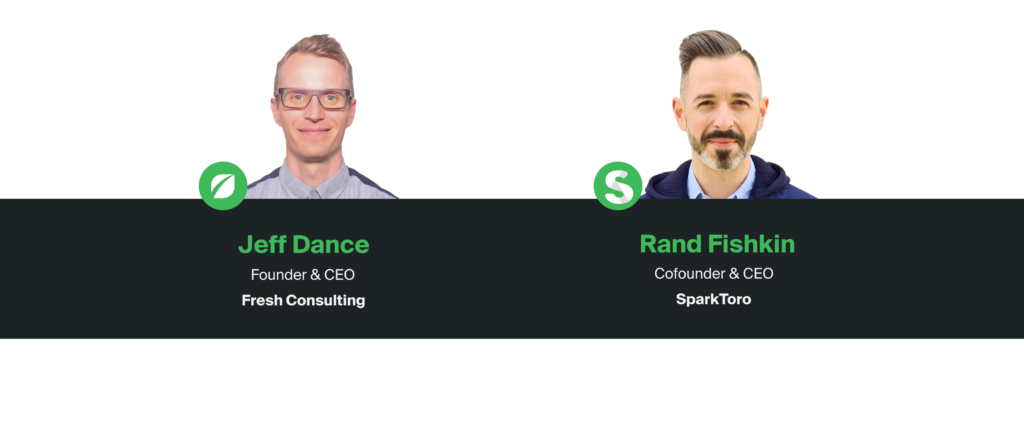
Rand Fishkin, CEO of SparkToro and co-founder of Moz, joins Jeff Dance to examine where marketing is heading in an AI-saturated era. Rand argues that AI search visibility is significantly overhyped, while Google’s AI Overviews—appearing on more than 45% of searches—represent the true frontier of AI’s marketing influence. He explains why short-form video now dominates consumption, why traditional attribution modeling is effectively dead, and how marketers should adopt a “measure, test, invest, analyze” approach instead. The conversation closes with timeless lessons on product quality, niche communities, and leading with integrity.
Podcast Transcript:
Jeff Dance: In this episode of The Future Of, we’re joined by Rand Fishkin to explore the future of marketing. Rand, welcome to the show.
Rand Fishkin: Jeff, thank you for having me. Good to be here.
Jeff Dance: Let me start with a quick intro for those that don’t know you. I grew up here in the Seattle area, so I’ve heard your name for a couple of decades now, and we’re really grateful to have you here. Rand is the CEO and co-founder of SparkToro and previously co-founder and CEO of Moz. Many people know you in the Seattle area for your long-term experience starting and leading Moz, but we’d love to hear more about your recent companies and initiatives. He also started an alternative to Google Alerts called Alert Mouse and Snackbar Studio, which is an indie game developer. So quite a few things there, and we want to unpack that a little bit. As I mentioned, Rand is a well-known tech leader in the Seattle area and worldwide. He’s keynoted hundreds of events on marketing, technology, and entrepreneurship, and his research has been cited by the US Department of Justice, the Federal Trade Commission, The Wall Street Journal, and The Washington Post, to name a few. He’s been a thought leader for many years now. For those that don’t know you, beyond that background I just shared, tell us a little bit more about your journey getting into the marketing space. You grew up here in Seattle like me — we went to the same high school — you went to UW, and as I understand it, you got a degree in finance. So tell us a little more about your journey.
Rand Fishkin: I did not get a degree in finance. I dropped out of the University of Washington, so I’m a college dropout, which is embarrassing whenever they invite me back to speak. I always have to say, “Hey kids, don’t do what I did — make sure you pay your full tuition.” No, the reality was I transitioned between a bunch of majors there, and I think the last one before I dropped out was finance. That was the closest I got to graduating. But I left to start working with my mom, Gillian, who had been running a small business marketing consultancy in the Seattle area for 20 years before me. Her clients started needing websites. It was the late ’90s, early 2000s, and I was passionate about the internet. I loved designing websites, but I was not very good at it.
We struggled for a number of years, from about 2000 up until probably 2003 or 2004, when we found SEO. That was because we were deep in debt — we did not have the money to pay our subcontractors who were doing SEO work for the people we were building websites for, so I had to do the work myself. It was staying up late nights, learning SEO, trying to figure out how to rank in Google, and being very frustrated about that — and frustrated with the search engines for not explaining how they worked. So I started a website called SEOmoz. That website was originally a .org, and it was just a place where I would share how Google worked — and at the time, MSN Search and Ask Jeeves, if you remember them, and Yahoo. It really took off. There wasn’t social media yet, so the blog was where people in an industry would gather. Over the course of the next four years, that became one of, if not the, leading destination for SEO information on the internet. Simultaneously, SEOmoz pivoted to software — we moved away from consulting and started doing software. Revenue grew really fast, some venture capitalists reached out, and that’s how Moz became Moz and a VC-backed company, and I became the CEO. We had maybe ten years of fast growth before things went off the rails.
Jeff Dance: Thanks for that background and how you got started. It’s fun to be at the inception of something. Growth is really hard. If you talk to any serious entrepreneur that has gone through growth cycles and has had investors, there are lots of ups and downs.
Rand Fishkin: I can tell you it was not fun from the inside. There were plenty of fun days too, but it was very brutal. Institutional investment is not designed for a good time. It is designed to make a small number of already rich people much richer and put a lot of other people to work very hard.
Jeff Dance: Thanks for being authentic. That’s one thing I’ve appreciated about your voice — talking about the hard times and the good times. Speaking of good times, though, what do you do for fun outside of work? It sounds like you’re busy running a few things and really staying engaged, despite all the success you’ve had.
Rand Fishkin: I’m a pretty passionate amateur chef, so I do quite a bit in the kitchen. Last night we had some vegan friends over, and I made some vegan tacos that attempted to replicate an outstanding eggplant and cauliflower taco that we had in Mexico City this past February. I got pretty close — close enough that you could squint and be like, “Okay, I see how he was inspired by this recipe.” They didn’t publish their recipe online or anything, but I did my best. My wife and I are also big travelers. We have friends there, and she has a lot of family in Italy, so we’re in Europe regularly. We’ve been to Japan a few times, we’re going back in February, and we’ll be back in Mexico City — so lots of social calendar stuff. And we’ve somehow become — this sounds so fancy and douchey, but I promise you it’s not, Jeff — we’ve become art world people. We go to lots of art galleries and events and hang out with artists, and they’re more creative and interesting and fun than tech people. It’s really nice to get away from tech world.
Jeff Dance: Nice to have that balance. I think balance is so important. That’s definitely something we strive for here — to balance good design, good empathy, and good creative with good tech. So I get that focus. Thanks for sharing that. And by the way, Mexico City cuisine — amazing, right? There’s lots of really good food in Mexico City.
Rand Fishkin: My God, Jeff, my wife and I went with a mission. We were there for seven days, and we were going to eat sixty tacos between us. The problem is we fell behind early and could only get to 47, but man, did we have some outstanding tacos and just outstanding meals all around. I think that city rivals Portland or New York or Montreal for best food cities in North America.
Jeff Dance: Yeah, it’s amazing. I think a lot of people don’t know that. We acquired a company down there, so I’ve visited and had that opportunity recently.
Rand Fishkin: Ooh, I love that idea. Let’s buy another company down there.
Jeff Dance: Let’s talk about the state of marketing. We’re in 2026, and I feel like we’re at the inception again of a wave of change — we’re on that ride. What are some of the biggest shifts you’re seeing right now, and what do you think is driving it?
Rand Fishkin: I think it’s undeniable that the AI craze — this obsession — is hitting the marketing world. In particular, you’re seeing that in the digital marketing world with an obsession by executives with being the brand that is mentioned most or first by AI answers. That is commanding a huge amount of intrigue and research, and also products and software. I think there are more than 700 companies now that promise to track your rankings in AI, which is kind of wild — when I started Moz, there were like two companies that would track your rankings in Google. That world has also pulled a lot of people who were struggling in traditional digital fields into this new SEO-for-AI world, so it gets a tremendous amount of attention. But our research definitely suggests that it is pretty overhyped. There is heavy usage of AI tools by about 20% of Americans, but it is maybe half a percent the size of Google in terms of the volume of questions that would bring back a brand that someone might buy from. That’s pretty weird, right? That’s smaller than the market share of, for example, Bing or DuckDuckGo, but you don’t see a whole lot of digital marketers racing to try to get their rankings in DuckDuckGo.
So I think the popularity of AI and the market perception has driven this huge amount of investment and obsession, whereas the reality is that if tomorrow, for example, SparkToro were the number one, always-top-mentioned brand for audience research software in every AI tool on the planet, it would probably bring us maybe a couple of extra customers a month. It’s a really, really small impact compared to something like Google, and I think that’s quite strange.
The other reality that’s definitely happening — and I’m sure you can see this with your kids — is that short-form video content has subsumed all other forms of social media consumption. This is TikTok and Instagram Reels and YouTube Shorts and Snapchat, of course, and short-form video on Reddit and Threads and Twitter and LinkedIn. That content is driving a tremendous amount of commercial activity, B2B and B2C, and does not get the investment from the business side that it probably should.
The last trend I’ll mention, which I think is quite interesting — and I’m sure you’ve experienced this as well — is the death of marketing attribution. In 2012, you could squint and make yourself a pretty darn good-looking dashboard that looked at a conversion on a website and asked: What was the path to purchase? What was everything — or nearly everything — that person experienced before they came to our site, before they signed up? And how much credit do we want to assign all of those individual touchpoints for the final attribution? Then we could make our marketing investments better for the future. But because of the death of third-party cookies; privacy laws in the EU, Canada, and California; the multi-device world; ad blockers, which are installed on 30% of US devices; browsers that have privacy installed by default, like Firefox and Brave and a bunch of others; and a hundred other factors — a lot of dark traffic, a lot of social sites (for example, TikTok does not send you referral data when someone clicks on your profile) — all of those things combine to mean that you cannot realistically build those dashboards anymore. You cannot build that attribution modeling.
And the people who are still building attribution modeling are doing it almost exclusively off of paid channels, which means paid has been growing and growing as an investment but returning less and less incremental new customers for everyone who invests. It’s a wacky world we’re living in — a lot of change, a lot of trends. The digital marketers I talk to know this stuff. The problem is they can’t convince their boss, their team, or their client to invest this way. People are locked into either the old idea of attribution or the new idea that AI is everything. And it’s tough.
Jeff Dance: This is fascinating. You have a book coming out — it’s called Zero-Click Marketing, a 101 on zero-click marketing. Do you talk about some of these trends that you just articulated?
Rand Fishkin: Yeah. We made an attempt to keep the book a little more timeless, so it’s still relevant in ten years. But yes, we definitely talk about what’s happened in the last decade, how and why the shift came about, and why it is almost certainly not going away unless there’s government action — which, as you know, the DOJ case against Google was not exactly gangbusters for the marketing world or the creator world, and I think most governments have declined to interfere with AI tools as well. So yes, we talk about that in the book and then try to talk through the solutions. You still need to measure things — how do you do that in a world where you can’t perfectly attribute sales anymore? You still need to invest in digital channels — how do you choose which ones? How do you have success in those places where a click is no longer the thing you’re driving toward? The whole concept behind zero-click marketing, which I think is obvious to certainly a 20th-century marketer, is that the goal is influence. Here are people paying attention in a place, at a time, on a subject. How do you get in front of them? How do you make your brand and your story relevant to them? How do you make them have a preference for your product? It’s Marketing 101, but the digital era really focused us all on traffic and getting people to websites, and then we’ll try to convert them once they’re there. We need to go back to the 20th-century world.
Jeff Dance: Thanks for this. Any thoughts on this term you have, “audience over keywords,” and that approach? How do you put that into practice? You mentioned several things, but a lot of us are still in those worlds, right? We’re still heavy into paying for clicks and the stuff we can measure. So give us a bit more detail if you can.
Rand Fishkin: I think the right answer in marketing, Jeff, is always “it depends.” It depends on the sector you’re in. It depends on who your clients and customers are. It depends on what you’re good at. A lot of times when I talk to small or medium-sized businesses or agencies, I tell them to focus on things that they’re great at as opposed to where the largest number of their customers are. If you do some audience research and look at what social network your customers or audience uses the most, the answer is YouTube. Okay, well, that’s because 85% of all Americans visit YouTube once a week or more. So the question is: is that a relevant channel or just a popular one? And are you good at YouTube? Are you great at making three-to-five or 10- or 20-minute videos? Are you great at making YouTube Shorts — these 30-to-90-second ones? If the answer is no, you’re probably better off picking a channel that has a smaller percent of your audience but is something you’re great at. That could still be your blog. It could be an email newsletter. It could be that you’re great at visuals — maybe illustrations or comics or photography or product shots — in which case some of the short-form visual channels probably make more sense. It could be that you’re great at one-to-one networking; maybe LinkedIn is the place for you. Maybe you’re great at hashing it out in subreddits — great. The latest Datos report that I wrote about yesterday shows that Reddit just had two months in a row where they are closing in on Facebook’s level of desktop usage. Now, Facebook is obviously a way bigger mobile app, but Reddit is getting to be a big, big place where people are going for answers, especially about brands in B2B and B2C. So I tell people: please do not just look at the research and say, “Okay, I’ve got to do this.” You also have to consider where your strengths and weaknesses are.
Jeff Dance: Yeah — B2B, B2C, age demographics, whether you have product or not, all those things play into which channels are right for you. And it could be older channels or newer channels, to your point. But what I’m hearing from you is that short-form videos are becoming pretty mainstream, and maybe we’re underinvesting in the applicability of those to businesses in general.
Rand Fishkin: I think this is absolutely true. Even in high-ticket-price B2B, I’ve started to see examples from folks of some TikTok wins. Historically, B2B enterprise on that channel was like, “What are you even doing there? Why bother?” But some folks are having success there, and I’m seeing people in the digital marketing world especially start to pick it up. I think it’s because if you can create the right kind of hooks and the right kind of format, you can be entertaining and educational with a little side of promotion, and that can work. My sense is that marketers who are 10 or 20 years younger than us grew up in that world. They are going to be natively creating a lot of content in all those places for whatever businesses they work for.
Jeff Dance: I liked your point around what you’re good at. Often people get into too many channels, and they’re spread thin and not good in some, and I think in essence it weakens how they’re representing themselves. It’s exciting to sign up for things, but if you’re not good at it, or you’re not sharing good things or staying engaged, I think it ends up being worse. I read a stat recently that your brain processes images sixty thousand times faster than text. So with the amount of information you’re absorbing through video — to your point, you can actually share a lot of information through video, even if it’s short. If every one of those images is worth a thousand words, you can share a strong message. Hence commercials to begin with, but it’s almost like creative commercials for your business that people cycle through.
Rand Fishkin: I think this is quite an interesting conundrum for a lot of people, because if your brand is not particularly visual, this era is hard. It is tougher than past marketing eras. When the primary channel on the web — or nearly the only one — was people who searched with keywords and saw rows of text and blue links in Google, which was my world for 15 years, you could be very successful with a purely text-based, very cerebral, very statistically minded approach. SEO is a formula, an algorithm. You play to that, you piece the content together, you get the links, and all that kind of stuff. This era we’re in is very different. It’s much more similar to the Mad Men era of the 1950s and ’60s in advertising, where marketers were dealing with new channels and rising-popularity channels, trying to figure out the messaging that would work, and building toward the maturity that eventually happened in the latter half of the twentieth century. I’m sure it will in this one too.
Jeff Dance: Our attention spans have been declining, and we grow up with the things we’re used to. Those that have grown up with short-form video are now in the workforce, maybe becoming senior contributors or managers, so I think there’s that demographic factor going on. But the notion that we’re in a highly visual era — and that the yesteryears were a bit more science, logic, and text oriented, and kind of sophisticated from that realm — is interesting to contemplate as we think about thematically where we focus from a marketing perspective and how we’re bringing our brand to life.
Rand Fishkin: I think this is one of the reasons why AI might be a little overhyped: it is returning to you a lot of text — big, big blocks of text. And I don’t want anyone to misconstrue what I’m saying. I’m not saying that millions of people aren’t using AI to get answers about brand preferences. They are, absolutely. It’s just so relatively small compared to a Google, or the billions of hours spent on Instagram or TikTok. Now, you might say, “Hey, it’s early days — give it five, ten years, and AI is going to be as big as any of those.” That could be correct, but the rate of growth is definitely slowing down. I think AI is going to end up slotting in along with these other channels as an additional one — an additional channel, but not the overwhelming one.
With one exception — and Jeff, I apologize, I should have pointed this out when we talked about it. When we talk about the influence of AI in marketing, the overwhelming place where AI is being influential right now is Google. That AI Overview you see at the top of Google’s results — which sometimes pushes all the paid results down, the maps results down, the YouTube results down, everything — dominates that space. That is now on more than 45% of searches. So we’re talking about nearly half of the more than three trillion searches a year that Google processes having one of these AI Overviews at the top. That’s influencing more people than every other AI tool combined, times ten. And that is something new that marketers have to contend with. I think a lot of people who are still in SEO are working very hard to try to influence those AI Overviews — as well they should.
Jeff Dance: I was talking to Steven Kotler recently, who’s written twelve bestsellers, and he was talking about how the age of information overload leads to some brain fragmentation and eventually some loss of purpose. We go back to more analysis, thinking that’s going to help, going back into our screens, but eventually it leads to more burnout — that part of the burnout we’re seeing worldwide is our time spent on screens and how we spend it, doomscrolling, et cetera, and how that fills our brains, our own LLMs essentially. I thought it was a really interesting analysis, but I was thinking, well, AI is kind of part of the answer to that. The appeal is: I’m going to simplify. If I have this answer from Google that synthesizes everything at the top, I don’t have to click into a bunch of things or analyze as much. I’m already in the attention decline, so let me get the summary up top. So I see that growing, to your point. Whether that’s good or not, it’s addressing a problem that people have, so I think it will continue to trend. But it would be interesting — I have seen some little pieces of visuals coming through some of those summaries. It could be interesting if it starts to merge the two as well.
Rand Fishkin: That’s true. I wouldn’t be shocked if, in years ahead, the AI Overview contains more visuals, even short-form video. I’ve seen Google start to surface relevant short-form video from, for example, an Instagram Reel, even occasionally TikTok, and you can play those right in the search results. I think that has a real future. And certainly, given it’s Google, they’re going to favor YouTube. I think one of their big efforts is: let’s make YouTube Shorts as big as these other two, get everyone to put their content on YouTube Shorts as well, and then we can favor those in the search results. Then we have an answer to “What if I want short-form video content to answer all my questions?” — which I often do. Those tacos that I made last night? I did not do a Google search for them. I went to the restaurant in Mexico City’s page and looked for the video of the chef making it on Insta. They didn’t write out the recipe, but that’s where I got the information.
Jeff Dance: You and your brain probably absorbed that pretty well. That’s cool. So lots is changing right now in the current state. I do want to ask: what is a lesson from your Moz days that you think still applies today? I’ve talked to some people, and the AI engines are still indexing sites, for example — they’re still crawling. So even if AI search just becomes another channel, there’s something to be said for “I still need good content,” as an example. What are some things that come to mind that haven’t really changed? Because a lot has changed, and I feel like we’re constantly absorbed in change — tech kind of has a life of its own. Any lessons that haven’t changed?
Rand Fishkin: One of the biggest, most painful ones I had at Moz was that in many markets, product eventually wins — especially emerging markets where there’s not already an established presence. I’m not going to say the best product always wins; that’s fully false. But the better your product is, the more each revolution of your marketing flywheel produces. One of the things I think really hard about right now with all three of my companies is: how much effort do we put into marketing — trying to be visible in these places, participating in these social networks, creating more content for our content marketing efforts, speaking at conferences and events, doing podcasts or webinars — and how much should be, “Hey, sit down at the whiteboard, look at the product, look at the data about how people are using it, and try to figure out how to make that a smoother experience”? When someone signs up for Alert Mouse, maybe we could do more to suggest what things they should be tracking. If we put that in there, that might make the flow better. That could be worth 50 conference presentations — speaking on stages and promoting the product — just by improving the flow of how people get their information and how they set up an alert.
One of the things I would tell a lot of marketers is: sometimes you’re staring at this high-friction, frustrating experience where you just can’t seem to get more from your marketing. You’re having more success on top-of-funnel metrics like impressions and engagement, and middle-of-funnel metrics like followers and newsletter subscribers, but at the bottom of the funnel you’re just not converting, or you’re not retaining people after you convert them. That could really be a product problem. And eventually it’ll hurt those top channels too, because people will lose interest. You can feel it very hard, for example, with Elon Musk’s companies. A few years ago, marketing was so easy — that guy would get up and deliver one talk or one news headline, and it would just blow up everywhere. Now people have lost faith and lost belief. There have been all these poor-performance issues: Tesla is clearly not the best car it promised to be, a lot of people think SpaceX is massively overvalued, and Twitter has become a cesspool that’s mostly bots and AI. As a result, all the marketing is so much more difficult. He’s still got his fanboys and he can play to that audience, but reaching new audiences is like pulling teeth.
I remember that stage of Moz. I don’t think we had nearly as many haters, but I remember the stage where essentially the marketing had eclipsed the product. Fundamentally, what I should have been doing was not adding a whole bunch of new features to the product, but making the data better, making the product better, and making the experience better. Eventually Moz was eclipsed by competitors because we took our eye off the ball and tried to be everything for everyone instead of being the right thing for the right audience and sticking to our positioning. A big part of that — I mean, it was all my fault — but a big part of that was our investors, and the next rounds of investors we talked to, Jeff. They were convinced that SEO would never become a big enough field to support a public company. As a result, they were pushing us: “You need to get into other spheres of marketing. You can’t stick to this one thing that you’re good at and that you built your bread and butter on.” Of course, now there are multiple companies doing north of a hundred million dollars of revenue in the SEO field. They all look stupid, but I look even dumber for listening to them.
Jeff Dance: Thanks for sharing that. The timeless aspect of addressing your product and how that plays into marketing — that as much effort as you put into marketing can be put into the product to increase conversion and retention — that feels timeless, even though things are changing. Let’s shift a little and talk more about the future, where things are going. We’ve talked a lot about what’s going on today, and that is a big shift. You talked about this next era being highly visual, and I feel like that’s something that’s going to keep growing, especially as the demographics that grew up with this continue to age. But what else do you see changing in the future?
Rand Fishkin: I think a few things are for sure true. There’s no doubt that eventually there’ll be a reckoning around the AI infrastructure issue — macroeconomically. Everyone who studies this and writes about it says, “We can see a train wreck coming. We just don’t know how big or exactly what shape.” Essentially, the planet does not have the finances to support the investment that’s been put into the AI economy, from a data center and infrastructure perspective and also from a training data perspective. It’s hard to say what that looks like, but if you are someone who wants to do some hedging, you would be wise to diversify your investments — in your own company, in the channels you invest in as a marketer, and probably in your own portfolio, if you do that sort of thing.
But I’ll focus on the marketing piece, which is to say: if you are counting on short-term things that work well right now to get brand visibility inside Google’s AI Overviews or the purpose-built AI tools like Claude and ChatGPT, I’m not saying don’t do that. It’s fine to make some investments there. Those things might keep growing — in fact, I suspect they will grow for at least a few more quarters, if not a few more years. But I would be cautious about shifting all your spend away from your content efforts, your email list, your social media efforts, your video investments, your presence in offline media, your conferences and events, your in-person networking. I know there’s a lot of AI psychosis going around. I know a lot of executives are pushing marketing teams to shift all their resources and investment over to AI, and I think that’s going to come back to bite you.
You know what it reminds me of? Do you remember 2009, ’10, ’11, when mobile apps were the focus of everything? Mobile apps became hugely popular. We all use mobile apps every day, but almost everyone with a phone uses the same 30 or 50 mobile apps — and if you’re not in those 30 or 50, it doesn’t matter. There was no reason for every Thai restaurant in Seattle to have their own mobile app, but they were being talked into it — convinced that they needed to do it. So, hey, SparkToro has an MCP connector that integrates nicely with ChatGPT and Claude and Gemini Enterprise. It makes sense for us because our users want that thing. Should you build that? I don’t know. Should you put a tremendous amount of effort into tracking your brand visibility inside ChatGPT and then pay an agency to go spam Reddit with your brand in every mention? I’m not sure that’s the right move for most folks. I just wouldn’t do it at the expense of other things if you’re going to invest.
Jeff Dance: Sure. There are many channels that have proven the test of time, and they will still be important in the future. You mentioned Reddit as an example. Well, it’s a forum, and forums have proven over thirty years that they work really well. It’s just good conversation, and if it’s authentic and not fake, then that’s kind of more permanent, right?
Rand Fishkin: I think this is a great point. Reddit obviously has become huge, but in every little niche field there are others — other places where those conversations are happening. Finding those and being present in those places is really important. I’ve become a bit of a classic menswear geek, so I visit a website and forum called Permanent Style quite a bit, and Styleforum quite a bit. They’re better than the men’s fashion subreddits — they’re specific and purpose-built around this stuff, and they get a lot of the really nerdy folks who know a ton about every brand, every piece of clothing, every type of flax linen, and all this kind of stuff. That’s true in tons of fields. I was helping someone in SparkToro who’s selling a special kind of yarn to knitters in the US, and we were looking through the SparkToro data together. I said, “Look, there are these three very popular communities” — one of them’s called Ravelry, R-A-V-E-L-R-Y — purpose-built for these knitting folks. There was another one I found that’s exclusively for science fiction authors. You find these places where your audience pays attention, and you’re in those spots with a message that resonates. I think you’re often going to have more success there than spamming the AI tools and getting your visibility score in whatever your tracking tool is up from sixty percent to eighty percent.
Jeff Dance: That’s helpful. There was an article in Search Engine Journal that predicted that data integrity is the new technical SEO. Thoughts on that? Do you agree or disagree?
Rand Fishkin: I saw this one. First off, before I fully had an opinion, I had to go figure out what they meant by data integrity. Now that I’ve grasped the concept, I think I do agree that it is very important, mostly because of Google’s AI Overviews and partially because of AI tools. Well — it depends on how far you take the analogy. The idea they had around data integrity was essentially — let’s take Alert Mouse, for example. I describe it mostly as a better alternative to Google Alerts: you get an email with all your brand mentions every day, which Google Alerts for some reason stopped telling you about in 2012. I don’t know why that product stopped working, but it’s been years since it was any good — it’s super weird. So that is one description of it. But what if instead we described it as a home for brand tracking, or the best place to get creator mentions, or any of these different things?
Jeff Dance: I only have a few more questions. I wanted to ask you about any other trends for the future, and how technology seems to be accelerating but also converging — whether there are other technologies that will be important for the future of marketing. And in closing, maybe the hardest and most rewarding moments of your career, since you’ve been on a crazy ride and have done a lot. Those are a few that come to mind, but are there any other questions you want me to ask that you think would be helpful?
Rand Fishkin: I know a lot of people are worried about measurement in a zero-click world. That seems to be a very popular one — especially people worried that they won’t be able to get investment. Because if they can’t prove to their boss that Instagram referred this visitor, or that this person saw this video from us on YouTube before they purchased, how do you get investment to make the next video? How do you get investment to make the next post? How do you get investment for the next channel? That’s been plaguing a ton of marketers, especially as I talk about channels outside of AI. It’s this weird thing, Jeff: if you’re talking about investing in AI, the CEO is all in — throw all the money at it. But if you say, “Hey, I don’t think that’s working. We don’t seem to be making any more sales. Are you sure you don’t want me to put some effort into our LinkedIn presence?” — they’re like, “Prove it to me.” We’re in a strange time.
Jeff Dance: That’s funny. So speaking of that, you had mentioned originally that attribution has kind of been turned upside down. Tell me more about that for the future. People are worried about it — what would you say to them?
Rand Fishkin: I think it’s a fair concern. I get it. I understand how painful and difficult it is when your boss or your team — or if you’re an agency, your client — comes to you and says, “We’re not going to make these marketing investments unless you can prove to us that they contribute to sales.” Here’s what I tell them. Let’s imagine we go back to 1955, and Coca-Cola is putting up billboards in all these cities across the US. Giant billboards, often lit by neon. They cost a fortune to put up and are expensive to maintain. They’re beautiful — but at what cost? How does Coca-Cola know that by putting up another billboard on another stretch of highway, they’re going to sell more Coke? Why are they doing that? Are they just throwing their money away? And the answer is no. It’s not measurable through attribution. They’re not hiring some guy — “All right, Lou, you stand by the sign and write down all the license plates, and then we’re going to check every store in a fifty-mile radius for any of those license plates and see how many of them buy Coke.” No, that’s not what’s happening. Side note, Jeff: that did happen a little bit. They did have license plate spotters to try to measure the effectiveness of advertising in the ’50s.
But okay, ignoring that — most of the time, what they did was very smart and very straightforward, and you can do it today. They put up a billboard in Cleveland, a different billboard in Cincinnati, and no billboard in Detroit, in areas with similar demographics, similar store density, and similar amounts of Coke sales. Then they watched what happened over the next three months. Hey, look at that — the Cleveland market went up 5%, the Cincinnati market went up 3%, and the Detroit market dropped by half a percent. Okay, the billboards are doing something, fellas. Let’s take that Cleveland billboard and roll it out to Cincinnati. Look at that — the lift went from 3% to 5%. Put it in Detroit. We’re rolling it out across the Midwest.
That sort of measurement is exactly what you can do today. So say you want to promote your webinar series. Once someone gets on a webinar, you have their email address, and you can see that your conversion rate is X or Y. Okay, you know what we’re going to do? We’re going to invest in a LinkedIn marketing campaign. We’re going to get a bunch of experts in our field to talk about the webinar and promote it. Let’s see how it goes. What do registration numbers look like? Did registration go up? By how much? On which days did those registrants arrive? When Jeff posted about it, we got 50 new registrants. When Rand posted about it, we got 25. We need to double down — next quarter, when we do the webinar again, we’re working with Jeff. That same kind of measure, test, invest, analyze — that is the approach you need in an attribution-poor environment like the one we’re in.
Jeff Dance: You may not have a direct line, but if you pay attention to the outputs and the inputs — it may not be linear, but you can still test and measure.
Rand Fishkin: Absolutely. And here’s the thing — I want to address the counterargument to that, which is: what if Jeff posted and that just happened to be a day when a lot of other things were going on, and those happened to bring those people? How can we prove that it was Jeff’s post on LinkedIn that brought those webinar signups? You can’t. And it’s okay that you can’t. If you were to take the UTM parameter URL for the webinar signup and put that in your post, our data shows that you would reach one-twelfth of the audience, because a post with a link performs about one-twelfth as well on LinkedIn as a post without a link. LinkedIn’s algorithm doesn’t want you to leave. LinkedIn’s algorithm wants you to stay on LinkedIn, just like Reddit wants to keep you on Reddit, YouTube wants to keep you on YouTube, and Instagram wants to keep you on Instagram. So you’re investing in this zero-click marketing philosophy knowing it will work better, knowing you’ll get more people, but being unable to prove it. And that is okay, because the alternative is that you only invest in channels you can prove — and then you’re going to lose to competitors. You’re going to lose to competitors who know that this zero-click world works better and are willing to take bigger risks for bigger rewards, willing to invest in channels that correlate with growth but can’t be proven.
Jeff Dance: Correlation, I think, is a key word there. Not linear, but correlation. I love it. A couple more questions before we wrap up. One is: technology, like I said, has a life of its own. It’s accelerating. We’ve talked about some of the hype that’s going on — over time we see what’s hype and what’s not — but it’s also converging. Can you think of other technologies for the future that will shape marketing?
Rand Fishkin: Ooh, this is an interesting one. It tends to be the case that marketing is a laggard behind technology — not just invention, but use and adoption. I realize we’re currently in an era where it feels like marketing is leading with this AI adoption thing, but historically what usually happened, for example in the mobile app era, was that mobile apps became very popular, they got a lot of traction and attention, the mobile app stores became very popular, and then marketing came to those places. The same thing was true with the rise of the internet. The internet took off, but it was at least seven or eight years after the rise of the internet before even half the businesses in your town had a website — never mind any other kind of marketing, just a presence there. When Facebook started, it took them a good decade to get most businesses to have a page and think about advertising there.
So what I think is that in this next era — whatever comes after AI, whatever new thing is hot and gets adoption — and I don’t have predictions there, because I am not a futurist by any means and I don’t love speculating — what I can tell you with near certainty is that the thing will get popular, and then marketing will come to it. And that’s okay. I’m not a Gary Vaynerchuk who believes you should be everywhere all the time in all the places. I don’t believe you should be an early adopter of these spots. I think marketing’s job is to go where your audience is. Until your audience is in a place using that tool, product, tech, platform, or discovery method, you don’t need to worry about it. Those things change so much and so fast anyway that being an early adopter is not nearly as valuable as people make it out to be, and usually not as valuable as investing in the boring old channels where your audience still pays attention. If you’re trying to sell yarn to knitters, being the most recommended yarn on Claude — we saw the usage data, and I can tell you, knitters don’t use AI, friends. They just don’t give two craps about what ChatGPT says about which yarn to buy. But they really care about what the Ravelry forums say about yarn. So be present in the places your audience pays attention over the places that are getting hype. And do your research — go figure out what those spots are, too. That’s the key.
Jeff Dance: Thanks. Sounds like SparkToro can really help with that. That’s great. You’ve done a few different things in your career — you’ve seen the ups and some of the downs. Tell us more about some of the most rewarding moments you’ve had, and maybe one of the hardest as well.
Rand Fishkin: Ooh, hardest. In my first book, Lost and Founder, I wrote about some very, very hard moments — heavy conflict with my mom, when the VCs wanted to make me the CEO. A really awful, knock-down, drag-out fight at the board meeting where we decided we had to do layoffs and were planning how much severance to offer people. That was the board meeting where I really lost the — I’m going to say combination of respect and friendship — of my investors. Turns out, Jeff, people don’t like when you point out how much money they’re worth to their face and then tell them they’re being a-holes about giving employees severance. That doesn’t go over well with millionaires. Let me recommend to other CEOs that they don’t do that. It’s one of those things where, when I replay it in my head, it would make for good television, and it made for terrible relationship building.
And you need a good relationship with your board. You can’t be doing that stuff. That was a terrible day. You know what? The day I left Moz was pretty bad too. There’s a company I built with my mom, and I’d been there my whole adult life — 17 years, from the time I dropped out of college until February 28, 2018. Putting all your stuff in a cardboard box and walking out the door — and not under good circumstances, right? There was a year-long negotiation about what was going to happen to me there, and lawyers got involved because we couldn’t come to an agreement. The CEO and I stopped talking entirely, and all our communication had to go through our attorneys. Ugh — like a bad divorce or something. Bad, bad times.
And despite all that, I’ll say that definitely one of my best days was — so Moz, years after I left, eventually sold. The deal was not good. The investors were not happy; they certainly weren’t making the money they hoped to be making. Most employees did not do well at all, even people who’d been there a really long time. But Geraldine and I still owned a significant portion of the company — we still had maybe fifteen percent of the stock, seventeen percent, something like that.
So one day we were at breakfast in a dive bar in San Diego, and I open up my phone and there’s a message from my credit union that says, “You have received a deposit greater than $100.” And I was like, huh, what is this? I was so nervous. I said, “Geraldine, you have to check it,” because we knew that maybe the sale was coming through. And sure enough, it was a lottery-winning amount of money. I’m not allowed to say how much — I would love to tell you, but I had to sign a thing that says you can’t tell anyone how much money it is. But we’ll just say too much money. It was ridiculous.
And that day, right after that breakfast, we met our cousins — Geraldine’s cousins — for lunch. They’re both therapists, but they work in the public service sector, so they just don’t make enough. Their kids were going to go to community college. Their eldest daughter was already graduating, and the youngest was coming up behind her. And I was like, “Who wants to go to college?”
Jeff Dance: I love it.
Rand Fishkin: That was a goddamn great day. Great day. So yeah, we got to pay for their college. We got to help. There was a friend of mine who worked at Moz and left right before this transaction happened — we started a college fund for his three girls. We sent the maximum amount you can send tax-free to dozens of people who worked at Moz — just writing fifteen-, thirty-thousand-dollar checks to tons of people and mailing them out with a card that said, “Hey, you deserve this. You earned it. This is yours. Thank you.”
And I don’t tell the story to try and make myself look good. I tell it because I want to shame other CEOs and other execs who have huge exits from companies and don’t take care of their people. So if you are listening to this and you’re like, “Wait, you can do that?” — yes, you can do that. You don’t have to care what the cap table says. We logged into Carta, which tracks all your stock, and we just looked at, okay, who’s been here? There were people who had been there 10 or 11 years who were getting next to nothing in this transaction, right? Because of a bunch of VC machinations, and also the sale price just wasn’t great. And so we were like, let’s just take care of these people.
Jeff Dance: Let’s create our own kind of cap table and distribution method.
Rand Fishkin: Exactly. It doesn’t matter what the cap table says — go take care of your people. And I will say, I am not thrilled — I am far from not thrilled; I am beside myself — that the board and the CEO didn’t do this themselves. Come on. When Geraldine and I gave this money, the total for all of it was under a million dollars, right? It would have been meaningless to them — nothing. It would be like you and I giving the corner store $2 for a York Peppermint Pattie. That is the price of being an honorable human being and doing the right thing for these people, when you’re worth hundreds of millions of dollars. I don’t get it. What do you need that money for?
Jeff Dance: Thank you. This is deep. I appreciate your thoughts, your heart and mind, and all the good advice — your authenticity as well, and your focus on intentional leadership. It was great to grab some of those nuggets during this conversation. So grateful to have you on the show. Thanks for joining us.
Rand Fishkin: Yeah, my pleasure, Jeff. Thank you for having me. Really appreciate it.
More Podcasts