Podcast
The Future of AI in Manufacturing
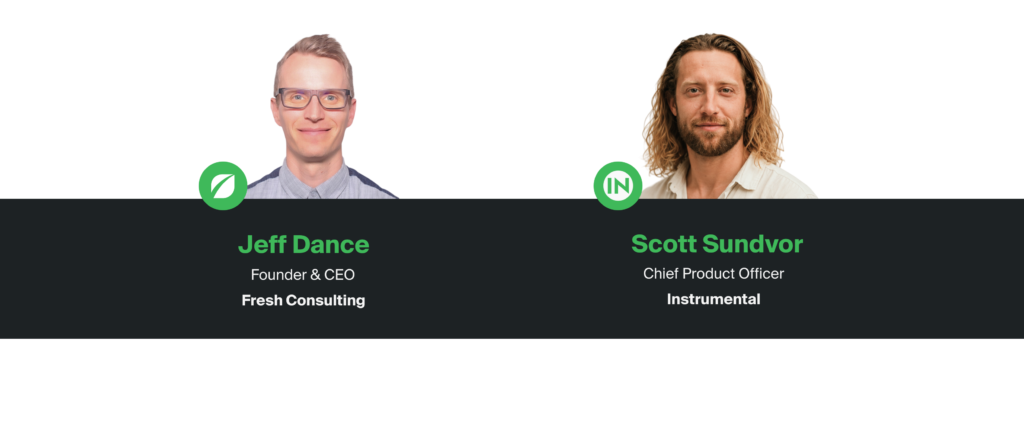
In this episode, Jeff Dance speaks with Scott Sundvor, Chief Product Officer at Instrumental, about how AI is accelerating and transforming manufacturing. Scott explains Instrumental’s three engines—vision, context, and analysis—that help complex electronics manufacturers improve yields and speed time to market. He shares insights on the AI infrastructure build-out, noting that “the factory floor is getting eyes before it’s getting hands.” The conversation explores the realistic timeline for automated factories, the trillions lost annually to manufacturing waste, and how AI can reduce it. Scott closes with an optimistic view of AI accelerating its own supply chain to solve the world’s biggest problems.
Podcast Transcript:
Jeff Dance: All right. In this episode of The Future Of, we’re joined by Scott Sundvor, Chief Product Officer at Instrumental, to explore the future of AI in manufacturing. Scott, welcome to the show.
Scott Sundvor: Thank you, Jeff. Great to be here.
Jeff Dance: Good stuff. I’m going to do a quick intro, and then I’d love to hear a bit more. By way of intro, Scott is a two-time former founder of successful companies—he’s had a couple of exits—and he’s also an MIT-trained engineer, now a product and engineering leader in AI and manufacturing, really at the front end of what’s going on with this next physical AI wave. He specializes in leading product and engineering teams to deliver products that solve customer problems and drive business value and profitable growth. We’re grateful to have you. Scott, I wanted to ask what brought you to Instrumental and into this space of AI and manufacturing. How did the journey lead to that?
Scott Sundvor: I joined Instrumental a little over a year ago—a year and a few months. My background before this, as you said: I’ve been a founder a couple of times. The first company I founded was a hardware company. Seeing the challenges there—which maybe we’ll get into in this conversation—it just really made sense to me to work on building software to help with those hardware and manufacturing challenges. So much of the benefit and value that we have tangibly in the world is from physical products, and being able to make that easier and faster is pretty exciting.
Jeff Dance: That’s awesome. Not everyone has a long history in hardware. Hardware almost seemed less popular than software before—it definitely wasn’t getting the investment it is today. Now it seems like it’s flipped: hardware is all the rage, and software is still just as important but not quite getting the investment dollars or the same energy. You’ve been on both sides. Tell us more about what you do for fun.
Scott Sundvor: Well, I love being in nature, I love traveling, and I love surfing—and a lot of times I get to combine all three. I just got myself a beautiful new surfboard last week, there are some waves coming here, and I have a trip to Tahiti planned in the near future. Whenever I get to be out in nature, especially in the ocean, it’s probably the best stress relief I can have—it quite literally washes the stress off. Anytime I can be in nature like that, it’s just the best.
Jeff Dance: I’m glad you mentioned that, because there’s a global mental health pandemic going on right now—the WHO reported a billion people now have mental health conditions—and we’re seeing more and more burnout and stress, and not enough ability to reset. Water itself has been known to be a big de-stressor—being in it, around it, on it, on a board. Being in nature, same thing. The Japanese have coined the tree-bathing concept that helps you de-stress. Those things are so much more important today as we have so much information coming at us and we get into that overloaded state. Having those resets and those vacations is critical for our productivity.
Scott Sundvor: Yeah, absolutely. And in the world we live in today—the social media age, all these quick hits we’re getting—any time we can spend in nature and in activities that keep us present is so important. I try to meditate regularly also, and I’ve definitely found, even in everyday life—whether you’re working or with family or friends—that without those activities, my ability to be present definitely erodes. So it’s important that people are talking about this and hopefully implementing the things they need in their lives for it as well.
Jeff Dance: We published a piece on balancing technology—how to connect and disconnect. Some people think, “I’ve got to completely disconnect; I shouldn’t use technology as much.” But I think it’s really in the balance, because there’s the productivity aspect of how we maximize our output. AI is actually an answer to some of this overload—it can simplify and help us offload some of the mental cognition, as long as we’re involved early and post. But that disconnect is so critical. Your background maybe speaks to this—nature’s sort of meditative state. But not enough people, I think, listen to themselves. We’re listening to all these other signals, but we don’t take the time to do that computer reset. With computers, you actually have to shut them off sometimes and let the RAM and the OS reset. It seems like meditation is a way to do that ourselves, right?
Scott Sundvor: Yeah, absolutely. And what you just said is so key—learning to listen to ourselves. I think we’re often taught not to do that: just tough through it, keep going, don’t feel that pain. For me, some of my motivation for the places I’ve worked has been driven by health issues I’ve had in the past. Learning to listen to myself, to listen to my body, is probably the most important thing in my personal journey.
Jeff Dance: That’s cool. Everything’s connected, right? And when we don’t do that and we fight it, we end up with so many more issues. Hey, we could talk an hour about this, actually—but what was the topic we were here for? Oh yeah, AI and manufacturing. Tell us a little more about Instrumental, especially for our listeners—the company and some of the acceleration you’re seeing.
Scott Sundvor: Absolutely. Instrumental has been around now for 11 years—so still a startup, but an 11-year-old startup. We are a manufacturing acceleration platform. We help the world’s most complex electronics get manufactured more quickly, with higher yields and faster time to market. We do that in a few ways, but the way we look at the products we provide is that we have three engines that drive this acceleration: a vision engine, a context engine, and an analysis engine.
With our vision engine, we have computer vision models deployed directly on the factory floor that can intercept issues live. With our analysis engine—now, with the AI we have available—we’re able to deploy swarms of AI agents to crawl through all of the data that might be available to help find root cause and solve problems a lot more quickly. And the context engine is what bridges the two. You can think of it as the way that every engineer in the company can be as good as the best engineer in the world. That’s what we provide to companies.
Right now we’re very focused on the AI infrastructure build-out—the company I can speak about publicly is NVIDIA, and many companies like them. We also have pretty deep business in consumer electronics and some in defense as well.
Jeff Dance: That’s awesome. I saw a lot of big names, and it seems like you’re in the middle of supporting this next wave, which is the physical AI wave. We’re kind of in the middle of the digital AI wave, and NVIDIA has been at a leadership point there, along with many of the other big tech companies building out the AI infrastructure. Tell us more about that. I’m assuming you’re at the front end of some of this build-out if you’re helping with the manufacturing. Tell us more about some of the signals you’re seeing for this future expansion.
Scott Sundvor: You mean for physical AI in general?
Jeff Dance: Physical AI in general. I know we’re in the middle of the digital AI wave expansion—the software, the LLMs, the browsers, MCPs, everything—but we’re also entering this next wave of physical AI. What are you seeing about that next wave?
Scott Sundvor: The lens I have is an interesting one because, as you said, I see it from the manufacturing side, and that side always has to come before what we see in the real world. I think the AI infrastructure build-out is really the leading edge of this. Every hyperscaler is racing to ramp up more compute—more racks, more servers—and what’s being built there is truly the most complex hardware that’s ever been manufactured. We hear about liquid cooling, the power density, high-density connectors, all these things. This is what I think is creating the physical footprint for the digital AI wave, but it’s also going to power the physical AI wave.
What we’re seeing in the factories right now—the way I would put it is that the factory floor is getting eyes before it’s getting hands. There are cameras everywhere. We deploy them; we can connect to ones that are already on the line. We’re seeing robotic camera arms; there’s inline imaging. AOI has been a thing on manufacturing lines for over a decade now. All of that has been at a level that is AI, it is ML, but it wasn’t very advanced until more recently. We’re also seeing more automation coming into play, especially with the higher complexity of some of these products coming out.
In terms of what will drive the actual physical AI build-out—humanoids, autonomous cars, all of these things—the real bottleneck there is yield. As someone who has built a hardware company and now sees many hardware companies building, the difference between building 50 units in a lab and building 50,000 units on a manufacturing line is absolutely massive. If I take my honest read on humanoids and all these other things: do I think it’s coming? Absolutely. Do I think it’s inevitable? Most likely. Do I think it’s going to happen at the pace and speed that news media and maybe VCs think? Absolutely not. This is going to be extremely difficult, and when it happens, it’s going to be extremely exciting. But really focusing on the manufacturing side of it is what has to solve the problem first.
Jeff Dance: Right. I agree. I think we should temper expectations as far as how fast things will move, and I think we should all agree that the confluence of different things happening at the pace they’re happening will lead to this continued wave. But we’re at the beginning of the wave, and some of the dollars have funneled in. As an example, robotics investment is at an all-time high—maybe double last year compared to prior years—but still at the beginning. Much like electric cars, it takes time to roll out all the infrastructure and integration before you really believe robotics are going to take over, let’s say, a whole bunch of jobs. But will it progressively happen and be the next wave for the next decade? That’s where I would say we’re at the beginning of that next decade of things, right?
Scott Sundvor: Yeah. I was speaking to a leader at one of these very large AI compute companies, and his perspective was that fully automated robotic factories are probably in the five-to-ten-year range before they’ll be more ubiquitous. Two to five years—that’s going to be tough. There will be factories doing it; there are already some of these lights-out factories you hear about in China. I haven’t had a chance to tour one yet, but these are factories that literally don’t have lights on because they don’t need people there to run them. I do think that will happen in the future and will enable other realms of automation, but it’s a difficult challenge.
Jeff Dance: You almost need to start from the ground up if you’re going to do something like that, because you need to almost re-engineer the facility for it. In my experience as well, there aren’t a lot of lights-out operations, but there are those that are getting started, implementing some robotics and then some computer vision. I really like your point about eyes before hands—and you guys are in the center, in the middle of eyes. You’re bringing the intelligence from the cameras, and I think that’s been underappreciated. What can be done with understanding everything a camera can see, and being able to bring that intelligence forward—we’re kind of seeing it on the personal side; people are starting to get it when they use their personal AI to see around them. But in the business setting, it can be so powerful if you have an engine that truly understands everything it sees. And you’re applying that in a manufacturing context. Is that the primary focus of Instrumental, or are there broader specialties beyond manufacturing?
Scott Sundvor: Definitely broader than just the vision. And to the point you’re making, one of the really interesting things about visual data—and images explicitly—is that it’s one of the very few data sources that can actually generate more data or more interesting findings after it’s been collected. If you think about test logs or temperature readings, that’s a point in time: you get that data, and it doesn’t change. But what you can take and extract from an image over time and after the fact—whether that’s for failure analysis or root cause analysis, or things in your personal life: “I noticed this thing in this photo that I never saw before,” or “look at this person in the background,” or it being used in crime prevention—that’s the way we’re leveraging images also.
There’s what we’ll call the point solution that’s on the line, doing live detection and stopping something right on the line. But then—and this is where what we call the analysis engine comes in—we can do a lot more, both with the images and with any of the manufacturing data that comes off the line.
To your question of whether this can be applied beyond manufacturing: absolutely. We’re focused purely on manufacturing right now, but the harness we’ve built—our root cause analysis harness—I took that, made a modification of it, and used it for some health research for myself. The same type of paradigm can be used in many places. The opportunity in the manufacturing space is so many trillions that it doesn’t make sense for us to split focus. But I sure hope other people do.
Jeff Dance: That’s great. Let’s step back a little bit. Tell us more about the current state of manufacturing and AI. Geopolitically, for a few years now, with the tension in China, we’re hearing that manufacturing is coming back to the US in a sense, or it’s going over to India, or more is going to Mexico. Give us a readout on how you see the current state of manufacturing and where people are with utilizing AI.
Scott Sundvor: To your point, we’re seeing a lot more manufacturing in locations other than China. When I started my first company, you basically had to go to China—it was China or maybe Taiwan; nowhere else had the quality you needed to manufacture something really difficult. Now we’re seeing Mexico, we’re seeing domestic, still a lot in Taiwan, but also Vietnam, Malaysia, and other places.
In terms of AI adoption: one, physical automation is everywhere, but it’s not ubiquitous. I mentioned some of this automation—robot arms with cameras on them (we call them cobots), automated testing, that type of thing. AI, I would also say, is everywhere, but it’s very narrow. You have AOI vendors that have claimed ML for a decade, but it’s still not very robust, and it’s still something that has to be very, very programmed—which Instrumental, for example, does not. It’s much easier to set up; you don’t need to train it like you would an AOI system. And then I would say that right now the actual intelligence layer is nearly absent. Factories are generating an enormous amount of data, and almost all of it is thrown away. Companies like ours and other startups in the space are changing that, but I think there’s a lot more opportunity for applying AI and intelligence in a way that can make a really large impact on this industry.
Jeff Dance: That makes sense. It seems like for a while we’ve been in this big data space, but the reality is we just need a little data that’s good and useful—and to have some real intelligence and real insights from that, versus just collecting it all. Tell us more about that with Instrumental—the intelligence layers. With generative AI coming out a few years ago, how has that impacted your business and some of the product features you offer?
Scott Sundvor: Massively, right? The big thing I always think about: if you look at the data—I forget what group provided the study—it shows that the complexity of tasks you can do with AI, or the length of tasks, is approximately 10x-ing every two years. With LLMs specifically—and we have VLMs now, and other transformer-based models—the pace of improvement is just ridiculous. So as we’re building products, we have to think about what’s possible today and what we can make happen today, but we also have to plan for when this is 10 times better or 100 times better, because that’s only two to four years out.
We’ve been doing computer vision for a decade, from long before I joined Instrumental, and those models are improving—our detection, the speed of training, all of that. But I think the big change for us is what I’ve talked about with the analysis engine. Now, with the strength of LLMs and being able to deploy agents at scale in a cost-effective way, we can finally make sense of this treasure trove of manufacturing data that was previously viewed as too unstructured and too difficult to reason across. It used to take weeks to solve a problem with it—now we can do that in minutes. All of this data actually has the potential to be highly valuable, and valuable very quickly, rather than in the length of time it used to take.
Jeff Dance: That’s cool. So you can provide some unique value to companies—those unique insights—because you can make connections across all the data, vectorize all the information, and provide it in an easy-to-digest format, but you can also abstract some of that information and provide insights to those just getting into the space. Is that right?
Scott Sundvor: Yeah, absolutely. If you think about it, you can plug some spreadsheets into Claude or ChatGPT and have it do analysis—and it’s actually pretty damn good. But when you’re dealing with terabytes of manufacturing data—one of the interesting things with LLMs is that they’re really good at anything that’s available publicly on the internet, because that’s how they were trained. Most of the stuff related to manufacturing is tribal knowledge that’s in people’s heads or that they’ve learned over decades. Both of our founders came from Apple; they learned all these things I had never heard of because my career started in startups. Through the decade our company has been around, we’ve been able to put all of that into our context engine. But all these companies are also able to add their engineers’ knowledge into it.
It adds this layer where you now have your human knowledge combined with your machine knowledge, able to reason across the terabytes of data you have. That creates something really powerful: you can now increase your yields at a pace that was never possible before, and speed up your throughput at a rate that was never possible before. I think one of the execs from NVIDIA was quoted the other day saying they’re scaling up to be able to produce a thousand racks a day. That’s seven billion dollars’ worth of production a day if they actually hit that. Being able to scale into that is the type of problem that will become bigger and more important to solve.
Jeff Dance: Wow. Do you see the AI server expansion happening as a result of AI continuing at the pace it is now for a while into the future? There’s an element of build-out, but do we finish the build-out, or do we have so much more coming? If we’re increasing 10x every two years in complexity and that continues, then maybe there’s 10 years of build-out. Server farms take a long time to build out anyway, right? And then there’s everything that goes into that. Are we looking at a long-term expansion of AI servers? If you knew that exact answer, maybe there could be some inference from a stock perspective—but from boots on the ground, is that a reasonable assumption, that there’s another decade of server growth here?
Scott Sundvor: I obviously think about this a lot, and my opinion is not really informed by anything trade secret that I know—it’s just based on what’s publicly available; I wouldn’t want to share anything here that wasn’t. My hypothesis is that we are still very early in it. I thought you might ask a question like this, so I was doing a little research yesterday on the rate of build-out when AWS started cloud compute and S3 and ECS. The rate of build-out was quite a bit slower in the beginning—about 25% year over year. Right now, in AI build-out, we’re at about 100% year over year. You could take that either way—maybe that means it’s going to boom and bust. But the bigger part of it, when I look at it, is actually the supply chain.
Part of it is the upstream supply chain, and then also the downstream—maybe we shouldn’t even call it supply chain—the data center build-out. On the upstream side, right now TSMC is really the only company that can build three-nanometer chips, so they’re the bottleneck on that side of things. If TSMC could build more, then NVIDIA and AMD and everyone else would be building, but there’s not capacity. And TSMC is being really careful about how quickly they add capacity because, in the past, chips were cyclical, and there was a chance that if they overcommitted, it could put their company out of business.
Jeff Dance: Too much inventory. Yeah.
Scott Sundvor: Exactly. So in a way, TSMC being careful here is, at minimum, slowing down the chance of us being in a bubble, or how quickly a bubble would expand. The other side of it is the data center build-out. Part of this is that America just does not have enough power to supply all the data centers, so that has to be built out. There’s the permitting and the physical build-out—think about some of these structures; they’re many, many football fields in size. And when the racks make it to a data center, it typically takes six-plus months just to get the data center turned on. I think Elon is the only one who has been able to do it more quickly than that.
So there are all these aspects that are slowing down the rate. I’ll put it this way: demand is way higher than supply right now, and to me that means the demand cycle will continue longer, because it’s going to take longer to be met. We’ll see if I’m right or not. I’m putting my money where my mouth is with my personal investments—this is not investment advice for anyone else—but I’ve maybe unwisely double invested: I’m working in the industry, and I also believe in tech stocks. So we’ll see what happens.
Jeff Dance: It does seem like the next big wave and the emergence of the next big tech companies, for sure. Tell us a bit more about the insights you generate in manufacturing. You have the vision engine, where you’re collecting a treasure trove of data, and the analysis engine. For those in manufacturing—or thinking about what’s possible—tell us more about the insights. I know there are pretty impressive case studies on your website with notable brands—Meta as an example, NVIDIA, and other big companies. But for those that don’t really know much about what’s possible, can you give us a bit more detail?
Scott Sundvor: Yeah—I’m going to speak in some generalities because I don’t remember what we have in public case studies and what’s confidential. At a high level, there are a few pillars to the types of insights we’re able to provide. One is identifying things much more quickly than companies would otherwise be able to. We have a feature we call Discover: as every unit goes through the manufacturing process and is being imaged, we’re running computer vision models over it and looking for anything that might be different. Through that, our customers are able to see, “Look, here’s an anomaly we weren’t even aware of that has been impacting yield.” Now they can set up a live monitor for that and actually catch it every time it’s happening. So one of the big value-adds is discovering things more quickly and really shifting left as much as possible.
That’s on the vision engine side. On the analysis engine side—let me see what I can say here; I’ll keep it very high level—we’ve been able to find root cause for things that can improve revenue by billions of dollars, and for things that were slowing down production or impacting yield that either were impossible to discover before or would have taken a team of engineers weeks to discover. Through that process, I would say the difficult part today for us is actually not finding those things—it’s then working with our customers and the manufacturer to implement changes on the manufacturing line and make sure the problem is solved. We call it going from insights to outcomes. That’s what we’re in the business of: driving insights to outcomes. And this is where I think the human element really comes in.
Jeff Dance: That’s great. I think those that aren’t in hardware don’t understand the importance of catching issues, because it’s not like software where you can go change it real quick. You have physical goods that have been made, and to remake them, redo a part, or catch a part—it’s so expensive to produce something from the get-go, and it can be detrimental to any company if they have a major issue. So catching things early, catching things on the line, and being able to trace back from a problem to understand where it is so they can fix it becomes really valuable.
Scott Sundvor: Exactly. And then bringing in the process change or the vendor change or whatever is needed to prevent that problem from continuing to happen.
Jeff Dance: Nice. With your vision models, how high up do they go from an optimization perspective? Do you actually step up above and look at, say, how a flow works on a plant floor or in a manufacturing facility? Do you have cameras on the ceiling looking at optimization of a layout, as an example? I’m sure you go very precise, down to the smallest details—looking at circuit boards, for example—but how high do you go?
Scott Sundvor: That’s a great question. Right now, typically, we’re looking at the finer details. But the nice thing about our platform is that we have two ways we can deploy it. One is that we bring cameras onto the manufacturing line and deploy it for the customer—if that’s the easiest and fastest, we’ll do that. The other is that we can plug into any images that are being generated on the line. In certain situations—I’ve mentioned robotic arms; those are a big one we plug into frequently. Some of these higher-level views looking at the process flow aren’t something we’ve done much of, but I think it may become more of an ask in the future, and with the platform as designed, it’s something we could just plug in.
Jeff Dance: That’s cool. We work with those in manufacturing as well, and a lot of times they have older equipment. The ability to look at machines that aren’t yet smart—that haven’t been connected to the internet and don’t have any intelligence in them—and actually identify issues in those machines, or pull data from them, becomes interesting. It’s like, “We have this throughput on this machine, but this one over here is only doing half for some reason.” Being able to add some of that intelligence is kind of a shortcut: instead of replacing the machine, you’re adding, to your point, the eyes—and maybe fixing some things in the meantime. It’s something we’re seeing on the ground—hence my curiosity. But I would assume you could just keep leveling up and add those additional value layers.
Scott Sundvor: Yeah, definitely. And one of the interesting nuances here, for people who are less familiar with manufacturing, is that the way manufacturing typically works, the brand is not the manufacturer—a brand contracts out to a manufacturer. We almost always work with the brand, but it’s the manufacturer who’s responsible for their process flow, and usually they’re the ones who own the metrics around yield and that type of thing. But they’re much slower to adopt some of this technology, and they also have a vested interest in maintaining a level of opacity between what they’re doing and what they share with the brand.
So it’s this interesting dynamic—we call it the three-body problem—of us, the brand, and the CM. We work with the brand because we share the same goals they have, so we can help them the most. And I think it’s actually through the brand that more AI and more advanced technology is being deployed on the line—they’re the ones paying for the automation, the AI systems, that type of thing. The CM is trying to protect their margin wherever they can.
Jeff Dance: Interesting. You’re kind of in the middle of the triangle, but you’re providing that visibility, essentially, to the brand itself—and some of the improvements to the brand and the CM at the same time.
Scott Sundvor: Yeah, exactly. And think about it from the brand’s perspective: if they’re producing the same product on eight different lines across four different manufacturers, the CM would never share—or even be able to see—the data from the other manufacturers. So we can provide those insights, including cross-site insights. If you have a factory in Taiwan that’s performing really well and you want to bring those learnings and part of that process to your site in Texas, we can help do that.
Jeff Dance: That’s interesting. We’ve developed a lot of test automation machines for different locations worldwide for manufacturers, because we’re in the hardware space—and people underappreciate test and test automation. I get the idea that there could be different quality and different rates, so how do you get at the heart of that and have eyes across these different regions that are running things really differently? That makes sense.
Let’s talk a bit more about the future. We’re seeing this acceleration, and you’re in the middle of it. You’ve been growing quite a bit yourselves as—what did you say, an eleven-year-old startup?—that’s really been accelerating the last few years along with this AI wave. As you think about the future, how do you think manufacturing will change, say, ten to twenty years from now? I know that’s a lot to ask, but how do we envision things getting better or changing?
Scott Sundvor: Well, I do think a lot more manufacturing is going to get automated. There has been a shift toward this, but I remember when I was in school at MIT, you would watch these manufacturing videos—the things you see on How It’s Made or wherever—and everything is automated, so that’s your perspective of what manufacturing is. Then I went to China and Taiwan for my first CM tours, and I saw lines a hundred yards wide of just people sitting there doing the same little monotonous task over and over.
In the AI infrastructure world, there’s already a lot more automation. But I think as machines get more easily programmable and more modular, that’s what enables more automation in general. Right now, automated manufacturing systems are generally only applied to very high-volume or very high-revenue products, because the investment is very large. If you’re a startup, you can’t afford that automation investment—it just doesn’t make sense. But when you have—whether it’s humanoids or more specialized robotics in manufacturing—machines that can adapt to building different products more like a human can, I do think that’s really going to shift manufacturing.
I think having more LLM-based or VLM-based intelligence on manufacturing lines, through products like the one we’re building, will impact the speed of bring-up and the speed of fixing problems more quickly. For people who aren’t in manufacturing, I’ll use an example from my first company. We have what we call NPI—new product introduction. That’s from when you have your prototype through all of the pre-production builds before you’re in mass production. For my startup, that process took, I want to say, 12 to 18 months. It was grueling; it was so difficult. And that was going from a product we had working perfectly in the lab to the point where we could reliably mass produce it. For advanced companies like Apple or Meta or others who have been building a lot more consumer products at scale, it’s a lot quicker—maybe six months, maybe nine months, depending on the product.
Where I think—and hope—we can go with more and more AI is compressing that cycle down further and further. And especially, if you have one line set up and you want to transfer that to another manufacturer, another site, or another location, being able to do that in a week instead of a few months, and saving all that time that just burns money.
Also, I think we have a stat on our website that twenty percent of every dollar that goes into manufacturing ends up as waste. So there’s eight to ten trillion dollars of manufacturing waste each year, and the better we’re able to make this process and system, the more we can reduce that waste. As someone who loves nature and goes to foreign countries and sees the trash everywhere—a lot of this waste is things you don’t see, but it’s still waste. So whatever we can do to improve that as well—I think there’s a lot of potential there.
Jeff Dance: That makes sense. Thanks for sharing that. Any other thoughts on changes, the future, or the acceleration? I think understanding the compression and the opportunity to eliminate waste—and what I heard from you, just to state it back: a lot more automation with hands. We’re implementing the eyes, we’re going to have the insights, and that’s going to continue to accelerate, but we’ll probably see a lot more hands—a lot more robots and a lot more automation—where it’s not just people doing monotonous, sometimes dangerous work.
Scott Sundvor: I definitely think so. And again, the transformation here is going to take a lot of time. Anything that’s a physical industry just takes time to transform. So I think your time range of 10 to 20 years is probably what it takes—maybe it’s even longer; we’ll end up seeing. I think all of this is more difficult than any of us can really anticipate at this point. There’s a lot of conversation about AI taking jobs and how that’s a bad thing. In this case, if anyone has been in a factory and seen these jobs—these are not good jobs to have.
Jeff Dance: Right. Not good for the soul, not good for human beings in general.
Scott Sundvor: Exactly. And so I very much agree with the perspective that if jobs are only disappearing, that’s a bad thing. But if jobs like that disappear and there’s potential to create jobs that are better, I think that’s a net benefit for people in these communities and societies.
Jeff Dance: Yeah. There was an estimate recently by the World Economic Forum that we’re going to be creating more jobs than we lose—but it’s change, and I think that’s what’s hard for people. We don’t have wagon wheel makers anymore, but if you were in the wagon wheel business, that was a hard change. So I do think that transition is hard, especially if it’s fast. But I’m with you—I think automating the dirty, dull, dangerous work with robots, and helping humans do more of their best work or what they’re made for, is a good aspiration, and I think there’s substance to that. It’s the change and the pace of change that’s hard for people, especially in the moment—if I’m a young college graduate and I can’t find a job, or if I lose my job as a result of this. I think we can all empathize with others from a human perspective. But if we think about the bigger picture of what this technology unlocks, there are a lot of benefits.
I think we saw that through the pandemic. We were in the construction industry helping people with robotics, and they were saying, “We can’t get enough workers to do this work in construction”—they were raising it to the government as an issue they were hoping to get help with. And through the pandemic, a bunch of other industries said that after people had time to think, they didn’t come back: “We can’t get people in the restaurant industry to stay.” I’m not saying anything against restaurants—I’m just saying some of the work is maybe dull or less ideal. And a bunch of other industries as well—manufacturing and warehouses were saying, “I can’t get people to come back after they had time to reset and think about what’s meaningful to them.” I think that’s going to be an ongoing thing, especially as the younger generation comes forward. There are going to be more and more people thinking, “Wait a minute—why aren’t we using automation for this, with what we have today, with what I grew up with?” So I think we’re at the beginning of that. For those in the AI, robotics, or automation space, there are some global benefits to consider as much as there are some global concerns in the near term.
Scott Sundvor: Yeah, absolutely. And I think it’s important for people to consider both sides of that. One of the biggest problems we have as a society in general is that people only look at their side and decry the other one. The importance is looking at both sides, figuring out what the pros and cons are from all sides, and how we can help the most people. I generally believe that most people are generally good—most people don’t want harm or ill for others. If we can all think from that perspective—and what I know as a fact is that every industrial revolution led to better jobs, better wages, less danger, that type of thing. Could this time be different? Sure, but history doesn’t suggest that it will be. There will be, as you said, the people making wagon wheels who couldn’t anymore—I’m sure that was challenging for them, and they had to find something different. So it’s: how can we help the people in jobs that are getting displaced, and make sure that the dangerous jobs, the monotonous jobs, the ones that aren’t inspiring you to reach your full potential, are the ones that go away—and that we can help people actually get inspired and do the thing that makes them feel like they lived a meaningful life.
Jeff Dance: Right. I think AI is empowering the creators—those that create. And we’re all creators by nature, in a sense; that’s one of the things that makes humans unique. I’m hoping this unlocks more of the creators in us—that’s a higher order of intelligence we can tap into—versus some of the monotonous stuff that the history of automation has been trying to take over. There’s been a push toward those skills, the specialization, and the creative over time, with more and more automation taking over the work that’s just the same. But to your point, unfortunately, when it comes to listening to both sides and trying to reconcile, we get in our echo chambers and tend to demonize those who disagree with us. There’s not enough listening to the perspectives that matter. So I agree with you.
Good stuff. Just a couple of other questions before we wrap up. First, any other thoughts on the future as we think about manufacturing? Sometimes there are different technologies converging. Any other thoughts about where manufacturing is going?
Scott Sundvor: In terms of convergence, one of the things I’m interested in is the convergence of AI with human knowledge, especially in the manufacturing realm—though I think this is the case in many places. With manufacturing, as I mentioned before, a lot of this knowledge lives scattered through all the human brains that are working on it, and when someone leaves or goes to a different company, a lot of that knowledge can be lost. So I’m really interested to see how we can converge machine intelligence with the human knowledge that we have—not even the human intelligence, but just the things that we know that nobody else does—and how that continues to improve hardware engineering, and even software engineering—really anything you’re building or trying to do.
The other one I think about a lot—and this is one of the reasons I’m motivated to be working at Instrumental—is the convergence of AI with its own supply chain. I believe that the faster we can build more intelligent models, the faster we can solve the world’s biggest problems. Instrumental is helping companies like NVIDIA build their new racks more quickly. That helps companies like OpenAI and Anthropic and everyone train the next models, and eventually that’s going to be used to help design the next generation of chips and the next generation of racks. So we’re in this loop.
People talk about it a lot with software engineering now—how the frontier model companies are likely using their models to help build the next generation of models—and people talk about it as this competitive advantage: whoever can do that most quickly is going to accelerate beyond everyone. And yeah, that’s exciting. But what if we think about this as a larger thing for the entire industry and the entire world? How can we accelerate curing cancer? How can we accelerate solving our energy problems and the climate problems? I think that’s what this whole AI supply chain, model-provider loop is doing, and I think it’s really interesting.
Jeff Dance: I think that’s deep, and I would agree. I’m glad you connected curing cancer and some of these diseases to the end of the supply chain, because you’re at the infrastructure layer, but there are those byproducts—we are seeing those things. There’s a book on the age of abundance, and you look at all these charts and everything’s up and to the right for a lot of things—look how much better human life is. But in the age of abundance, we also have issues like information overload, and that’s leading to mental health issues as well. Abundance isn’t always good; there are other consequences.
But I’ve seen some doomsday forecasts when it comes to the climate and things like that—it’s almost like everything’s down, everything’s going to get worse. And the one X factor they said they haven’t accounted for in a bunch of these graphs is technology. What can technology do to actually solve those issues? Some of the folks that work in the space don’t fully know, but it’s at play—it’s definitely at play. It’s in that supply chain, like you said. And I think that’s some hope to hold on to—that the very answer to these issues of the future is there. Take the issue we just talked about of losing jobs: maybe AI is part of that problem, but it’s actually also the answer to the great reskilling—it gives you the ability to learn on your own, at your own pace, to get reskilled and then go back into the workforce. So there’s a cycle here—a supply chain—and it’s connected to a lot of great benefits as well.
Scott Sundvor: Totally agree. There’s something called the precautionary principle—I don’t know if you’heard of this. It’s the idea that humans are very good at forecasting problems. This is one of the things that makes us human and has probably made us survive as long as we have. But we’re also very bad at forecasting solutions to those problems. By definition, if we were forecasting the solution, then there wouldn’t be a problem for us to forecast, right? So it’s this evolutionary thing where we’re great at thinking about all the things that could go wrong.
Jeff Dance: That’s the easier part. It’s always easier, right?
Scott Sundvor: Exactly. It’s evolutionarily ingrained in us. But what we have proven time and time again is that we develop the solutions, and I think technology is how we do that. I’m also just relentlessly optimistic—I think to be a successful entrepreneur, you in a way have to be relentlessly optimistic and willing to chew glass, as they say, and stare down all the problems. But I really do believe that this technology is the most meaningful and impactful thing we’ve ever seen, and that it could solve the world’s biggest problems.
Jeff Dance: Let’s end on that note. Scott, thanks for being on the show today. I really enjoyed the conversation—your expertise, but even deeper, your other perspectives as we think about some of the problems and opportunities of the future. Really appreciate you being here.
Scott Sundvor: Thanks for having me on the show today.
More Podcasts