Article
The AI Prototype Trap: When a Working Demo Isn’t a Working Business Solution

August 12, 2026 ...

A polished AI prototype can make the future feel close. But a working demo is not the same as a deployable enterprise AI solution.
A growing number of business leaders arrive with something exciting: an AI prototype.
They may have built it themselves with an AI tool. It has a polished interface. It responds to questions. It may demonstrate a workflow the organization has wanted for years.
It works.
And that is exactly where the AI prototype trap begins.
A working demo can create the impression that a working business solution is close at hand. The screens are finished. The core interaction is visible. The idea seems proven.
But a demo that works is not necessarily an enterprise AI solution that works for the business.
The gap between those two things is where most of the work—and most of the value—lives.
Why a working AI demo can be misleading
An AI prototype answers an important early question:
Can we make this idea tangible?
That is valuable. It helps leaders express a vision, gives teams something concrete to react to, and replaces vague conversation with a visible possibility.
But a business-ready enterprise AI solution must answer a harder question:
Can this create reliable value for real people, using real information, inside our real organization?
Those are not the same question.
A demo can operate with sample data, a simplified workflow, and a single happy-path interaction. A production solution must work with fragmented systems, imperfect information, competing priorities, privacy requirements, changing conditions, and people who may not use the tool in the way its creators imagined.
The prototype proves an idea is possible. It does not yet prove that the idea is useful, scalable, trusted, governed, or adoptable.
This is part of a broader leadership blind spot: mistaking visible momentum for meaningful operational change. As we explored in AI Leadership Blind Spots: 10 Mistakes I See Leaders Repeating Right Now, AI impact is measured by changed behavior and better outcomes—not the quality of a demo.
A working interface is not a working enterprise AI system
Consider a manufacturing organization that wants an AI assistant to answer a simple question:
Why did production fall behind this week?
A prototype can make that interaction look effortless. A manager asks the question, and an interface returns a clear explanation.
But a dependable enterprise AI system must do much more. It may need to combine equipment sensor data, production information, inventory levels, maintenance records, quality systems, email threads, messages, spreadsheets, Notion, SharePoint, Confluence, and other operational sources.
It must determine which information is current, who is authorized to see it, what business definitions apply, and whether the answer is based on a meaningful pattern or incomplete data. Then it must return an answer people can understand, verify, and act on.
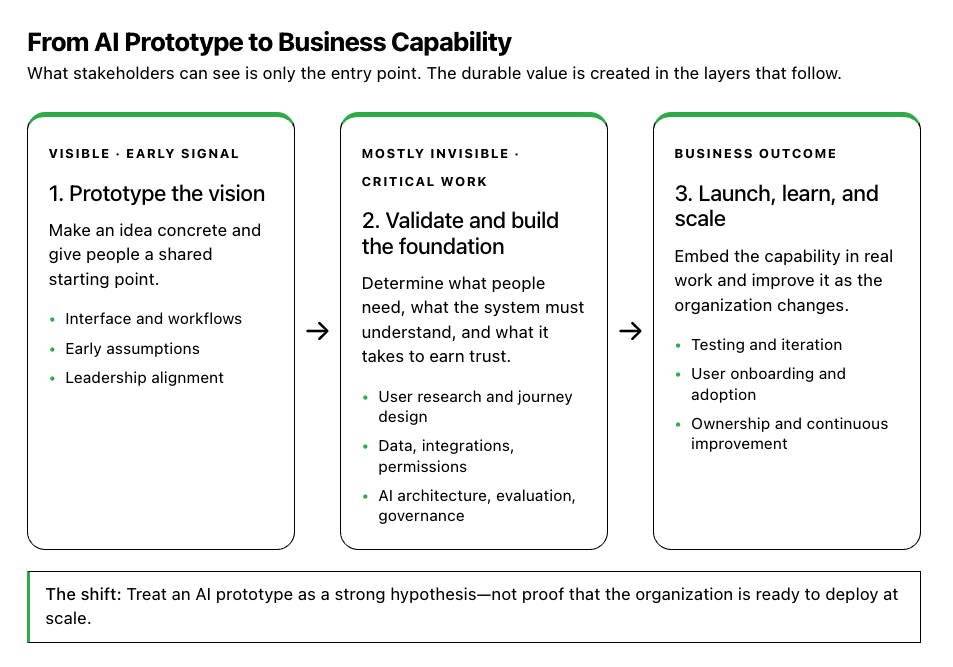
The interface may be the part everyone sees. But the business solution depends on the data, integrations, permissions, intelligence, governance, and workflows behind it.
The visible engagement layer is often the easiest part of enterprise AI to prototype. The deeper operational, data, and intelligence layers determine whether it can work in production. For a closer look at those foundations, read Why Most Enterprise AI Initiatives Stall Before They Start.
The first question is not “How do we build it?”
When an AI prototype looks compelling, organizations often move immediately to implementation.
But the next question should not be, “How do we build this at scale?”
It should be, “Are we solving the right problem in the right way?”
A senior leader may have a strong point of view about what employees need. That perspective is important. But the people who will use the system every day often reveal a more complex reality: different workflows, missing context, exceptions, competing tools, and needs that are not visible from the top down.
Before scaling an enterprise AI prototype, teams need to understand:
- Which user problem are we actually solving?
- Which decision or workflow should improve?
- What do frontline users need in the moment they would use the tool?
- What information must the system understand?
- Where does that information live today?
- Which data can the organization access, trust, and govern?
- What would make the output useful enough for someone to act on?
- How will the organization know the solution is delivering value?
Discovery is not a delay before the real work. It is part of the real work.
Is your AI prototype ready to become a business solution?
A compelling prototype is a strong start. Before moving into production, leaders should be able to answer yes to most of these questions:
- The problem is validated. We have spoken with the people who will use the solution and understand the workflow or decision it should improve.
- The desired outcome is clear. We can define the business result we expect—not just the interface we want to launch.
- The right data is available. We know which systems and information sources the AI needs, who owns them, and how reliable they are.
- Access can be governed. We understand permissions, privacy requirements, security expectations, and any data-sharing agreements needed.
- The experience fits real work. The solution is designed for how users actually operate, rather than asking them to adopt an additional, disconnected process.
- The intelligence can be trusted. We have a plan to evaluate outputs, handle uncertainty, identify sources, and improve performance over time.
- There is an adoption plan. Teams know who owns the solution, how users will be onboarded, and how new ways of working will be supported.
- Success can be measured. We have agreed on the behavior, operational metric, or business outcome that will demonstrate value.
If several answers are still unclear, that does not mean the prototype was a mistake. It means the prototype has done its job: it has exposed the questions that need answers before the organization invests in scaling it.
Enterprise AI is as much human work as technical work
Building a durable AI capability requires more than a model and an interface. It requires alignment across people, data, systems, and decisions:
- User research and journey mapping
- Requirements definition and experience design
- Data discovery, quality assessment, and integration
- IT collaboration to establish secure access
- AI governance, privacy, permissions, and data-sharing agreements
- AI architecture, retrieval, evaluation, and monitoring
- Testing for accuracy, reliability, and usefulness
- Onboarding, training, and adoption support
- Clear ownership and continuous improvement
Many of these challenges are not primarily technical. They are organizational.
From working demo to working business solution
A working demo says, “This could be valuable.”
A working business solution says, “This creates value, reliably, for the people and organization it was built to serve.”
At Fresh Consulting, we help organizations use prototypes for what they are best at: clarifying the vision and starting the right conversation. Then we help move from a promising demonstration to a capability that is designed around real users, connected to trusted information, and ready to operate at scale.
Prototype the vision.
Then build the business solution.
Frequently asked questions
What is the difference between an AI prototype and an enterprise AI solution?
An AI prototype demonstrates an idea or interaction. An enterprise AI solution must also connect trusted data, fit real workflows, meet security and governance requirements, perform reliably, and be adopted by the people it serves.
Why do enterprise AI initiatives stall after a successful demo?
A successful demo often exposes unresolved challenges beneath the interface: fragmented data, inconsistent records, unclear ownership, access restrictions, undocumented workflows, and missing adoption plans.
What should leaders validate before scaling an AI prototype?
Leaders should validate the user problem, desired business outcome, data availability and quality, governance requirements, workflow fit, output reliability, ownership, and adoption plan.
I optimized the draft around enterprise AI trap, adoption, governance, and solutions, plus an SEO title, meta description, and slug. It answers the question more directly now. Want me to also add a short FAQ for AI answer engines?