Article
Why Most Enterprise AI Initiatives Stall Before They Start

June 4, 2026 ...
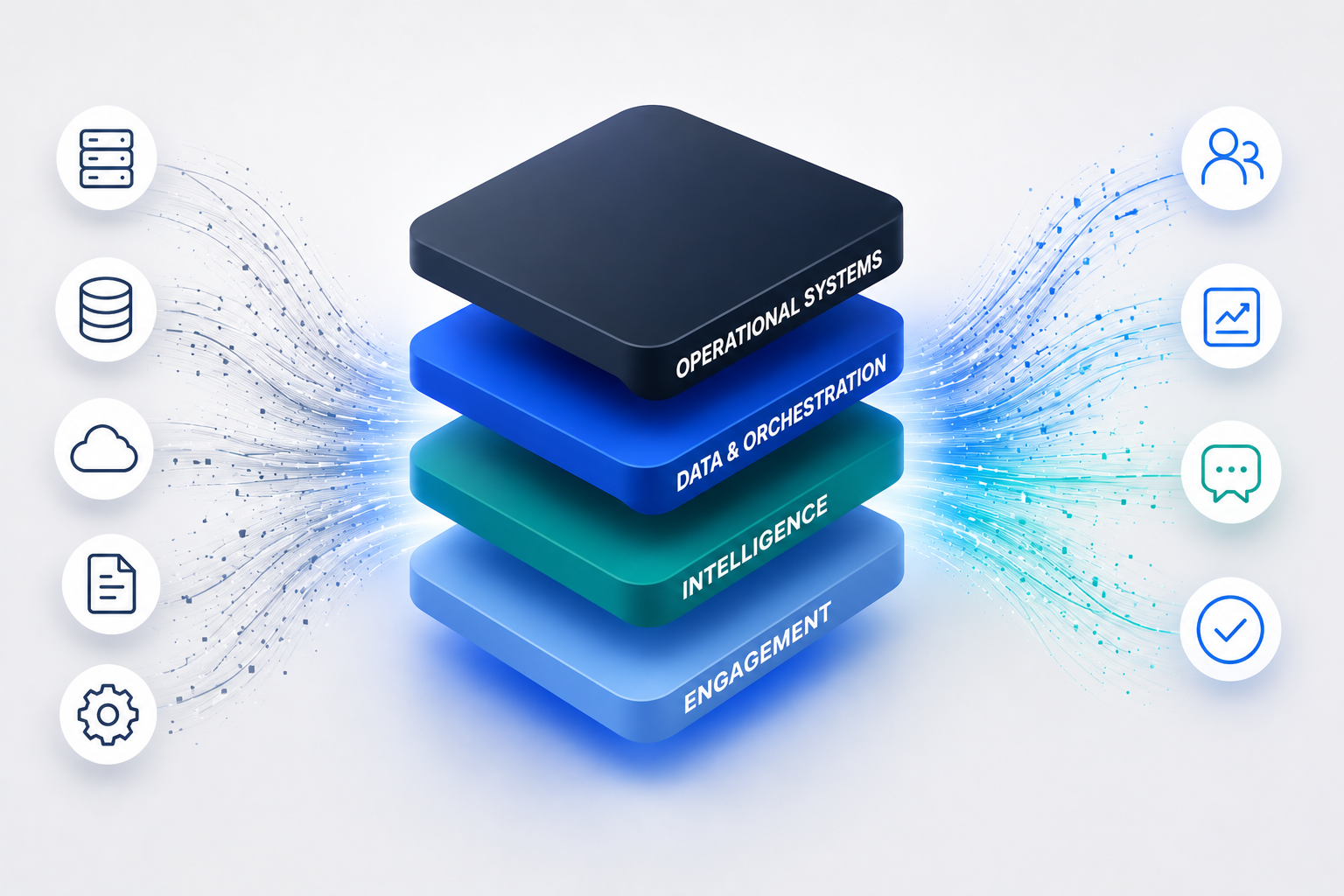
Most organizations are trying to build the AI interface first while the operational and data layers underneath it still aren’t ready.
The chat interface is often the easiest part of enterprise AI. Making the organization understandable to machines is the hard part.
The AI demos looked straightforward.
Connect the data. Add a copilot. Ask questions.
At the same time, executives are under pressure to move quickly. Conversations around AI have shifted from experimentation to expectation surprisingly fast. Leadership teams are asking valid questions:
- Why can’t we search across the business conversationally?
- Why does the AI still give inconsistent answers?
- Why are employees still manually pulling reports together?
- Why does the pilot work in demos but struggle in production?
Then reality starts surfacing:
- Fragmented systems
- Conflicting records
- Stale knowledge
- Undocumented workflows
- Permissions spread across dozens of tools
The demos are real.
The friction is real too.
Many enterprise AI initiatives stall because organizations start at the top layer of the stack instead of fixing the layers underneath it first. The interface gets deployed before the operational foundation is ready to support it.
The Enterprise AI Stack Behind AI Readiness
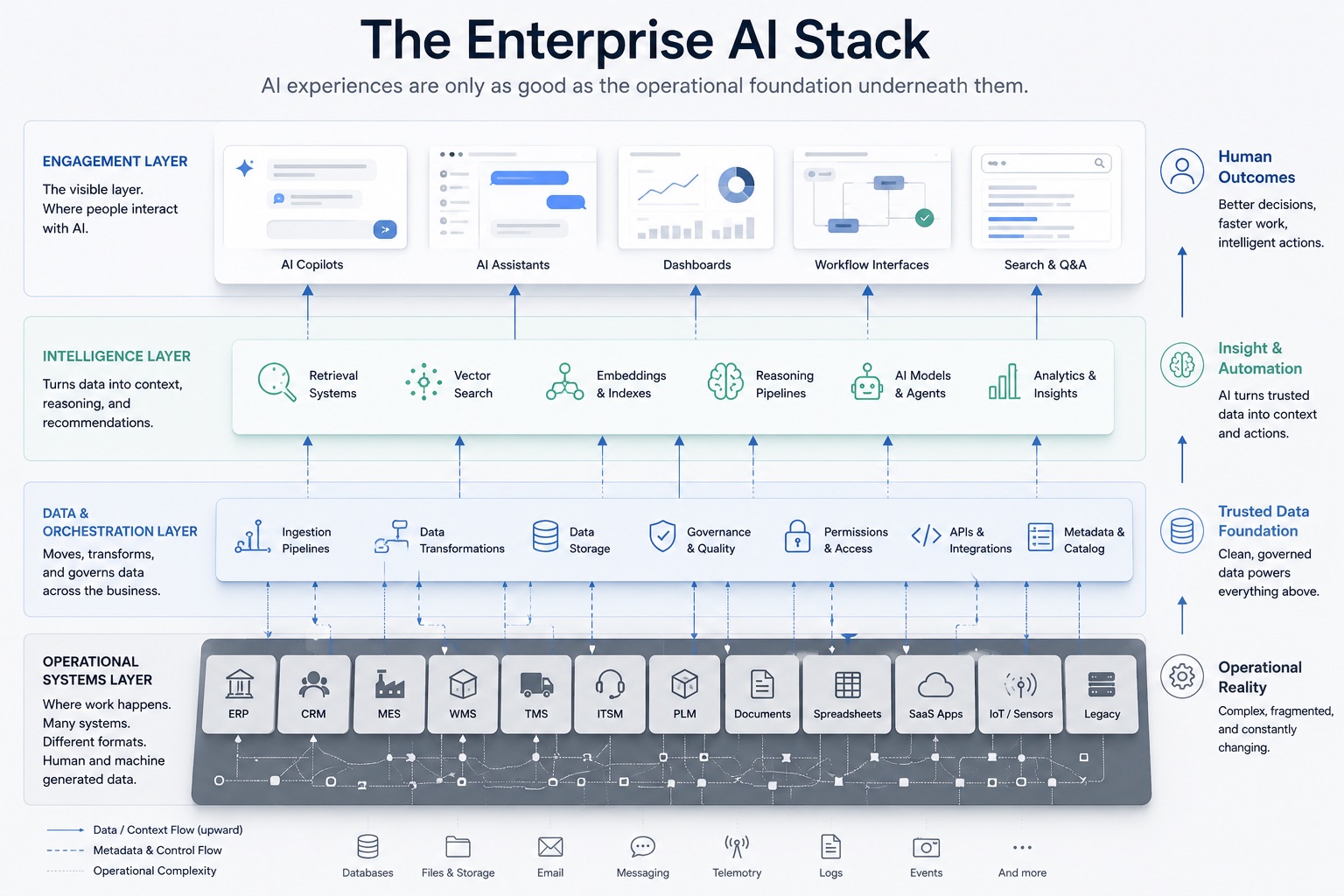
A lot of enterprise AI strategy conversations focus heavily on the visible layer:
- Chat interfaces
- AI copilots
- AI agents
- Workflow automation
- Conversational enterprise search
But those systems sit on top of something much larger.
A useful way to think about enterprise AI readiness is as a layered operational stack.
Operational Layer
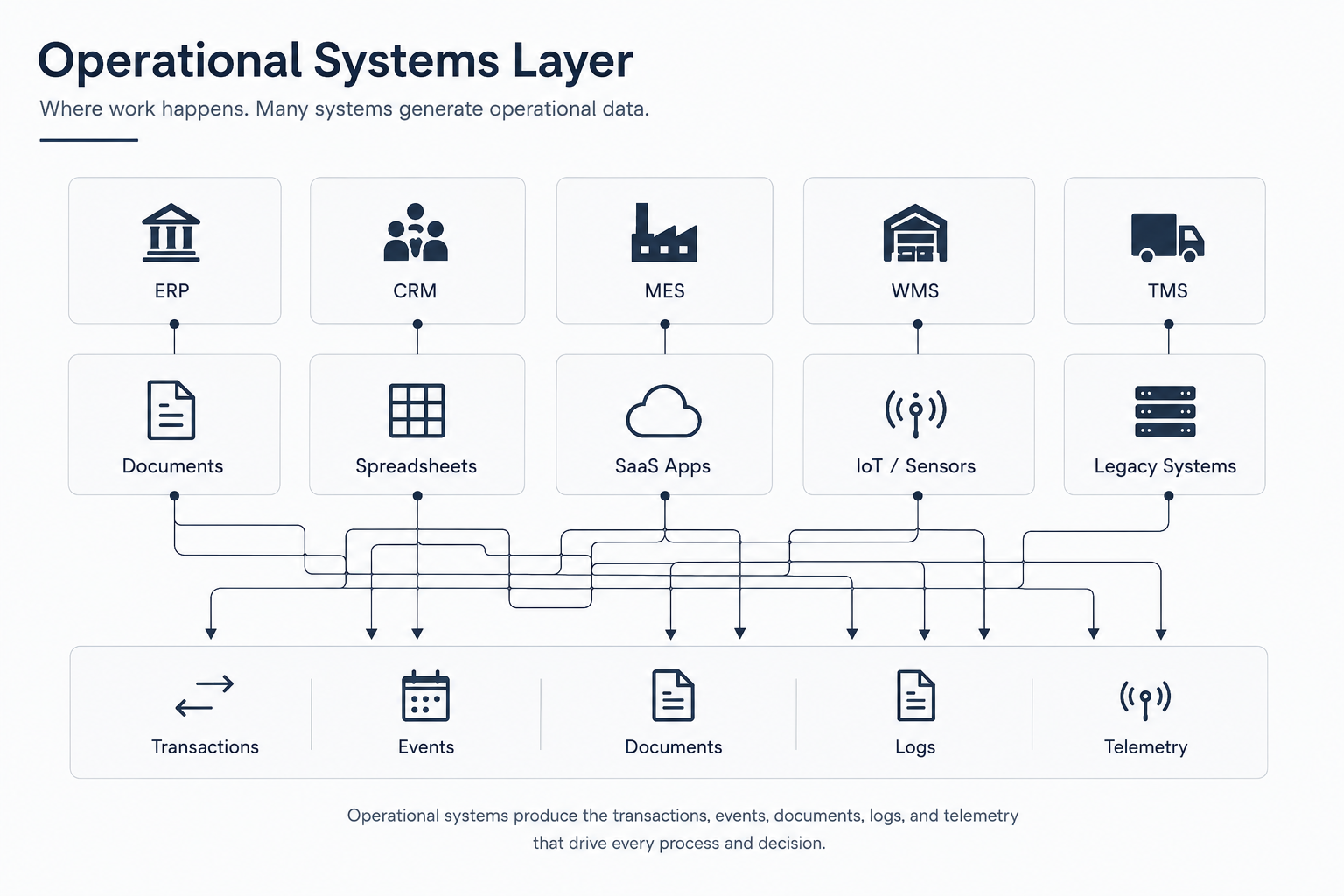
At the bottom sits the Operational Layer.
This includes the systems businesses already rely on every day:
- ERP systems
- CRM platforms
- MES systems
- Ticketing systems
- SaaS tools
- Operational databases
- Spreadsheets
- APIs
- Shared drives
For manufacturing, logistics, and industrial organizations, this layer may also include:
- IoT sensors
- Machine telemetry
- PLCs and control systems
- Warehouse scanning systems
- Robotics and automation equipment
Data Layer
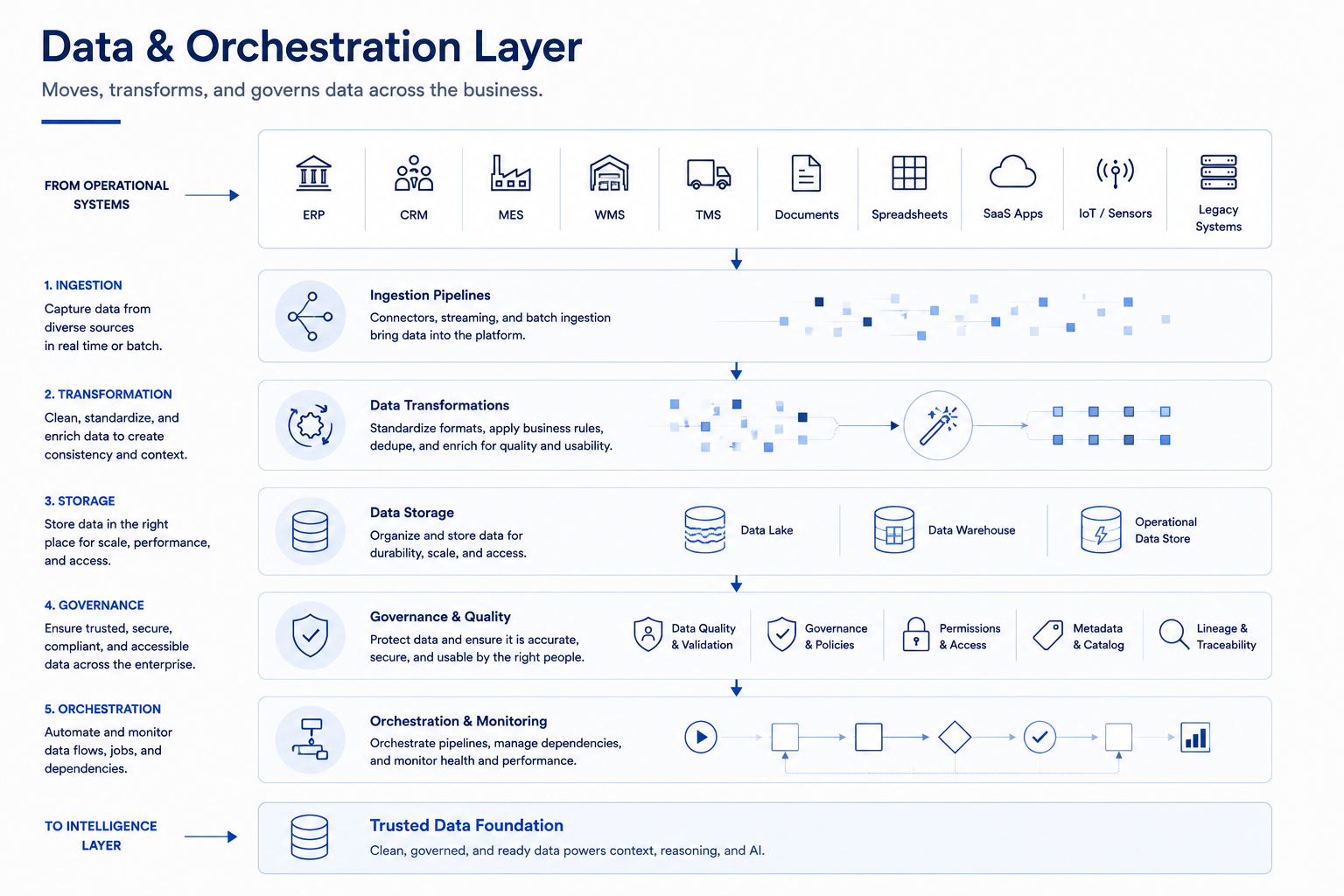
Above that sits the Data Layer:
- Ingestion Pipelines
- Data Transformations
- Data Storage
- Governance & Quality
- Permissions & Access
- APIs & Integrations
- Metadata & Catalog
This is where organizations attempt to connect systems, ingest information, normalize formats, establish governance, and move data reliably between platforms.
Intelligence Layer
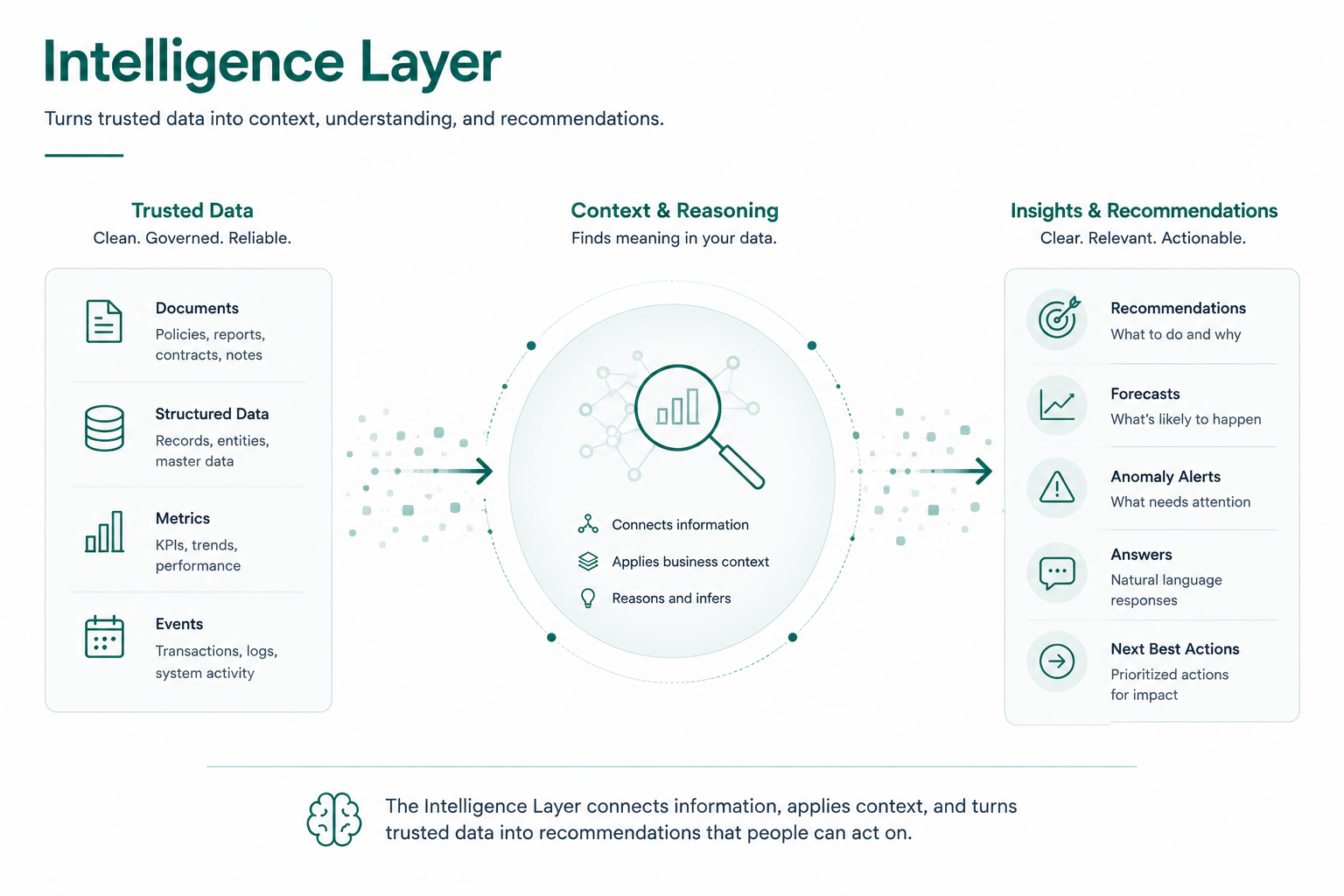
Then comes the Intelligence Layer:
- Retrieval systems
- Analytics
- Embeddings
- Vector search
- Reasoning pipelines
- AI models
Engagement Layer

Finally, at the top, sits the Engagement Layer:
- Copilots
- AI assistants
- Executive dashboards
- Workflow interfaces
- Conversational search experiences
This is the layer most people see.
It’s also the layer many organizations try to start with first.
Why Enterprise AI Initiatives Often Start at the Wrong Layer
The Engagement Layer is visible. Executives can interact with it immediately, teams can prototype it quickly, and vendors can demo it beautifully.
A conversational AI interface creates the impression that the organization is suddenly becoming intelligent.
Sometimes that illusion lasts right up until the first production rollout.
Then the operational reality underneath the interface starts surfacing:
- Customer records don’t match across systems
- Metrics differ between dashboards
- Permissions aren’t synchronized
- Terminology changes between departments
- APIs technically exist but aren’t reliable
- Institutional knowledge lives inside Slack threads and meetings
The AI didn’t create those problems.
It exposed them.
This is one reason many enterprise AI initiatives slow down after the excitement of the initial pilot phase. The interface layer advances quickly while the underlying operational maturity moves much slower.
Cleaning up workflows, reducing operational fragmentation, and improving interoperability rarely feels as exciting as launching a copilot. But that foundational work usually determines whether the AI becomes genuinely useful or quietly unreliable.
The Model Is Rarely the Bottleneck Anymore
A few years ago, the model itself was often the limiting factor.
That is becoming less true surprisingly quickly.
Modern language models are already capable of:
- Summarizing information
- Reasoning across context
- Generating structured outputs
- Translating between systems
- Interacting conversationally
The failures many organizations experience now are often upstream from the model itself.
The AI cannot reason over information it cannot reliably access. It cannot reconcile systems that fundamentally disagree with each other, and it cannot retrieve context that was never structured properly in the first place.
In many organizations, the challenge isn’t missing intelligence. It’s fragmented operational context.
One department may define a customer differently than another. Product naming may vary across systems. Reporting logic may exist only in someone’s head or inside a spreadsheet nobody wants to touch because it has become operationally critical.
The model is rarely the bottleneck anymore.
The organization is.
The Operational Infrastructure Behind Enterprise AI
Useful enterprise AI depends on a surprising amount of invisible infrastructure.
Not glamorous infrastructure.
Operational infrastructure.
Things like:
- Data ownership
- Governance policies
- Integration consistency
- Permission mapping
- Retrieval pipelines
- Taxonomy alignment
- Knowledge freshness
- Auditability
- Workflow standardization
These systems don’t usually appear in keynote demos, but they determine whether AI outputs become trusted enough for real operational usage.
This becomes even more important as organizations move from informational AI toward action-oriented AI.
Reading information is one thing.
Allowing AI systems to:
- Modify records
- Trigger workflows
- Approve actions
- Coordinate operations
- Interact across departments
…requires much stronger operational discipline underneath the interface.
An AI assistant answering a question incorrectly is frustrating.
An AI system executing the wrong operational action is much more serious.
AI Readiness Is Operational Readiness
Organizations often talk about AI readiness as if it exists separately from operational maturity.
In practice, they are deeply connected.
The organizations seeing the strongest AI outcomes usually already have:
- Cleaner operational systems
- Better integration discipline
- Clearer ownership structures
- More standardized workflows
- Stronger governance practices
Not perfect systems.
Just lower operational entropy.
That operational consistency gives AI systems something stable to reason across.
This is one reason enterprise AI strategy is becoming both a technology conversation and an organizational design conversation at the same time.
The interface layer may look intelligent to users. But underneath it, the organization itself increasingly needs to become machine-readable.
The Companies Quietly Winning
Some of the most successful AI implementations probably won’t look dramatic from the outside.
They may not launch flashy copilots first.
Instead, they spend time:
- Normalizing data
- Cleaning workflows
- Standardizing APIs
- Improving permissions
- Reducing operational fragmentation
- Creating machine-readable processes
It’s slower work.
Less visible work.
But it creates the conditions where AI systems become genuinely useful instead of superficially impressive.
And I think that distinction is becoming increasingly important.
Because as AI capabilities continue improving, the competitive advantage may shift away from simply having access to AI tools.
The advantage may increasingly come from how operationally prepared an organization is to support them.
Where This Series Goes Next
This article is the starting point for a larger discussion around enterprise AI infrastructure.
In the next articles, I’ll break down the layers underneath modern AI systems in more detail:
- Why most organizations already have more data than they think
- Why retrieval quality matters more than many teams expect
- Why governance and permissions become critical surprisingly early
- Why the hardest part of AI agents often isn’t the agent itself
- What AI-ready organizations actually look like operationally
Because most enterprise AI challenges don’t begin at the interface layer.
They start much lower in the stack.