Article
The Different Learning Styles Of Artificial Intelligence



August 21, 2020 ...

If you’re new to artificial intelligence, the concept of AI learning might be a bit hard to wrap your head around.
After all, an artificial intelligence is still just a series of ones and zeroes, no different than any other computer program. So how does an AI learn?
How Does AI “Learn”?
First, let’s establish what we mean when talking about AI learning. An AI on its own doesn’t necessarily imply learning. Virtual assistants like Siri and Alexa are technically AIs, but they don’t do a whole lot of learning (though this is slowly starting to change). When an AI is learning, it is essentially interacting with its programming on its own to achieve a goal.
For example, say you have an AI that has control over a robotic body. You give it a function that allows it to move its left left leg, its right leg, and both of its arms. But you don’t give it a “run” function. Instead, you tell the artificial intelligence you want it to run, and then by testing out its various movement functions, it eventually learns how to use its programming to run.
That, in a fairly basic form, is what we’re talking about when discussing AI learning.
The Different Types Of AI Learning
Of course, giving an AI a set of tools and a goal is just one way to help it learn. There are multiple ways to teach an AI, each with its benefits and uses, which we’ll delve into below.
Inductive Learning: An AI model that draws basic conclusions
Inductive learning is the type of learning you engage in school, college, and with your elders. Essentially, it involves being told something, which you then draw a conclusion from.
For example, if you wanted to teach an AI that fire was dangerous, you would give it datasets on the dangers of fire. This could include images of things being burned, data on the risks and costs of fire, etc. From this, the AI would learn that it is in its best interest to avoid fire.
In Introduction to Inductive Learning in Artificial Intelligence, AI expert Jair Ribeiro discusses four additional examples of the model and its practical application:
- Problems in which no human expertise is available. People cannot write a program to solve a problem if they do not know the answer. These are areas ripe for exploration.
- Humans can complete the task, but no one knows how to do it. There are situations in which humans can do things that computers cannot or do not do well. Riding a bike or driving a car are two examples.
- Problems where the desired function is frequently changing. Humans could describe it and write a program to solve it, but the problem changes too frequently. It is not economical. The stock market is one example.
- Problems where each user requires a unique function. Writing a custom program for each user is not cost-effective. Consider Netflix or Amazon recommendations for movies or books.
Inductive learning is one of the easier styles of learning for an AI, as the transfer of information is very controlled. However, the drawback is that it prevents the artificial intelligence from being able to draw broader conclusions. In other words, telling someone how to ride a bike will never be as effective as giving someone a bike to practice riding on.

Deductive Learning: An AI model that pulls insights from conclusions
Which is where deductive learning comes in. Deductive learning is the reverse of inductive learning. Instead of being given facts that lead to a conclusion, the AI experiences something that immediately leads to a conclusion, and from that conclusion, it can pull out facts and lessons.
Data specialist Jazmia Henry provides another useful explanation and example in her article On AI and Types of Reasoning:
Where Inductive Reasoning begins with the specific and leads to the general, Deductive Reasoning starts with the general and draws specific conclusions. This would look like driving past a forest of trees, noticing all of the leaves on the trees are green, then making a hypothesis that any given tree in that forest would also have green leaves.
Returning to the fire example, an AI with the right sensors and programming could interact with fire and quickly learn that it’s dangerous without needing to be told. However, it might also learn that fire is useful, can be controlled, how to put it out, and how to react when you’ve been burned.
This style of learning is of course riskier and a bit more difficult for the developer and the artificial intelligence. Neither has full control over the process and the results aren’t guaranteed, though you can be sure that the results will be interesting.

Supervised Learning: An AI model that identifies patterns from data sets
Supervised learning is a method of teaching AI that builds off of inductive learning but uses a little less structure. It involves providing an AI with labeled training data.
For example, let’s say you give an AI a set of images correctly labeled as either “cat” or “dog”. By looking at these images, the AI would start to see patterns in the “cat” images that distinguish them from the “dog” images and vice versa. Eventually, after it’s learned everything it can from these images, the AI would then be able to correctly identify any image of any cat or dog.
The only drawback to supervised learning is that it requires an existing dataset. You have to have data (e.g., pictures of cats and dogs) to get started, and there are plenty of cases where that data isn’t available to you or simply doesn’t exist at all.
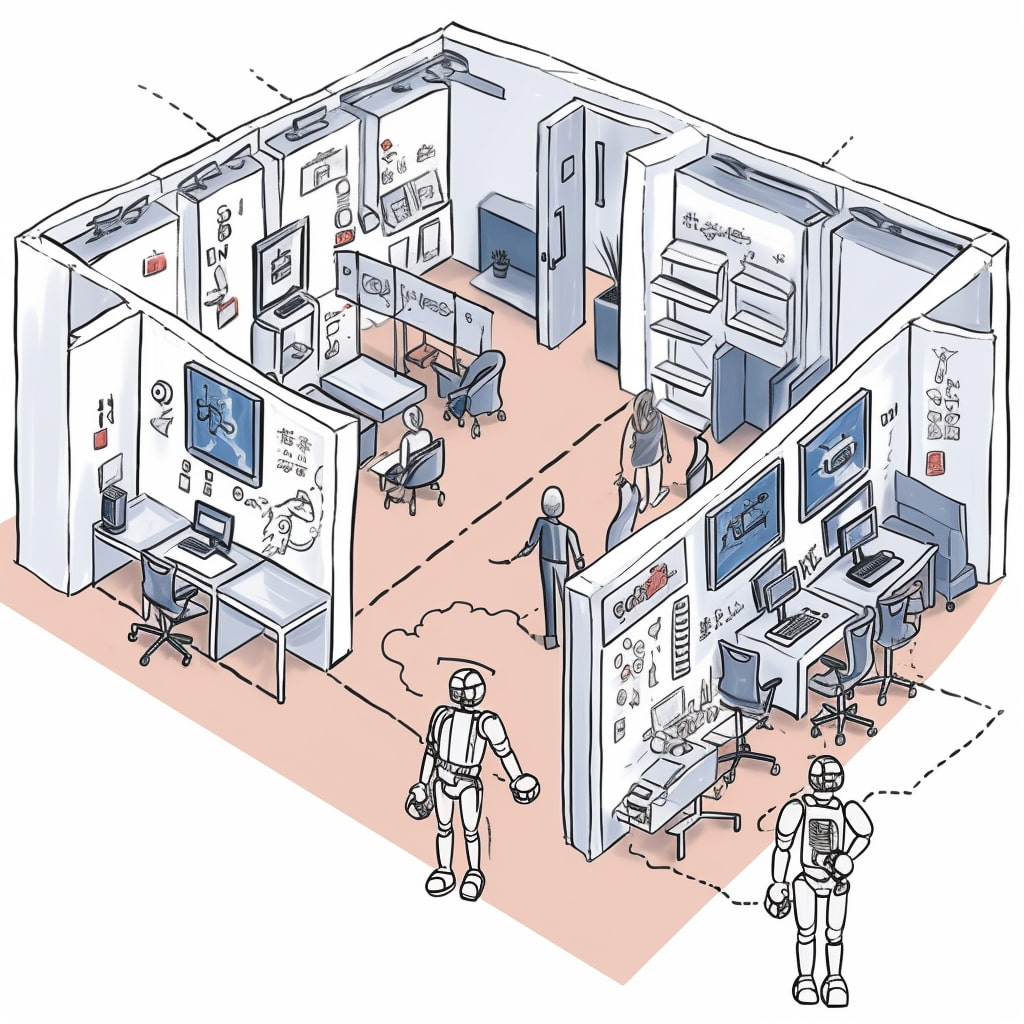
Another example highlighting our work at Fresh is our autonomous mobile robots team teaching one of our machines to recognize different types of doors in an office building (glass, solid material, etc.) to more reliably navigate an “non-ideal,” challenging environments.
Unsupervised Learning: An AI model that develops its own definitions
That’s where unsupervised learning comes into play. Unsupervised learning also teaches AI to look for patterns in data, but unlike supervised learning, it doesn’t provide training data.
In an unsupervised model, you would give the AI images of cars, buses, and bicycles, without labeling them as such. This way, the AI would have to make deductions about these images and come up with its own categories. When given a new image, the AI will try to classify it into one of these categories, but it will not know what that category represents, such as “car” or “bicycle.” It would be forced to come up with its own definitions.
Returning to the robotics example, creating a perception library for robots is the first step, but to create a fully autonomous fleet of robots, unsupervised models would be essential.

Semi-Supervised Learning: An AI model that identifies connection between data sets
Semi-supervised learning was created to address a common issue in unsupervised learning, which is aimlessness. In theory, unsupervised learning is great, but it often gives the AI too little data to work with, resulting in minimal progress.
Semi-supervised learning involves giving the AI a small set of labeled data and a larger set of unlabeled data. The AI is still forced to come up with its own connections for the most part, but it has enough of a starting point to ensure the AI learns in the way the developers want it to.

Reinforcement Learning: An AI model that relies on trial and error
Reinforcement learning is a type of machine learning that involves teaching AI through trial and error.
Take the familiar lab mouse trying to find the cheese at the end of a maze. On a first attempt, the mouse may struggle to even make it to the end. But each time it’s placed in the maze it becomes more and more proficient at the maze, until eventually, it can make consistently perfect runs.
In an AI context, this involves giving the AI a set of unlabeled data (pictures of dogs and cats that aren’t identified as “dog” or “cat”) and asking it to separate them into two groups. When the AI matches a dog with a cat, the AI is given a “wrong” feedback. This continues until the AI eventually figures out what makes a dog a “dog” and a cat a “cat”.

Need assistance with an AI-related project? Let’s connect.
AI is thriving and we’ve seen firsthand how many industries are benefiting from its implementation. If you’re looking for a partner for:
…don’t hesitate to reach out. Let’s connect.