Podcast
The Future Of Rocket Propulsion
This episode explores the current challenges and future advancements in rocket propulsion with leaders from Juno Propulsion, Stoke Space, and Space Happy Hour. The discussion covers innovative engine architectures, the impact of rapid and reusable rockets on the space economy, and the roles of government, commercial, and defense markets in accelerating launch technology. Key developments in testing, in-space manufacturing, and vertical versus horizontal integration are addressed, with a strong emphasis on collaboration and competition in the space industry. Emerging challenges such as launchpad availability, talent shortages, and evolving AI applications are highlighted as pivotal to shaping the next decade of space propulsion.
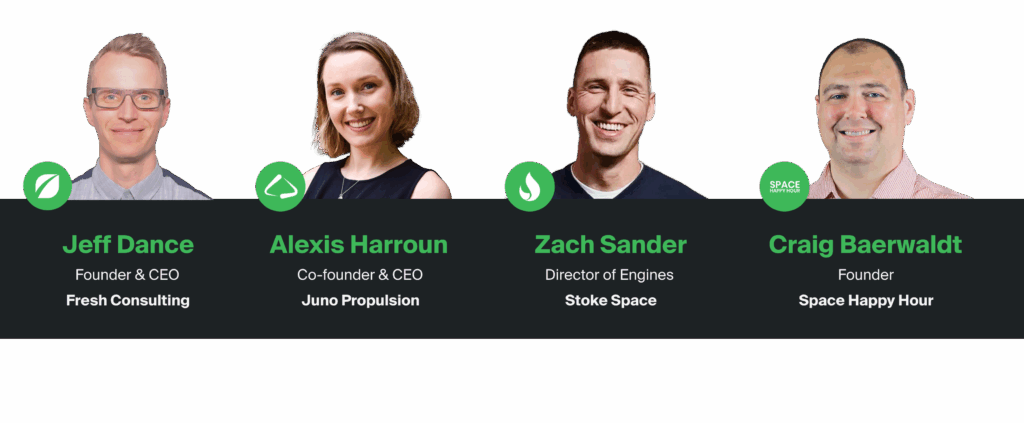
Jeff Dance: In this episode of The Future Of, we’re joined by three guests to talk about the future of rocket propulsion. I’m joined by Alexis Harroun, founder and CEO of Juno Propulsion; Zach Sander, director of engines at Stoke Space; and Craig Baerwaldt, founder of Space Happy Hour and hardware solutions manager here at Fresh Consulting. Welcome.
Zach Sander: Good to be here.
Alexis Harroun: Thanks for having us.
Craig Baerwaldt: Thank you.
Jeff Dance: Let me give some quick intros here since we have three guests, which is atypical but fun. Alexis Harroun earned a PhD from Purdue University, focusing on new rocket engine architectures. She also received a master’s from Purdue and a bachelor’s from UW here in the Seattle area. After winning the NASA Tech Leap Prize, Juno Propulsion, her company, is powering the future of rocket propulsion, and they’re scheduled to put the first rotating detonation engine (RDE, if we refer to that later) in orbit in the summer of 2026. It’s exciting. Zach Sander is the director of engines at Stoke Space, a company developing a 100% reusable rocket, Nova, with a 20x reduced cost to orbit. Stoke recently announced a math: 510 million Series D funding on a2 billion valuation, and they seem to be moving at unprecedented speed. It was fun watching the video and learning more about Stoke. As we know, in space, time flies, so it’s exciting to learn more about how you guys are moving so fast.
Then Craig is the founder of Space Happy Hour, as we mentioned. They just did an awesome event all around the world—we want to hear about that quickly, Craig—but he’s also our hardware solutions manager here at Fresh Consulting, specializing in robotics and hardware development. He’s also the executive director of the Northwest Robotics Alliance, and we’re seeing some crossover between Space Happy Hour and the Northwest Robotics Alliance. Great. So, we’re going to start with a very deep, hard-hitting question: Are you a Star Wars fan, a Star Trek fan, or another space fan? Alexis, let’s start with you.
Alexis Harroun: I’ll have to say “other.” I think my two favorite sci-fi stories are either Dune or The Three-Body Problem. I really like that kind of high-level concept of sci-fi and where we’re going to go in the future.
Jeff Dance: Love it. Okay, Zach?
Zach Sander: I’ll say Star Wars. I grew up watching all the Star Wars movies, doing movie marathons. I love the excitement of Star Wars, but I will back up Alexis on The Three-Body Problem. I read all the books, and they’re just cerebral—amazing to read through. They really open your mind to the far future of space exploration.
Craig Baerwaldt: I’m definitely a Star Wars guy, but I like all things space. Space Happy Hour is actually doing a big Hollywood event in early December with one of the other space franchises, so it’s going to be a lot of fun.
Challenges in Space Propulsion
Jeff Dance: Awesome. Well, let’s dive into the future of propulsion. I’m clearly surrounded by people way smarter than me, especially on this topic, and I’m excited for us to go deep into what is, at least for me, a black hole—maybe for some of our audience as well. I’m hoping we come out with some five-star clarity on the topic. Because we have three people, I don’t want to go in circles on every question, so I’ll be addressing each of you, but if you feel you have something important to add, feel free to jump in and make sure we get that insight. So, Craig, just for those outside the space industry, to get us warmed up, what are the challenges and problems in space propulsion today? Why are we even having this podcast?
Craig Baerwaldt: The Apollo program was absolutely revolutionary, and then it came and went. We got the shuttle program, which was also a unique architecture, but then innovation in space kind of died out. We had cost-plus programs—there wasn’t any incentive. If you’re making money and have a guaranteed profit margin, there’s not a lot of incentive to innovate. Finally, SpaceX came along with Falcon 1 and Falcon 9, and they really kicked off the new space revolution. “New space” is actually an old term now; most people in the industry just say “space industry” or “space.” But there was a time when SpaceX was totally doing things differently. There has been a lot of innovation, and there continues to be evolution. Most importantly, these new systems are going to truly kick off an in-space economy. That’s when space is really going to take off. The more we continue to bring launch costs down, the more things we can do in space. That’s why we’re having this conversation today.
Zach Sander: I’ll add to that. That’s been the big thesis, right? You’ve always been able to get to space over the last few decades, but the cost hasn’t really dropped that much. With SpaceX moving to partial reusability with Falcon 9, it’s dropped the floor a little, but it could go a lot lower. That’s what Stoke is trying to do—rapidly reusable rockets that make access to space even cheaper. What we haven’t seen yet is what the future economies of space will be just by lowering that floor. You can get a ride to space, but it might take a while right now. Startups can’t really get to space efficiently or quickly. By lowering that floor, we’re going to see an explosion in the number of startups that can actually take new ideas to space, do new things, and grow new markets. That’s what we’re hoping to enable with Stoke.
Alexis Harroun: I’ll jump in as well. To me, there are basically two knobs to adjust the cost of getting to space. Zach spoke to the reusability part of launch and in-space vehicles, but the second part is engine performance. If you’re familiar with the rocket equation, engine performance is essentially an exponential lever on what you can take into space and move around. So those are the two main pieces to address the cost-effectiveness of operating in space: reusability and engine performance.
Innovations in rocket propulsion
Jeff Dance: So, high hurdles today. We’re hoping to lower those hurdles. Alexis, tell us more about how your propulsion system can make a difference.
Alexis Harroun: At Juno Propulsion, we’re working on a new rocket engine technology called rotating detonation combustion—also called rotating detonation engines, or RDEs, in the popular lexicon. Essentially, our engines are like a souped-up version of the rocket engines we use today. If you’re familiar with Falcon 9’s Merlin engine or any similar engine, the way they work is that you inject fuel into the chamber, have a steady flame that converts that fuel into useful thermal energy, and then convert that into kinetic energy for thrust. With our engines, we use detonation-style combustion. Instead of a steady flame, which is almost like turning your gas burner stove on, our engines are essentially a ring of fire. We have a circular racetrack shape where detonation waves travel around at supersonic speeds. The reason this is important is that it’s almost like an aerodynamic compressor. These detonation waves compress the fuel, and in combustion science, the higher the pressure you burn at, the more efficient the burn is. So we’re able to extract more energy for the same amount of fuel—essentially like a higher MPG for your rocket engine.
At Juno, we’re developing RDE technology for everything from in-space propulsion—which will be our first demonstration flight next year—all the way to larger space vehicles, upper stage engines, and launch vehicle engines.
Use cases for RDE technology
Jeff Dance: It sounds like there’s not really a limit to how RDE can help—not just getting into space, but also operating in space. Is that right, or are there certain use cases where this is more ideal?
Alexis Harroun: The exciting thing about this technology is that because it’s a new type of combustion, it can be used for many different architectures. It’s fuel-agnostic and size-agnostic. We can use it for in-space applications with certain propellants or for launches with typical rocket engine fuels like methane, kerosene, or hydrogen. What it enables in each part of that launch stack is relevant to that fuel efficiency. For a launch vehicle engine, we can double the amount of cargo sent to space with each launch. For in-space propulsion, we can radically improve the payload fraction and the lifespan of a satellite in orbit. Now, more than ever, how fast you can maneuver from A to B is critical. That’s really the tip of the iceberg in terms of what this fuel efficiency can provide.
Stoke Space’s second-stage propulsion architecture
Jeff Dance: Sounds amazing. Stoke has a really unique second-stage propulsion architecture. Can you give us a brief overview of how that works?
Zach Sander: Absolutely. The second-stage engine on Stoke’s Nova rocket is kind of wild. It’s typical in that it’s burning hydrogen and oxygen, like other engines, but it’s atypical in that it’s also the engine that pushes the vehicle to space and then, after flipping the vehicle around, is used to protect it during reentry. Our engine has a dual-use purpose: it boosts to space, then when you come back, it self-cools with regeneratively cooled metallic panels on the entire bottom of the engine. This lets it absorb the heat of reentry, transfer that into the propellant—liquid hydrogen—and use it in a useful way. Instead of ceramic tiles, it’s a rapidly reusable metallic, ductile heat shield that’s more tolerant to different scenarios. The engine is unique because, for a high-performance upper stage, you usually want the biggest nozzle possible, but that’s hard to package aerodynamically for reentry. So we made a bunch of little ones, packed them around the periphery, and made the engine more like a pancake—very wide, about the diameter of the Apollo heat shield, but not very tall. There are a lot of small thrust chambers, all powered by one set of pumps, and we’ve improved this design over the last few years. We have great control schemes and can use it for active cooling during entry. Our core thesis is making regeneratively cooled heat shield panels and putting them everywhere on our rocket.
Jeff Dance: Nice, a lot of innovation coming together to make that happen. Both companies—and both of you as leaders in space—are tackling the overall problem of cost and efficiency. Craig, from the conversations you’ve had in the space industry, what are you hearing about propulsion?
Craig Baerwaldt: I’m getting to that, but I have to make a comment. If anyone wants to know about Stoke’s awesome architecture, there’s an amazing Everyday Astronaut video—about an hour long—that any space nerd will love. Just search “Everyday Astronaut Stoke Space” and check it out for background. Now, on what’s coming in space: there couldn’t be a better day to have this conversation. Yesterday, we saw Blue Origin land a booster on their second attempt, which is phenomenal. Now we have three space companies—SpaceX, Rocket Lab, and Blue Origin—who have shown they can return a first-stage booster back to Earth and reuse it. There’s no question in my mind that Stoke, maybe not on their absolute first try, but very soon, will land their first-stage booster. What’s really exciting is all the companies working on second-stage reusability. Rockets have stages; you’ve heard Elon Musk say space is expensive when you fly a 747 from Los Angeles to New York and then throw the airplane away after one flight, which has been the norm in space until recently. So, the race for second-stage reusability literally begins today. SpaceX has returned Starship to Earth, though not yet in reusable form. Stoke has a really cool, unique second-stage architecture, and others are working on this as well. That’s the next race in space: who can have a fully, rapidly reusable rocket. I think companies not working on reusability are going to get left behind.
Zach Sander: The key is “rapidly reusable,” too. We keep emphasizing that because it must be rapid, or else you’re stuck in a long repair and inspection cycle. You have to not only make it reusable but also minimize the turnaround time for reusing a landed vehicle. That’ll be a game changer.
Craig Baerwaldt: On that note, the Space Shuttle was reusable, but it cost just as much to refurbish it as it did to fly it. So, from an economic standpoint, although it was reusable, it wasn’t really cost-effective.
Jeff Dance: Zach, what about—go ahead, Alexis?
Alexis Harroun: Zach, I was going to ask you: is second-stage reusability, second-stage landing, the next space race?
Zach Sander: I think it is. Everyone’s doing first-stage landings now, like Craig said. Blue just did it—it was crazy. Our whole company was watching and cheering because it’s so cool to see New Glenn land and pull off that mission. Everyone is moving in that direction—Rocket Lab, Relativity, and others. Second-stage reusability is the next space race, and it’s a game changer. SpaceX is doing that with Starship, trying to land and reuse them, but refurbishing and reusing is a big obstacle.
Alexis Harroun: Craig, I think we’re getting feedback from you.
Jeff Dance: Craig, yeah, we’re getting a lot of feedback from you. We’ll edit that out. But Zach, you were saying about second stage…
Zach Sander: That’s a great question. Second-stage reuse is the next big obstacle. Enabling that is hard—the velocities and heat loads are so high, it’s a tough problem. It will take iteration. You can’t really test it on the ground; you can get close, but it’s through flight testing and expansion. The cool part is you can make a vehicle that gets payloads to orbit, then use return flights to iterate and prove the technology. It doesn’t affect your primary mission of delivering payloads to space and improving the space economy. It allows you to be a cheaper, higher-cadence company and not have to focus on production rates for second stages, like SpaceX is limited by with Falcon 9. They’re limited by how many second stages they can make per year for flight cadence.
Enabling rapid reusability at Stoke
Jeff Dance: At Stoke, what is critical to enabling rapid reusability in your architecture?
Zach Sander: One thing is our metallic heat shield tiles. Inspections are a big part of it. You need to be able to trust that the vehicle is ready for reflight. If it has tiles, you probably need to inspect them. With a metallic heat shield, we can qualify the heat loads and check for leaks with pressurization and leak decay. You can test its ductility and endurance as well, since it’s ductile metal. A big part is qualifying your systems for long fracture and fatigue lives, testing them under those conditions, and then getting into the actual environments to ensure they’re correct. Returning from Earth, proving your coolant is sufficient, and iterating as needed. It’s about going through design, test, and fix cycles as fast as possible. That’s how you unlock rapid reusability.
Will RDE become universal?
Jeff Dance: Thanks for those insights. Alexis, what is the role of having different propulsion solutions? Do you think RDE will become universal, or do you see a role for different types?
Alexis Harroun: Our vision for the company and the technology is to replace all chemical rocket propulsion as it exists today. In terms of different types, there’s chemical propulsion—which is what we’re doing—there’s electric propulsion, and maybe in the future, nuclear propulsion for Mars missions. There’s always going to be a need for different types or architectures. For example, a launch company might need very large engines with certain fuels, while in space, for a vehicle, you might need something different—maybe something storable that can last five to ten years, waiting for a go signal. We do need all these different systems. For chemical propulsion, that’s our best way to get off the planet. We live in a gravity well, and chemical rocket engines are the best way to escape it. Improving that technology, as we are with rotating detonation engines, is key to making space more affordable. Everything after the launch stack is just a tiny fraction of the last stage. When I mentioned doubling the cargo to space, it’s because the payload fraction is usually one or two percent of the weight at launch—ninety percent is fuel. Efficiency at each stage, especially the first, is really key.
Jeff Dance: Thank you. You mentioned reducing the cost and increasing the payload. What sort of cost reduction are we talking about if RDE becomes mainstream? Would it cut the cost in half, or be three times cheaper? What are your thoughts?
Alexis Harroun: It really comes down to making money based on how much mass you push to orbit. If we can double the cargo capacity, that’s already a doubling of revenue for the launch provider. But this also has more complex impacts on the in-space economy. For example, there’s a tension between electric propulsion, which is very efficient but slow, and chemical propulsion, which is moderate in performance but has high thrust. If your bottom line is determined by how fast you start operating and generating revenue, waiting for electric propulsion might mean waiting weeks or months, with technical issues like radiation exposure. With chemical propulsion, you can get to your destination and start generating revenue much faster. This materially impacts cost and revenue, sometimes by millions to tens of millions per month. It’s a really important piece of making the space economy viable.
Balancing commercial, civil, and national security markets
Jeff Dance: So, a lot of exponential potential—that’s really exciting. As you think about the commercial side, it seems like most successful space companies have a blend of commercial interests, civil (NASA), and national security (DOD) markets. Are you working with those three customers, and what are the challenges of meeting those different needs? Maybe Zach, start with you.
Zach Sander: Sure. It’s easy to talk about because Stoke just got into the NSSL—the National Security Space Launch competition. In that, we’re entering with a small group. There are existing primaries: Blue Origin, United Launch Alliance, and SpaceX. Now, there’s Rocket Lab and Stoke Space. We got into the NSSL competition, and I think what they’re doing is great. They’re changing the lanes and tiers so earlier startups like Stoke, who haven’t launched yet but are close, can take on higher-risk missions and work up the requirements ladder. By entering the NSSL, we’re working towards getting some of those launches. We’re also working on commercial launches—that’s our bread and butter. The middle is civil, but I won’t talk about that here. By targeting our engine and vehicle qualifications to meet government requirements, we also end up meeting commercial needs. With a reusable rocket, you need a reliable process and vehicle. Once you start landing and reusing rockets, you learn about failure modes and can fix and iterate. SpaceX has done this with Falcon 9 first stages, making them more reliable. Doing that with the second stage will make the whole stack more reliable. Most customers prefer to ride on reused rockets because they’re more proven. So, it’s natural to target all markets. If we have a super-reusable and reliable rocket, we can launch any customer to orbit and even bring them back.
Jeff Dance: Thanks. Alexis, how about you? Are you already working with all three? RDE seems universal, but do you have those relationships in place?
Alexis Harroun: Absolutely. In the past, space was mainly the purview of the government, partly because of the high cost, but also because of national security. Now, as launch capability has expanded and costs have come down, more commercial entities are enabling real applications—monitoring the planet, remote sensing for firefighting, or helping insurance companies price land. Commercial has really grown. For our first product flying next year, we work closely with satellite manufacturers and producers. There’s a lot happening—companies doing rendezvous and proximity operations for refueling or inspecting satellites, which has both commercial and defense purposes. Space stations, on-orbit vehicles, and moving mass in space are big pulls, especially for the government. The government will still be a big player for the foreseeable future, especially as things heat up. High thrust and high launch cadence, like Zach mentioned, are important for them. If something happens in space, we don’t want to wait a year for a launch. We want to be able to move quickly. Chemical propulsion is really good at that, but all these architectures—more launch vehicles or more assets in orbit—will be key.
Ensuring rapid responsiveness in propulsion
Jeff Dance: It seems like a lot of defense requirements recently have been about rapid responsiveness. Zach, what do you think is important within the propulsion space to be ready within 24 hours?
Zach Sander: A 24-hour turnaround starts with great operational procedures. You want an agile launch pad and rocket, quick operations. At Stoke, we’ve developed our own software, Boltline, for procedures, inventory, work orders, and more. Streamlining that is important. Automate your test stand, launch pad, and rocket. You want automated, repeatable operations. The vehicle must be rapidly reusable, able to fly and return within days, and have high margins. If you have multiple reusable vehicles, you can always have one ready to go. Having just a few vehicles that are reusable lets you have them ready for repeated flight ops. Once you get to space, you want to maneuver anywhere in orbit, which is something the government is looking for. Fast to orbit, fast from orbit—those will be future capabilities.
Vertical integration & competition
Jeff Dance: So, there are a lot of components to being ready for a 24-hour call-up, and having ownership over those components is part of that. When I talked to Sir Peter Beck at Rocket Lab, he said a lot of their innovation was about having ownership of those areas. Is that how Stoke approaches it—high ownership over each of the core components to move quickly?
Zach Sander: Absolutely. We’re pretty vertically integrated. We own the pad, its design, and operation. We talk a lot about ConOps—concept of operations—on how to quickly move through every phase, from integration to launch. We own the software we developed to make it agile. We’re also strong in hardware; we have our own machine shop and test facilities, all designed by our team. That lets us quickly test, iterate, and make the hardware reliable. Vertical integration is key to being fast, and we’re moving toward even more integration for all operations.
Alexis Harroun: If I can jump in, I have a slightly different point of view. I want to challenge vertical integration a bit. As a company looking to sell propulsion systems and be a horizontal layer in propulsion solutions, I think part of the reason we’re pushed toward vertical integration is a lack of a strong supplier base for these critical systems. It’s odd that every company is redoing engine development for each new launch vehicle. Every vehicle has its own niche engine. I say this with the bias that we’re also producing propulsion, but everyone’s favorite topic is supply chain and logistics, right? It’s a critical issue in the space industry. We don’t have strong horizontal supply chains for components, which is why we bring them in-house. Every space company feels pressure to vertically integrate to control schedule and costs. However, this is unique to the space industry—we don’t see this as much elsewhere. In Europe, they’ve identified this as a major problem and are investing in companies that provide components and services, as well as full solutions.
I say this to gently push back on the idea that vertical integration is the only way. I understand why, and Stoke has done it effectively, but as we build the space economy, the idea that every company has to hire a team and build the full system in-house is cumbersome and prevents new entries into the market.
Jeff Dance: That’s a key point. Vertical integration is a competitive advantage in the current state, but in the future, with costs coming down and demand increasing, you’d expect that supply chain to be built. I think what you’re saying, Alexis, is that we need it now due to current challenges, hence the investment. Both perspectives make sense.
Zach Sander: I’ll add to that. Competition is what’s amazing about the space industry. We like competition—if other launch providers can produce capable vehicles, it only makes us better. The more competition, the more each company wants to iterate and accelerate their products, making both companies better. There’s a lot of competition among launch providers, which makes them focused on making more reliable products and delivering more value to customers. By providing what Alexis mentioned, it boosts competition, which is healthy. You don’t want one company running everything; the more, the merrier. The market will help steer to the final solutions, and there should be more than one provider.
Alexis Harroun: Absolutely. A rising tide lifts all boats.
Jeff Dance: That’s the sense I get in space, talking to other leaders. There’s a friendly aspect, and while there are more players now, it’s still a small community. There’s a groundswell of movement, but also a sense of co-opetition. When a competitor wins a big grant, sometimes they both work on it anyway, collaborating where needed. But at the national security and country level, there’s a proprietary aspect as well. That can be both exciting and challenging as we try to push things forward collectively.
“Testing is truly the bottleneck”
Let’s talk more about testing. It’s not always as sexy, but it’s critical to speed. Craig, maybe start with you. I know we do a lot of end-of-line tests here for the space industry. Tell us more about why testing is so critical to speed.
Craig Baerwaldt: In the space industry, especially in small space, it may take four hours to assemble something and 200 hours to test it. Testing is truly the bottleneck. For startups, there’s a massive capital expense to get all the equipment. There are test labs startups can use, but that’s a huge burden. The big players can buy all their equipment, but for others, it’s a bottleneck. It’s about how you go from one to ten to a hundred units—how you build and test for that. We’ve seen companies with bespoke software for early testing, but by satellite number ten or twelve, they need a better way.
That’s where we come in—helping with testing and better data capture. SpaceX, for example, found that real-life launches sometimes behaved differently than simulations, but over time, they learned to trust certain patterns. Getting more quantity through, capturing data, and analyzing it—not just real-life versus simulation, but launch to launch—is key. That’s an area we help companies with. I’m also interested to hear how Alexis and Zach are pushing testing forward, as it’s one of the key things for the space industry.
Jeff Dance: Alexis, how are you thinking about testing?
Alexis Harroun: I think testing is incredibly exciting. I love a good hot fire test—that’s what gets me up in the morning. Testing is a key part of our strategy, allowing us to rapidly iterate and test in-house. Failures often teach us more than successes. Maybe a part burns up or doesn’t operate as intended, and getting as close to the real environment as possible is critical. There’s an art to testing, and it can be expensive and time-intensive, but with a team that likes to handle hardware and isn’t afraid to burn things up, you can really improve your speed of iteration.
Are there explosions in RDE?
Jeff Dance: With RDE, are you worried about explosions? Is that one of the reasons it hasn’t been innovated yet? Is there a high consequence if it doesn’t work out?
Alexis Harroun: That’s a question I get a lot—there’s “detonation” or “explosion” in the name, so what’s going on? The history of this technology goes back to the 1940s. In the early days of rocket engines, behavior similar to detonation was observed frequently. If you look at the classic F-1 engine for the Saturn V, you’ll notice the injector looks like a weird organ pipe—designed to dampen acoustic behavior that was likely trying to do detonation-type combustion. We’re just leaning into that—accepting it. They didn’t like it because it shook their engines apart. Now that we understand it, we can design for it and utilize it.
There are no actual explosions—nothing is blowing up every time we test. Our engines, if you didn’t know it, sound and look a lot like normal rocket engines or thrusters. It’s just under the hood, with a high-speed camera, that you can see the detonation at work. It’s a scarier name than it really is. The challenge is having the expertise to capture and utilize it effectively. That’s the break we’re addressing and commercializing.
Jeff Dance: I’m going to come up with another name and send you some ideas. I think you’re in a position to rename it if you want to.
Alexis Harroun: Yeah, we could get the press people—the folks better at naming than the scientists—involved.
Zach Sander: I’m sure you’ll come up with a new name for it, Alexis, but “rotating detonation” does sound cool. I’m passionate about testing too, so I want to talk about that for a second. We all want super-reliable products, and with Alexis’s product, you want to test the bounds of everything—sometimes to failure. At Stoke, we do that often, finding failure modes. My simple way of thinking is: predict your environments for whatever you’re doing (engine, vehicle, etc.), draw a box around the expected environments, make a bigger box for margin testing, and test the extremes. Sometimes you want to fail it to know your margins. If you find a new failure mode, you adjust your box. It’s not enough to do it once—you want continual testing on hardware to prove it’s reliable. You don’t want flight to be your test; you want flight to be successful. The more you do on the ground, the more you build your test stands and operate them yourself, the faster you can iterate to really reliable hardware.
Stoke Space’s engine advantages
Craig Baerwaldt: I want to add a follow-up question because it’s unique about the Stoke architecture—going smaller. We deal with all things new product development, from consumer hardware to space products. By making your engine smaller, I know you’ve been able to manufacture them faster. Because you have so many in the ring, you have more thrusters and more ability to test. Talk about how that architecture increases your test speed.
Zach Sander: Thrusters, yeah. Yeah.
Zach Sander: Yeah, it’s kind of delightful, right? Stage 2 has 24 identical thrust chambers all around it. Our combustion engineer, Jenna Humble, is amazing—she can create a bunch of different thrust chambers, test them, push them to their limits, and figure out the best version. Once we find that, we can mass-produce them for the whole engine. This approach allows us to iterate quickly by testing a lot of full-scale hardware, but just a single part of it. Find your best version, field it, and you also get cost reductions—testing is just a 24th of the cost, not the whole engine. You’re developing one thruster at a time, iterating, and once you find what works, you make a ton of them for the engine. It’s the same for stage one—we have seven engines on our Nova rocket. We optimize one engine to be the best version for our needs, and once we like it, we replicate it for the vehicle and can scale it out. Breaking up your design into smaller parts that are still full-scale and beating them up, iterating quickly, really helps you get to the finish line faster.
Jeff Dance: Thanks for these insights on testing. Go ahead.
Alexis Harroun: Shout out!
Zach Sander: Yeah.
Alexis Harroun: I was going to say, shout out to Jenna Humble. She and I went to school together at Purdue and had the same PI.
Jeff Dance: Awesome. When you said “she,” I wasn’t sure if you were referring to a person or the architecture itself. I didn’t know if you’d personified the engine, but that’s cool.
Alexis Harroun: No, the combustion engineer that Zach’s mentioning—Jenna Humble.
Zach Sander: Yeah.
Future advancements in space economy
Jeff Dance: Great, shout out to her. I think we could talk about testing for another two or three hours, but we might lose some of our general audience—though we’d keep our space engineers. Let’s project a little more to the future. Looking ahead, Alexis, you talked about some of the key problems, and you guys are working on the future right now, which is awesome. What would you say, ten years from now, are some of the key advancements that would make you say we’ve entered the golden age of space, the space economy, and space propulsion?
Alexis Harroun: I love that question. I partly think it’s not propulsion related. The key development to enabling a successful economy in space is going to be our ability to manufacture things very precisely. Our current biggest challenge for space is the gravity well of Earth—getting things up is so energy intensive. That’s why we need these huge launch vehicles, and only the top one or two percent of payloads actually end up doing something in space. So, in-space manufacturing and refueling, being able to stay in space, will be really important for operating there.
In the short term, for startups and space companies, there’s not much incentive to iterate in space because every mission is a one-and-done shot to show you can do it. Sometimes missions fail for unrelated reasons, which really hurts our ability to demonstrate new technologies and capabilities. That all ties back to cost, the economy of getting to space, and the prevalence of launches. I would love to just throw bad ideas into space—we should be doing that! Sometimes a bad result leads to a better idea in the future. So, the ability for a company to do multiple iterations without millions of dollars and time down the drain is going to be really key.
Zach Sander: I’ll add to that. Those are great points. What is success in ten years? I haven’t thought about it deeply, but in the end, it’s about the payloads and customers you put in space and how hard it is to get there right now. It’s crazy hard. If you’re a startup, just finding a launch vehicle and getting a secured slot can take a year—it’s probably a Falcon 9 mission right now. The end goal is for it to be like Amazon: super easy. You want a part, you find it, hit a button, and you get it.
How easy is it, in ten years, for any startup to get a bad or good idea to space, find an immediate launch provider, and test it? That’s probably the metric—how easy and seamless it is to secure a launch and get through all the hurdles. The timeline for a new startup to put something up there should be much shorter.
Craig Baerwaldt: The thing I’ll add, just as far as what’s going to pull the space economy forward, is when it’s easy to get to space, the problem is solved. In-space manufacturing is key. SpaceX has gone from a math: 20 billion addressable market with launch, but they’re rapidly shifting to telecommunications—a2 trillion total addressable market. When we can manufacture things in space for use back on Earth, you’ll see massive new investments. Just like rideshare opened up a whole new realm of space companies, in-space manufacturing will create a revolutionary change. That’s when people will be living and working in space, and the true space economy will take off.
Jeff Dance: Go ahead.
Predictions for in-space manufacturing
Alexis Harroun: If I can add one more thing on in-space manufacturing—my specific prediction for the turning point is when you can additively manufacture something at a scale of about 20 thousandths of an inch. That’s my prediction because that’s the relevant size for propulsion and a lot of other things, whether it’s cooling or on-orbit operations.
Jeff Dance: Fascinating. So how close are we to this? Zach, you mentioned Amazon, but what about an airline-style experience where we’re talking about hours or days instead of months? Are we going to get there in a few years, or will it be ten years or more? What are your thoughts?
Zach Sander: I can’t predict exactly—it’s a long-term market. I hope we can bring it faster and accelerate that at Stoke. You have to work on these pervasive technologies and make them so ordinary that it comes faster. For example, with Falcon 9, I stopped watching the landings. I used to watch every one, but now it’s routine. That’s great, and that’s where we need to get to. The next level is state-of-the-art reuse, then energy-efficient in-space transportation, like what Alexis is working on.
It’s hard to predict, but sometimes you under-predict how fast things can move. If you stay focused on near-term objectives, you might be surprised how quickly you can accelerate long-term visions. It’s exponential sometimes. You have to make space access so easy and hardware so reliable and cheap that it blows up the economy—then people will build new things to go to space and pay for those rideshares and direct flights. That’s the first goal: easy rides. The vision is like UPS, FedEx, or Amazon rapidly delivering with no worries—you just want to know when.
AI’s role in the future
Jeff Dance: We’re seeing a similar trend with AI—sometimes we’re over-predicting, sometimes under-predicting, with so much change happening. Alexis, how do you see AI playing a role in the future? How are you using it today to speed things up?
Alexis Harroun: I’m AI cautious. Right now, our engineering work is so specialized that it requires very specific skill sets and experience—like the engineers we’ve hired. AI is basically a new type of computational tool, and as a former student of computational fluid dynamics, the adage is “garbage in, garbage out.” So, I think there’s capability, but at this point, we rely on the expertise we’ve brought in.
AI can help with simplifying business operations—probably more relevant for Stoke at its stage—and maybe in the future, AI tools can handle routine tasks, freeing up specialized talent. But our secret sauce is still our people. I’m sure a lot will develop with AI in the near future.
Jeff Dance: I can see how there isn’t a specialized AI model for RDE that you can just tap into, especially since there hasn’t been much innovation in rocket engines for 70 years. But I appreciate the perspective. Zach, what are your thoughts?
AI’s potential and limitations
Zach Sander: Alexis needs to develop RDE so AI can train on her results! We need foundational improvements, and then AI will train on it. AI is good at past data. At Stoke, we have in-house secure AI tools—it’s great for code, and for things with lots of historical examples. But we’re mostly a hardware company, so it’s not used for hardware design. It’s a numerical, code, and language tool right now. But you don’t want to ignore it—who knows where it will be in two years? As long as your company is adaptable, you can jump on new capabilities as they arise. We don’t use it intensely for engine design—it’s all based on experience and our responsible engineers, who are amazing synthesizers of hardware, data, and physical observations. There’s nothing faster than having a smart engineer in the loop with all the tools they need to go fast.
Jeff Dance: One thing we’re seeing with AI is its support for simulation and computer vision—simulation seems to be an area developing rapidly. How can you test digitally before testing physically? Are you seeing AI play a role in that yet, or is it still early?
Zach Sander: I’ll hop on that. I haven’t seen it yet. You want super repeatable, reliable results for the digital twin analogy. You want your digital simulation of your engine and your real-life engine to match, so you can fully understand how the digital version is designed and how the physical one reacts. We’ve developed our own in-house tools for 1D predictions and modeling of our engines and other systems. Maybe in the future, AI will pick that up, but until you’re sure it’s reliable, you probably don’t want to base your stack on it.
Craig Baerwaldt: Let me follow up. What are you seeing today? There’s been a huge push over the last ten years for digital twins. How closely are digital twins replicating real life? And what about those anomalies you see that you call “in-family”—unexpected but recurring patterns? Can you dive deeper into how close simulation is to real life?
Zach Sander: Happy to. Simulation is only as good as your models. You need to understand the underlying physics to represent them. You have to model things like rotational inertia of pump shafts, volumes, combustion time scales, valve time scales. The more real-life resolution you put into the digital model—like an engine transient tool—the more it resembles reality. You learn to trust the parts where it’s good. When the model diverges from test data, there’s something going on, and you need to dig in. It could be a misdesigned part in the digital model, but it’s different in real life, so you need to inspect it. That takes extreme ownership—diving into the details. The little details matter; the little wiggles in your data traces are telling you something. Very few things can solve that except a smart person exploring all the data.
Alexis Harroun: One of the core challenges in simulation right now is just compute power. For example, I likened rocket engine combustion to a gas burner stove, and that might seem simple, but when you dig into the details, it’s a complex physical problem. Our particular technology is very difficult to model computationally—one of the biggest open problems. Sometimes a simulation shows one thing, but if you resolve it more, it shows something completely different, and it doesn’t match the tests we’ve done. That’s frustrating—you want to simulate what you’re testing. Part of it is needing more compute power, but also the tools for this type of simulation are still nascent. I’m a hardware person; I like testing because the proof is in the pudding. But those tools are helpful for knowing how tweaks impact the engine.
Jeff Dance: Makes sense. As we project to the future and try to reach a trillion-dollar-plus economy, what other challenges do you anticipate? Are there critical skill shortages or other obstacles you see coming?
Zach Sander: Hiring is hard, I’ll tell you that. We’re always looking for the best talent—apply to Stoke, we have open roles and internships. Finding great people who fit our GoFast culture and want to have fun is tough. We try to keep the team small for easy communication—grow too big, too fast, and it gets harder to solve problems. That’s a big one: getting the right folks. Another big challenge is launch pads. There are very few places in the world you can launch from: Cape Canaveral, Vandenberg, SpaceX’s own pad, Wallops. That’s about it for orbital launch pads in the U.S. We need more launch sites to grow the space economy. Once we get through reusable rockets, having more places to fly from is probably the biggest obstacle I see coming.
Alexis Harroun: I’ll echo the sentiment on hiring. I’m part of the hiring process for everyone at our company, as you’d expect for a startup. Fortunately, engineering programs are getting more sophisticated every year. I’m shocked by what students are doing now compared to when I was an undergrad. Beyond engineering expertise, we also need manufacturing and technician expertise. There’s a good community here in Seattle, but it’s still being pushed to the limits. Launch pads are another interesting point. One limitation is satellite processing and fueling. Many satellites using chemical propulsion rely on hydrazine, which requires specialized facilities because it’s carcinogenic. Our product flying next year uses non-toxic, green propellants. The intent is that you can load it during satellite assembly—just put in the gas and cap it, ready to go. I think Zach is right: we need to open up more places to launch from. It’s cool that Stoke is at a historic site in Cape Canaveral, but why only historic sites? We’ve got a lot of land in the U.S. for launches, and that’s part of the problem we’re trying to address.
Craig Baerwaldt: Big shout out to Alexis and Zach for actually serving at the forefront here. A ton of people go to Space Happy Hour to connect. In 2026, we’re adding a job board. I’ve had multiple people from various industries, like automotive, wanting to transition into space—they come to Space Happy Hour to see how their skills translate. We’re also working to bring up the next generation. Last night, we funded STEM education and the National STEM Foundation, and I was a speaker at Space Vision. We’re always trying to bridge the gap from students to industry. Whether it’s here at Fresh or any space company, we look for students with hands-on hardware experience—it’s critical for success in the industry.
Jeff Dance: It’s really fun to see those photos all around the world of women in space at the Space Happy Hour event last week. Two more questions, then we’ll wrap up. First, having launched a company myself and worked until 2 a.m. for six years, I know how hard it can be. You all have so much potential and so many challenges. What do you do mentally, or what mantra do you have to stay grounded when things get tough? That’s a more personal question. Zach, start with you.
Zach Sander: I’ll hop in. We have a couple of mantras internally that we repeat. When things get tough—like when we fail components—we learn, we iterate. We say, “You make your own luck.” You don’t just get lucky; you make your own luck by digging in at first principles and building fast iteration loops. If you have a failure, be ready with the next hardware and go test it again. Don’t let a big failure sideline you for six months. Make your own luck as a company by having the right people, working at first principles, and making the iteration loop so tight that failure isn’t a big deal. The other mantra at Stoke is “every day counts.” Don’t lose a day—it’s precious. Every day costs something, every day is a slip to your bottom line. Know what’s critical, help those teams, and help them be more lucky by supporting them. Every day counts—we say that a lot.
Alexis Harroun: Zach, I really like those. I might have to borrow some! I can tell you live that “every day counts” mantra—the proof is in the pudding. To answer your question, Jeff, on a personal level, and to refer back to your first question, a great quote from Dune is, “Fear is the mind killer.” I think about that a lot—fear and anxiety about the future can be paralyzing. Sometimes you just have to push through the fear that something won’t work. For me, as someone handling the business side, you just have to keep pushing through. That has led to our success—not letting day-to-day issues or failures keep us from moving forward.
On company culture, building a team that encourages growth, mutual responsibility, and openness is really important. If someone doesn’t feel comfortable sharing a problem, or admitting they made a mistake, that can hold you back. It’s more effective to be open and humble, and it’s more fun when you enjoy working with your team. One of the most exciting things for me is building a workplace I love, which makes everyone better. You multiply each other’s throughput that way. It’s a long-winded answer, but I have my own ways of handling the stress of building a space company. It’s wild, but I think we have the building blocks in our team to be successful.
Inspiration from industry leaders
Jeff Dance: Thank you. I love “fear is the mind killer.” I recently heard that anxiety is just unfocused fear. I think we live in that state a lot more these days without focusing on what we’re really going after, and whether we have good people around us to do it together. Thanks for those insights. Last question: Other than Craig, who seems to be networking the entire space industry—thank you for your leadership, Craig—who do you look up to in space? I’d love to hear if anyone comes to mind. Craig, maybe we’ll start with you.
Craig Baerwaldt: I’m super excited about Jared Isaacman, and if he finally comes through as NASA administrator on the second try, I think someone who’s been to space twice and is really pushing the envelope of what can be done commercially is inspiring. NASA needs a shakeup—it’s been unchanged for six or seven years. Some of the science there is important, but maybe that gets shifted to places like NOAA. I think Jared will bring a pragmatic approach, innovative thinking, and deep passion. I don’t think anyone cares more about the future of space. I’m excited to see him hopefully confirmed and to see where the next few years take us.
Zach Sander: I’ll hop in here. I don’t have a single person I look up to, but I like to see positivity in space. I want to celebrate everyone’s achievements—like seeing New Glenn land on their barge. That’s a cool achievement. I worked on BE-4 a bit, and though I’ve been out for five years, that team is crushing it, achieving reusability on New Glenn. Jared embodies positivity and advancement. I love that answer, Craig. Positive competition and support in the space industry are key—competition makes us all better. More entrants, more competition, and constraints help everyone go faster and harder. The general vibe of positivity is healthier for the space community.
Mentorship and community support
Alexis Harroun: I’ll echo what Zach said. I’m fortunate to have a long list of advisors I rely on. Ten years ago, there wasn’t this community of previous space company founders and folks in these positions who support the next generation like there is today. Positive competition is great—we should all be working to succeed and win. Everyone knows this is really hard, and many people have started companies, succeeded, or even not succeeded but still did great things. I’m lucky to talk to those people—they’re the behind-the-scenes forces propelling companies like Juno and other startups. I don’t have a specific name, but if you know who you are, thank you. Space is a cool field because we’re all united by the dream of exploration and the next frontier. It’s really special.
Craig Baerwaldt: I’ll wrap up by saying that’s part of why I started Space Happy Hour. There’s such a rapid, supportive community. I work across space, robotics, and general consumer hardware for some of the biggest companies. But there’s something unique about the space industry—competitors cheer each other on for success. Everyone wants to see other companies succeed, even as we compete. It’s similar to the UAV world—doing things for the first time, fighting regulation, solving unique government challenges. No one wants to go first, so we come together on those issues. The space industry is unmatched in having competitors cheer each other on.
Jeff Dance: It’s a cool culture, a great community, and a big market. It’s really exciting. Thank you for helping me come out of my black hole of understanding about propulsion and learn more about rocket science. I really enjoyed our time together and appreciated your insights. We look forward to watching you all and working together to bring this to the everyday world. Really appreciated the insights and grateful to have you here today.
Zach Sander: Cool. Thank you, Jeff. Thanks, Craig.
Alexis Harroun: Thank you so much.
Craig Baerwaldt: Thanks, Alexis. Thanks, Zach.
More Podcasts