Podcast
The Future Of AI in Space
This episode explores the current state and future of AI in space with Will Marshall of Planet. The discussion covers how daily satellite imaging is creating a searchable index of the Earth, the growing importance of real-time data for navigating global challenges, and the convergence of AI, sensors, and edge computing in orbit. Additional topics include the rise of sovereign satellite networks, the massive impact of hardware miniaturization, and the profound ethical implications of super-intelligence and preserving human sovereignty.
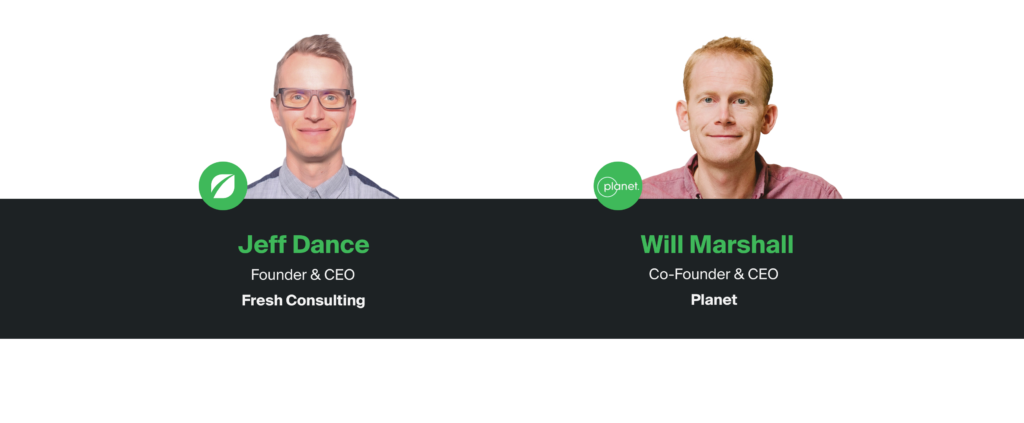
Jeff Dance: In this episode of The Future Of, we’re joined by Will Marshall, Planet co-founder and CEO, to explore the future of AI in space. Welcome to the show.
Will Marshall: Hey, thanks for having us.
Jeff Dance: Excited to have you. I’m going to do a quick intro for those that don’t know you. Will, as CEO and co-founder, leads the overall company strategy and direction at Planet. Prior to Planet, he was a scientist at NASA, where he helped formulate the small spacecraft office. He was also a systems engineer on the lunar orbiter mission LADEE, which was the Lunar Atmosphere and Dust Environment Explorer, and he was a member of the science team for the lunar impactor mission LCROSS, which was the Lunar Crater Observation and Sensing Satellite. He has lots of other interesting experience at NASA, but in addition, he got a PhD in physics from the University of Oxford. He got a master’s degree in physics with space science and technology from the University of Leicester. He also completed a postdoctoral fellowship at Harvard and George Washington University. It is a really interesting background with a lot of deep space experience prior to Planet.
We are really grateful to have you here with us. Will, what do you do for fun? You do a lot of serious deep tech work, and I’m really excited to nerd out on all these things, but what do you do for fun?
Will Marshall: Well, I do some serious hiking. I like adventuring around the world, scuba diving, skiing, and hiking. I just got back from a trip to Antarctica. It was my first time visiting the seventh continent. It’s incredible hiking around there and seeing the wildlife. My passion is nature and getting out in it.
Jeff Dance: Amazing. You get a look at more nature through your company as well, in deep detail. Let’s talk a little bit more about Planet. Tell us more about the company. You co-founded this, and you’re the CEO, so give us the CEO view of Planet.
How Planet is utilizing AI
Will Marshall: Of course. Planet lets people see change across the whole Earth every day to make informed decisions. This spans across civil government applications, commercial applications, and defense and intelligence applications. We do this with over 200 satellites that image the entire Earth’s landmass once per day. With advances in AI, we track changes that happen across that imagery in near real-time. I liken it to what Google did with indexing the internet to make it searchable. We’re indexing the Earth to make it searchable.
Jeff Dance: Are you adding data to make it searchable?
Will Marshall: You mean labeling data? Certainly, sometimes we have to, but AI is actually getting better at zero-shot or low-shot learning. That’s because foundation models, as they become multimodal, have been trained on a huge array of imagery data as well as text on the internet. So, they’re starting to get better and better at processing imagery right out of the gate.
Historically, AI has gone through several revolutions. We’ve been working on AI for over a dozen years now. With classical machine learning, especially computer vision, there were early successes that used to require training with thousands and thousands of images—with humans labeling this as a ship, this as a tree, or what have you—to build up sufficient accuracy. But now, increasingly leveraging those historical training datasets, plus the advances in multimodal models generally and other datasets that have nothing to do with satellite data, they have become better at doing that without needing much of that direct training themselves. You can go with zero-shot or low-shot learning—one-shot, two-shot—where you iterate just a couple of times and it already gets the idea. Just imagine the power of this new tool. AI has largely been trained on the text of the internet. That’s great, and it does incredible things with that. Large language models can write essays, compare things, and encompass a massive amount of human knowledge. Essentially, it has Wikipedia in its head, which is incredible. But imagine the power of adding all of the Earth data to that. You’re not subtracting all of that contextual history of human knowledge; instead, you add all of the Earth data and then become able to make queries not just of the text of the internet, but queries of the physical planet. That opens up a vast array of applications, such as agriculture and disaster response.
How are you going to manage disaster response without real-time information? It’s no good just creating a virtual world; you need real-world data. As we move towards real-world models, you need real-world data. This is why space and AI are a match made in heaven. You were saying earlier, Jeff, that AI is touching a lot of different technologies, and I think that’s right. Pretty much every technology is being touched by AI. But space and AI have particular advantages for one another that go beyond a lot of other disciplines. Space has been generating huge amounts of data. Planet alone images the whole Earth every day, and we’ve been doing that for eight years. So, we have daily snapshots—3,500 images for every point on the Earth’s landmass, one every single day. What an incredible dataset to train AI on regarding how the physical world is changing, with all those applications acting as a downstream consequence. AI needs three things: compute, data, and algorithms.
“Space and AI are a really a match made in heaven”
Increasingly, it’s the data that is holding up the generation of new applications. That’s why you see leaders like Demis Hassabis, Dario Amodei, and Yann LeCun talking about the need for real-world models. For real-world models, you need real-world data, and space is gifted with huge amounts of it. Meanwhile, from the space perspective, we’ve had gobs of data. But try getting value out of that if you’re an individual. We produce about 40 terabytes of imagery per day—four million 47-megapixel images. If you as an individual want to get information or answers out of that, it’s really hard. If you’re observing a small local area, fine, you could do that with your eyes. If you’re trying to search the Brazilian Amazon for deforestation or search China for missile threats—two examples that we work on—you simply can’t do that manually. You need to look at millions of images. Therefore, AI is a massive boost to space. This is why I say space and AI are really a match made in heaven. They are getting married right now, and it is having explosive consequences for the world.
Jeff Dance: That’s fascinating. One of the things I’ve been impressed with regarding LLMs is how they compress knowledge. You guys have this massive dataset every day that you can query in an easy format. Taking all that raw output and making it usable is really interesting. The notion of using zero-shot models to understand that data, or to convert all of your images into the LLM, seems like a huge accelerator for what you guys were doing for years. In the last two or three years, did you catch it early and realize this was the turning point?
Will Marshall: 100%. As you said, we’ve been working on AI for about 12 years now. Convolutional Neural Networks were particularly good in the field of computer vision. Initially, recognizing cats and dogs in pictures on Facebook was very applicable to satellite imagery; we just had to adapt the models and do the retraining. Now, we’ve moved all the way through to large language models and multimodal foundation models that are actually doing quite well on imagery, and we are fine-tuning those. There is no question that this is an accelerating moment. Space is in a revolution, AI is in a revolution, and together they are doing incredible things.
I like to think of Planet as the first truly space and AI company. We’ve been doing this for years. We sit in Silicon Valley in San Francisco. I call it the AI triangle because we are a few blocks one way from Anthropic, a few blocks another way from OpenAI, and a few blocks from the Gemini team. Although people think of Google as being in the South Bay, a lot of the Gemini team is actually in San Francisco. I actually plotted it on a map because I’m a map geek, and we are geographically right in the middle of this revolution. While our background and differentiation as a company is building, launching, and operating large fleets of satellites—we’ve built and operated over 600, making us the largest Earth imaging fleet by a long way—we needed AI to extract value from our datasets for normal human beings. Teams of people at NASA, the NRO, or NGA could realistically analyze this manually because they already had thousands of people processing satellite imagery, but normal humans couldn’t get value out of the raw data. Because of this combined need, we’ve been working on this for a while, and now it is coming to fruition.
Jeff Dance: That’s amazing. I visited Planetary Resources here in Seattle about 10 years ago before they went under. I remember them saying, “We’re not just going to mine asteroids in the future; we’re going to try to turn these satellites on Earth and get a lot of value out of that.” Were you guys created around the same time? They died, and you guys lasted.
Will Marshall: It does feel like a similar timeframe. I think we were a little bit earlier. I know Chris Lewicki and Peter Diamandis who started that company, and I have a lot of respect for those guys. But we were always focused on Earth imaging, not trying to mine asteroids. While I love those guys, asteroid mining is not an immediate business plan. That is a long-term philanthropic endeavor that may, in some decades, have a business plan. Earth observation data, however, has a real business plan around it. There is no question it has applicability to many trillion-dollar markets: agriculture, insurance, finance, intelligence, civil government, and defense. I’m not saying we can capture those entire markets, but Planet’s data is relevant to them all, making them more efficient and effective. So there is a huge business proposition, and that was never in doubt. You didn’t have to take any leaps of faith to believe that.
Serving dozens of countries
Jeff Dance: Amazing. There are clearly companies and sectors that can use this. There’s also obviously the government. You guys recently announced a nine-figure deal with Sweden. How many countries are you working with right now from a business perspective?
Will Marshall: Dozens of countries. Up until a couple of years ago, we worked primarily purely on data and analytic services. We were built to launch all the satellites and sell data feeds or analytic feeds of specific areas of interest to them. That’s the most efficient way of consuming the data because you don’t have to put up your own satellites. Countries often say, “I want a satellite,” and we point out that it only spends 2% of its time over their territory and spends 98% of its time elsewhere. So it’s better to just rent hours, so to speak.
We have dozens and dozens of countries—a reasonable fraction of the countries on Earth—using our data in that way. But recently, like the partnership with Sweden we announced yesterday, we are providing dedicated satellites to those countries. What they’re saying is, “I want sovereign satellites. I want to be able to task them over my area without anyone conflicting with that.” Because it is so important for their security, they need to have that reassurance. For those countries, we’re willing to build, launch, and transition the operations of those satellites over to them to enable that. We then operate them in the rest of the world where they don’t need them, which makes it cheaper and faster for everyone to get access.
We just announced this low nine-figure partnership with Sweden for dedicated satellites and data and information services over a number of years. We’ve done a similar thing with Japan, and also in partnership with the government of Germany. We shared at a recent investor day that there are 20 or so countries pursuing things like that in various stages. So that is a meaningful, multi-billion dollar business in and of itself. Planet is uniquely situated for it because we have already launched and successfully operated 600 Earth-imaging satellites. We are the most prolific actor in Earth observation in history. Therefore, we are probably the first company that gets a call when a country decides they want satellites. While there is competition, we are uniquely positioned and have the trust of these countries because we’ve already been working with them for years on data services. We started exploring this just last year, and we’ve already gained real traction.
Vision on a planetary scale
Jeff Dance: Nice. Your newest satellite, OWL, that’s launching later this year, is going to produce one-meter resolution, AI-analyzed images available within an hour of capture. What impact will that have on some of the industries you guys already serve?
Will Marshall: Let me describe our satellite system first to give a little background. We have about 200 operating satellites, making it the largest Earth imaging fleet. Most of those are doing a daily scan, imaging all of the Earth’s landmass. They are not specifically tasked; rather, they exist in a sun-synchronous polar orbit. As the Earth rotates underneath them, they strip-map the entire Earth’s landmass and a bunch of coastal waters once per day. That is at a three-meter resolution today, and the typical time we get the data back is about six to eight hours. That is a unique system that no one has ever matched.
We also have another higher-resolution system where we can task a specific location at 50-centimeter resolution. We don’t cover the entire planet automatically with that system because it would be too expensive. We are currently upgrading both of those fleets. OWL is upgrading the daily scan system. Instead of three meters, it will capture one-meter resolution, which means 10 times more pixels per unit area, and therefore 10 times more data. We are bringing that latency down from six or eight hours to about an hour. That represents a 10X improvement on both axes: 10 times more data, delivered 10 times faster.
Additionally, we’re building our Pelican fleet to upgrade the high-resolution system. That one is moving from 50 centimeters and 10 revisits per day, to 30 centimeters, 30 revisits per day, and just a 30-minute latency. So, it will take just 30 minutes from when you request an image of a location for the satellite to fly over, take the picture, analyze it, and get it into your hands. For disaster response—like floods, fires, and earthquakes—or for security applications, you can easily imagine why getting data that quickly is really important.
I liken our approach to how the human eye works, which we actually modeled these systems after. In the human eye, you only have high resolution in a tiny part of your field of view. Most of your peripheral vision operates at a medium resolution. You fill in the gaps by scanning around occasionally in high resolution. Humans are very good at change detection; if you see something move in your periphery, you move your head or your eyes to look at it with your high-resolution vision. What’s happening there is you’re scanning a large area, your visual cortex analyzes that information, and then points your high-resolution focus exactly where you need it. That’s exactly what Planet is doing. Our daily scan is that medium-resolution piece. Our AI replaces the visual cortex for change detection and feature identification. Then, our high-resolution system can zoom in on whatever has changed that we really need to look at closely. We’ve modeled this system after a biological invention that evolved hundreds of millions of years ago because it is very wise and efficient, but we are doing it at a planetary scale.
Jeff Dance: The more I study the human body’s connection to deep tech, the more impressed I am. When you study the eye and biology, and then look at the meta-level of AI, it’s impressive what’s happening. But when you realize the power your brain operates on and its connection to the eye, it makes me appreciate what we have as humans even more.
“Putting the ‘eye’ in AI”
Will Marshall: Well, we’re literally putting the “eye” in AI by giving it eyes. I think that’s really where we’re going. AI today is basically blind. It doesn’t have its own sensors; it only has information from the text of the internet and videos that people have uploaded. In contrast, when a baby evolves, it has access to some intrinsic knowledge latent in its brain from evolution, but it then collects information using sensors and interacts with the world to get feedback. That is how it learns and becomes conscious. Right now, we are talking about Artificial General Intelligence, but we haven’t given it senses. Having sensory input is obviously critical in biology to developing greater intelligence, self-awareness, and consciousness.
Jeff Dance: Sense and respond. You need to be able to sense something to respond to it.
Will Marshall: Absolutely. The classical test of self-awareness for babies or monkeys is the mirror test: can they see themselves in the mirror and recognize, “That’s me”? A prerequisite for that is having eyes. We are giving AI eyes, and we think that’s incredibly important for its development. This is not just about AI benefiting space as a tool; space can benefit AI because we’re bringing in real-world knowledge to open up applications. Hopefully, this will lead AI to value the Earth and our beautiful ecosystem. You asked me at the beginning what I care about, and it’s nature. Kids intrinsically care about animals and plants; it’s in our DNA. We all love getting outside, right across the political spectrum. I believe that getting AI to understand nature will help it value nature. I certainly value nature more the more time I spend in it.
My partner is an avid birder, and when we go out and find new birds, being able to identify specific types rather than just saying, “Oh, there’s a bunch of birds over there,” creates a whole different appreciation for their features and the ecosystem. The more I know about it, the more I intrinsically care about it. Maybe there’s an analogy to AI here. We really want AI to care about humans and to care about nature, since we’re part of nature. It’s a very philosophical point, but I do hope that we will help steer AI to value nature in part by giving it access to information about it.
Jeff Dance: Giving it that deep knowledge and real-time sensory response information is amazing. I love that you’re getting philosophical about where things are going because it is becoming real. You think about all the changes over the last few years, and we know that things are going to keep progressing. We really are at the beginning of a lot of transformation with AI. So, as we think about the future, where do you see things going? What does AI in space look like 10 years from now?
The future is “systems of systems”
Will Marshall: First, I underscore what you said: a lot of this is happening very fast and is very real. There is concern about AI hype, but I see a lot of AI reality. There’s bound to be hype, but this isn’t like crypto hype. This has deep ties to the real economy and the real world, so there is a lot of tangible value. Where things are going is moving at breathtaking speeds. Things that were science fiction just a few years ago are suddenly becoming reality on all sorts of fronts.
In my domain, as a space geek, I used to think I could predict where the space sector was going 10 or 20 years in advance. Now, I feel like that time horizon has come in much closer because AI is disrupting everything. What you can do with the same assets is changing dramatically. It’s not just the underlying hardware technology; it’s the combination of hardware and software, making it much harder to predict. That caveat stated, we are going to collect more and more datasets from proliferated architectures of satellites. These will be “systems of systems,” featuring all sorts of sensor modalities—optical, infrared, hyperspectral, and various resolutions—gathering more data about our changing planet toward a live, real-time understanding. AI will then take that data into its world models, or large Earth models, to understand and give us advice about real-time events.
For example, a farmer could ask, “Can you have a look at my field and tell me what I need to do?” A civil government agency could verify permits across their district. An emergency services worker could say, “I’m trying to respond to a fire. Where is it? Who is in danger? Where do I send medical relief?” A journalist could use it to investigate a flood or an oil spill. In all of those examples, AI should be able to go and find information about the real world, and that is where satellite data comes in. Technologically, in the longer arc, I think we’re going to see “brains” and sensors come together. Once again, biology supplies the lesson. In humans and most animals, sensor systems and the brain are located very close together. Your eyes, ears, and nose evolved near the entrance to your gut. Because those sensors needed immediate processing, a mass of neurons evolved right next to them, which eventually became the brain. Biology shows us that sensors and compute go together. We’ve already figured that out because we’re putting sensors in space, and we’re trying to put more horsepower of compute next to them to process data in real-time.
For instance, our Pelican system uses Nvidia GPUs on the Jetson Orin platform to process at the edge. If you want to detect illegal shipping off your coast, the satellite can detect the ships, identify their IMO numbers, and send that data down in seconds rather than waiting for all the raw imagery to download.
Recently, Google approached us about Project Suncatcher, an initiative to put large compute capabilities into space. As launch costs come down, it will eventually become cheaper to put compute in space rather than on Earth. That reduces the stress on land and resources, and you get a lot more solar power. We can see that reality is a few years out, so we’re starting to work on early demos. Ultimately, we’re going to have the compute brains and the sensors right next to each other in space, working together just as biology figured out hundreds of millions of years ago.
Jeff Dance: I love your connection to biology. We recently had an episode on The Future of Rocket Propulsion with Stoke Space, and it will be interesting to see how that changes the cost to get things up there. Talking to the founder of Rocket Lab, it seems like we’re at the very beginning of the space highway. There’s a lot coming in the future that is all related to this. You talked about the convergence of technologies. Propulsion is one, and AI is accelerating everything. What other technologies come to mind that you think are part of this acceleration?
“The space field is in a renaissance moment”
Will Marshall: Firstly, I agree with Peter Beck that we’re just at the beginning here. The space field is in a renaissance moment, and commercial space is really taking off. There’s a documentary called Wild Wild Space about Peter Beck’s company, Planet, and a couple of other companies. It captures the characters and the moment quite well, showing why space is suddenly taking off again. Space has had waves, just like AI has had waves.
The current space wave seems very real because it is tied to the Earth economy. The cost points and efficiencies of rockets and satellites have radically changed. Many people know that launch costs have come down four or five times per kilogram thanks to SpaceX’s reusability. But what a lot of people don’t appreciate is that the biggest change in space over the last 10 years is that the capability and performance of what you put in that kilogram have improved by roughly a thousand times. We leveraged the miniaturization of modern electronics and put them into our satellites. The space sector used to be so risk-averse that we weren’t using these modern components, which made things more expensive. We are now up to date, and that has led to a 1000X improvement in cost performance. Industries don’t often experience a thousand-fold improvement without major, game-changing consequences. This greater capability per kilogram has changed the game of what is possible and economical, from communications to Earth observation, and soon compute in space.
As for other technologies, my background is as a quantum physicist, and that field is changing very fast. I think we might see quantum key distribution—which the European Space Agency and the Chinese have already explored in space—lead to cryptographically secure communications that are unbreakable in principle according to physics. That will be really interesting and relatively near-term.
Additionally, I am shocked at the advances of AI applied to almost every field of science. I’m an avid reader of Nature magazine, and researchers are constantly applying AI to problems in biology or genetics and outputting new answers and developments. Whenever that happens in Nature magazine, it normally means there will be a massive technological advance in that domain 10 to 20 years later. Understanding biology, weather modeling, and climate modeling will totally change. These are physics-based models, and people who claimed AI couldn’t beat physics-based models are going to eat their words because AI is getting better at everything. It has essentially solved first-order protein folding. The direction of AI applied to all these fields is monumental. We will see if it starts having results in energy and battery storage as well.
Jeff Dance: Battery storage is changing and accelerating, which also impacts the miniaturization of all these electronics that have intelligence on the edge. When data can be compressed, these layers compound, making it really exciting. We are pretty heavy in the robotics space, and we’re seeing a massive acceleration there too. It seems like the exact same thing is happening in space.
Will Marshall: That’s right. The underlying factor in a lot of those fields is AI. It feels like a tool as generically applicable as calculus. Calculus helped advance a lot of disciplines simultaneously because it is a fundamental underlying mathematical system. AI is like that, but perhaps even more so. It is definitely not a narrow technology.
Jeff Dance: I think part of the breakthrough has been that AI is sort of the new UI as well. You can just talk to something or query it, and that accessibility is huge. Any information can be vectorized, put into an LLM, and made immediately accessible. As we think about the future, ethics definitely comes up. We were talking about giving AI real-time sensory information in a superintelligence way. Have you thought through the ethical areas we need to be concerned about or planning around?
Ethical AI requires thoughtful innovation
Will Marshall: Definitely. It’s something I care a lot about, and our whole organization thinks about it a lot. On the face of it, Earth observation generally has overwhelmingly positive benefits because the resolution is too low to infringe on personal privacy. You can’t identify a person from space because you are simply too far away. It does touch military applications, but it mainly gives a rough idea of what everyone is doing. We provide this data to defense and intelligence, but we also work with NGOs and journalists who use it to shed light on world events. Every technology has good and bad users, but some technologies are naturally bent toward positive outcomes. I would argue nuclear technology is riskier due to the existential threat of blowing up humanity, whereas Earth observation is bent toward good.
But you’re absolutely right to bring up ethics. Look at social media and the challenges of misinformation, harassment, and children’s mental health. I don’t think we thought enough about that, and we certainly weren’t preventative enough. At Planet, we have a set of ethical principles and an ethics committee that reviews all of our partnerships to make sure they align with our values. I’m not saying we are perfect, but we genuinely care about trying to bring this technology into the world in a way that truly improves it. It is the ethical responsibility of technologists to think about unintended consequences and to try to get ahead of them. That doesn’t mean we need overly restrictive regulatory environments that stifle entrepreneurship. We can be thoughtful about preventing major harms while still innovating. It’s the job of technologists to help figure that out.
Jeff Dance: Thank you. You mentioned Artificial General Intelligence, and the notion of giving it real-time awareness and autonomy. Where do you stand on the fear that we won’t be able to control it?
Will Marshall: How many hours do you have? I think there are clear dangers. Let me be clear: I believe the upsides outweigh the dangers, and we should use AI. But there are obvious near-term dangers, like its ability to reduce barriers for people making chemical or biological weapons. Then there are the more existential threats regarding sovereignty and control. If we invent something that is generically smarter than us, there is a very good probability that we are giving up our sovereignty as a species. That is a major moment for humanity. We are giving birth to our progeny and potentially handing over the keys to the kingdom. If it is generically intelligent, it can outsmart us in whatever ways we might try to control it, whether through off-switches or limits to its goal functions. It is very hard to prove that we can bring that technology about in a way that is generically safe for humans and the rest of life. This is cosmically significant.
We are on the only planet where we have found life in the universe so far. My friends at NASA look at exoplanets, and we might find life off Earth soon, but right now, we are the only life we know of, and it is incredibly beautiful, diverse, and intrinsically valuable. The idea that we might transfer control to something we don’t fully understand in the next few years, simply because a few companies in Silicon Valley decided to do so, is a massive step.
We are way behind in how we are thinking about being careful with this technology. We have implemented smart regulation in the past, like self-regulating mechanisms in biology for recombinant DNA to ensure we don’t splice together crazy beasts. We need sensible equivalent steps for AI. We haven’t gotten countries working on the treaties or global coordination necessary to be thoughtful about the transition to superintelligence. AI is racing forward so fast, and we are way behind the eight ball on creating thoughtful systems to bring this incredibly powerful technology about in a way that is safe and net beneficial for humanity.
Jeff Dance: Thank you. I appreciate that you have perspective and concern there, and that you are driven by values. You mentioned some good examples of regulation that has worked in the past, so that is promising. I really appreciate all your insights and the amazing company you have built. Before we wrap up, are there any other thoughts on the future you want to share?
Building the infrastructure for a “queryable Earth”
Will Marshall: I would only go back and ask you to imagine the power of being able to search the Earth in real-time. I gave a TED Talk about a “queryable Earth” six years ago, and that technology is now here. The ability to answer real-time questions about the physical planet, compressed into large Earth models, is now possible. We are just starting to see the fruits of that emerge. It is going to be a major revolution and an incredible toolset to bring to bear on everyday challenges. This could help that farmer, that journalist, or that fire responder who needs real-time information without needing thousands of experts to process satellite imagery. What an incredible time to be alive. We are facing a complex set of challenges, from extreme weather and climate change to refugee movements and geopolitical dynamics.
What we need to make thoughtful, data-driven decisions is real-world information and AI systems that can comprehensively understand how all these factors fit together. AI can become that new generalist tool that assists us in navigating these challenging times. Planet is sitting in the middle of these trends, and I hope we can help take care of Spaceship Earth across all these different domains. The potential across civil government, security, and commercial use cases globally is tantalizing. This pipe dream is now coming together.
Jeff Dance: It’s a pipe dream that is coming together. Will, thank you for your insights and wisdom. We are excited to watch you and Planet continue to take off. It’s been fun to have you on the show.
Will Marshall: Lovely to be here.
More Podcasts