It is a wild moment to be an industrial designer. Type a few words into a prompt—“a minimalist electric kettle, Dieter Rams style, brushed aluminum, on a marble countertop”—and within seconds, a grid of photorealistic, fully rendered concepts appears on the screen. The speed and visual fidelity is seductive. This is the promise of AI in industrial design: infinite options, instant visualization, and an end to the tedious creative process.
But before we blindly accept new AI tools, we must look at the consequences in every other creative industry where the friction has been obliterated by this technology. In the digital realms of social media, music, photos, and video, we have already witnessed the rapid, overwhelming rise of “slop”: low-quality, ill-considered, and often entirely nonsensical AI-generated content produced at a scale that dwarfs human output.
This isn’t a theoretical problem. It’s the flooding of Pinterest with low-quality AI pins often linking to content-farming sites run by SEO spammers, negatively impacting user experience, real content creators, and small businesses. It’s Spotify having to remove 75 million spam tracks in a single year—a number that rivals its entire legitimate catalog—because fraudsters are using AI to impersonate famous artists or upload endless streams of generic audio to dilute royalty pools. TikTok faces a surge of misleading and bizarre videos manipulating its algorithm for viral reach and scamming users for credit card information. Not to mention book covers, literary submissions, biographies of the recently deceased, and photography competitions.
Today’s generative AI cannot, by its very nature, have an original thought.
This flood of digital clutter is the danger now racing toward the world of physical objects. The same dynamics are at play: AI is making design ideation nearly frictionless, while the ongoing democratization of manufacturing makes production more accessible than ever. The collision of these two forces risks a new, more insidious kind of pollution: physical slop. If we are not disciplined, our profession is on the verge of becoming a channel for cheap, low-quality, unoriginal, and environmentally irresponsible products that will fill our homes and landfills.
At Fresh Consulting, our stance is one of disciplined, skeptical adoption. AI is not a magic wand, and it is certainly not a replacement for a designer.It is a powerful but deeply limited tool that must be measured against its ability to serve our core purpose. Design is not about generating alluring assets. Design is the rigorous process of making informed decisions to solve problems. The adoption of AI design tools must be viewed through this critical lens.
Artificiality vs. Human Ingenuity
To navigate this rapidly approaching reality, we must be honest about what AI is and what it is not. The fundamental limitation of today’s generative AI is that it cannot, by its very nature, have an original thought. As Nilay Patel, editor-in-chief at The Verge, has observed, large language models are “statistical representations of the past.” LLMs are complex prediction engines, trained on vast datasets of what humans have already made, written, and designed. They can reorganize and regurgitate that existing information with incredible sophistication, but they cannot create something truly new.
AI cannot have experiences. It has no empathy, no body with which to feel the heft of a prototype or the texture of a surface. It has no personal history, no loved ones with physical limitations, and it has never banged its shin on an ill-designed coffee table. AI has no capacity for the surprise and delight that drives true ingenuity. It can analyze data about user frustration, but it cannot feel the frustration itself. It is a powerful echo of what we have already done.
Therefore, the designer’s mandate becomes clearer in contrast. Our value is not in our ability to generate endless variations of a coffee maker. Our value is rooted in the complexity, messiness, and idiosyncrasies of our lived experience. It is our empathy, our opinions, and our ability to connect disparate ideas from the world around us that allow us to create something genuinely innovative. While AI looks backward to predict the next probable pixel, the designer’s job is to look forward and create an intentional, informed, and meaningful future.
There is a clear and practical division of labor that allows us to harness AI’s power without abdicating our responsibility. We must use AI for what it does best: sifting through massive datasets to find non-obvious patterns and automating the repetitive toil that adds no creative value to our work. The time saved through automation isn’t merely a bonus; it’s a strategic asset. This reclaimed time must be reinvested in uniquely human endeavors such as critical thinking, thorough research and user testing, and empathy-driven decision-making.
The concept of automating tools and processes isn’t unique. Consider the Hole Wizard feature in a CAD program like SolidWorks. No industrial designer finds creative fulfillment in manually modeling the threads of an M4 screw. It is a necessary but repetitive task that is perfectly suited for automation. The same goes for Photoshop’s “Select Subject” tool or Figma’s AI-powered layer renaming. These tools are net gains. They don’t automate the thinking; they automate the work, freeing up cognitive bandwidth for the decisions that actually matter. The danger of the new wave of AI is that it is being marketed as a tool to automate the thinking itself, and that is a line we must not allow our profession to cross.
AI in Industrial Design: Slop Risk vs. High-Value Opportunity
The promise and peril of AI manifest differently at each stage of the design process. We must be ruthlessly critical, identifying where AI offers a genuine opportunity to elevate our work and where it presents a seductive shortcut to mediocrity. The following framework breaks down this tension phase by phase.
UsingAIDuringInitialResearch & Discovery
The initial phase of any design project is about understanding the problem space, the market, and the user. AI design tools promise to supercharge this process by gathering and synthesizing vast amounts of data at superhuman speeds.
The primary risk here is what a recent Yale paper terms the “illusionof understanding.” An AI tool can ingest transcripts from one hundred user interviews and report that 73% of participants found a particular feature “frustrating.” What it cannot do is convey the weary sigh that accompanied that word, the exasperated tone of voice, or the subtle look of disappointment that a human researcher observes and feels. Relying solely on these surface-level summaries creates a dangerous empathy gap. It abstracts the human experience into data points, stripping away the emotional context that is the soul of user-centered design. This is compounded by the known issues of AI “hallucinations”—where the model simply invents information—and the potential for it to synthesize flawed data without any critical filter. While working on a recent project, Gemini proved effective at summarizing potential key insights through analysis of a spreadsheet containing all of the participant responses. However, its performance faltered when asked to generate a starting point for key insights from a specific user (a specific row); in this task, the tool repeatedly fabricated notes and phrases entirely. The ultimate expression of this risk is the emergence of “synthetic users,” AI personas that provide feedback on designs. Mistaking a simulation of a user for a real human being is the first step toward designing products for no one at all.
This moment forces a fundamental clarification of the industrial designer’s value.
However, the opportunity is to use AI as a tireless research assistant, not a replacement researcher. AI can be a valuable initial step for information gathering, for example, by identifying key market competitors, their most successful products, or a comparative overview of their pricing; provided that results are carefully fact-checked. The potential of these tools lies in scale. On a recent project, we used AI transcription tools to convert nine hours of interviews from seven participants in mere minutes. This task would typically consume dozens of hours from a researcher, ultimately saving the client money and significantly expediting our process. Even factoring in the time needed to correct inaccuracies, this allowed the designer to concentrate on in-depth, qualitative analysis—understanding the why behind the what.
As an ever-present digital assistant, it could directly reference and calculate quantitative data from our research surveys and quickly retrieve half-remembered quotes, such as, “What was the wearable fitness tracker that a participant mentioned being frustrated with?” Furthermore, AI can be a powerful tool for combating our own cognitive biases. A designer can prompt the AI to act as devil’s advocate: “Based on this research, construct the strongest possible argument against my primary hypothesis.” This forces a confrontation with disconfirming evidence, something human brains are notoriously bad at doing on their own. Used this way, AI doesn’t just synthesize data; it stress-tests our understanding of it.
Using AI During Concept & Form Generation
This is the phase most visibly transformed by generative AI, and it is the source of the slop risk. The allure of instant, photorealistic concepts is immense, but it comes with profound hidden costs.
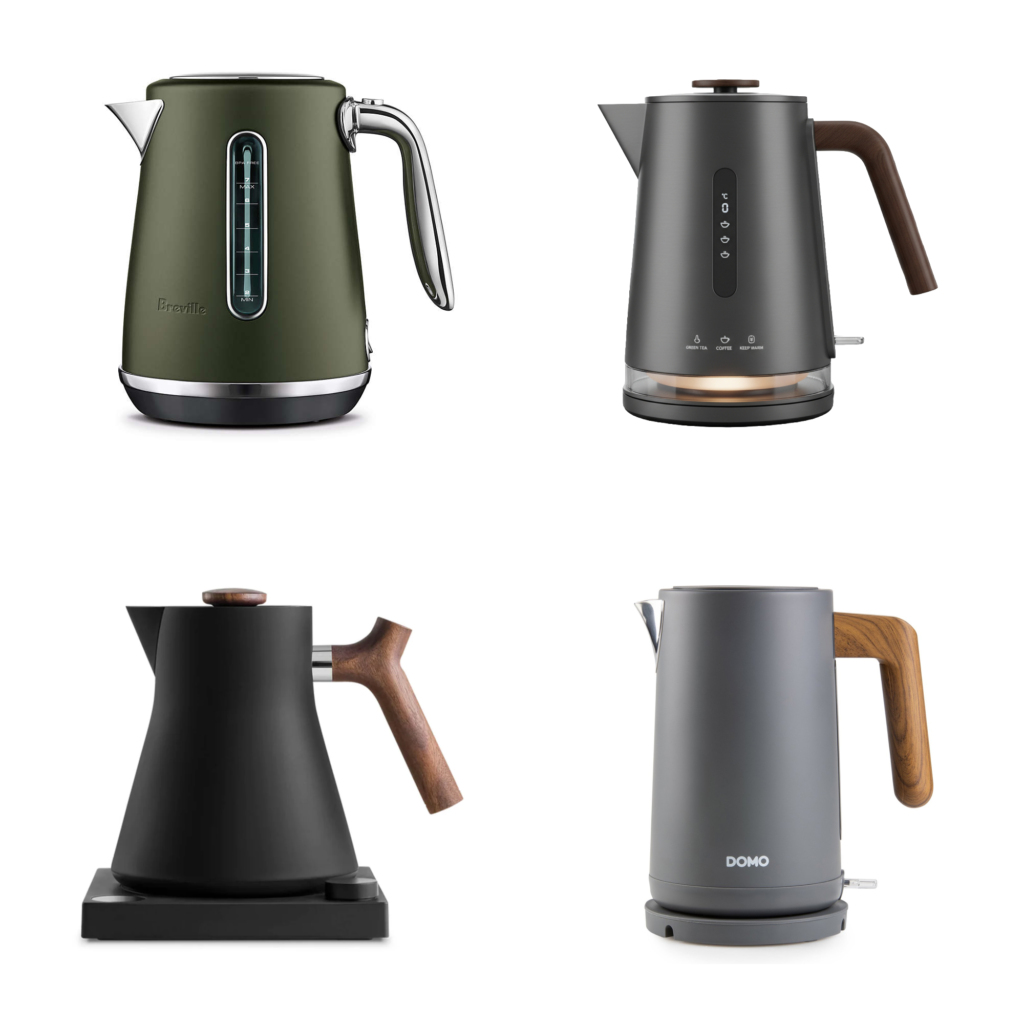
The most significant risk is that of unoriginality and intellectual property (IP) infringement. Because AI models are trained on existing datasets of images and designs, their outputs are, by definition, “derivative.” Asking an AI to design a “sleek, modern electric kettle” will almost certainly result in a statistical mashup of every popular kettle design from the last decade. This leads directly to a market flooded with homogenous, uncompetitive products that all look vaguely familiar. Even more dangerously, the AI’s output could inadvertently infringe on an existing design patent, trademark, or trade dress, exposing the company to costly litigation.
Image: “AI Prompt ‘sleek, modern electric kettle’”
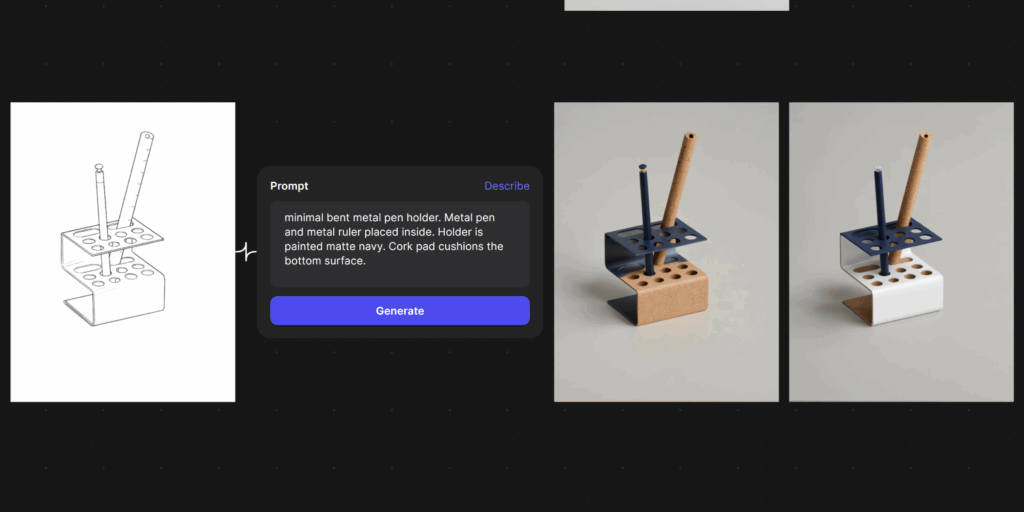
Compounding these risks is the current state of the technology itself. The ecosystem of AI design tools is fragmented, spread across separate platforms for text-to-image generation, 3D modeling, and research synthesis, with no single, cohesive workflow yet developed. AI image generators are often inconsistent, producing designs that are nonsensical or unmanufacturable. It can produce frustrating results when trying to turn early sketches into higher-fidelity concepts, with software hallucinating details. This became particularly evident during a recent project for a niche fitness product. Even with sketches and prompts provided by our team, Vizcom had difficulty accurately interpreting the object.
For instance, they rendered hollow areas connected by a wire as solid forms. The AI’s output frequently incorporated recognizable elements from competitors’ products, including malformed versions of their logos. This was largely attributed to the limited datasets available in this specific niche category. Even if a desired image is achieved, current tools struggle to replicate the concept consistently from various angles, making fair evaluation across concepts difficult. While these tools will undoubtedly improve and integrate into more holistic programs, for now, an over-reliance on them can lead to a time-wasting and energy-consuming cycle of repeated prompts across multiple platforms to correct for the machine’s errors.
Image: Vizcom prompt to render the original sketches image to the left; renders to the right.
The responsible and high-value use of AI in this phase is not for ideation but for iteration on a human-validated concept. Once a designer has developed a core form through combinations of sketching, modeling, and critical thinking, AI can become an incredibly powerful visualization tool. AI, with sufficient prompting around parameters and goals, can help us break out of creative ruts by using designer-led concepts as a seed and pushing them in unexpected directions. It can generate variations in color, material, and finish (CMF) in seconds, allowing for rapid exploration of a product’s aesthetic range. There is potential to use these tools to automate numerous material and rendering options, saving designers time and allowing them to focus on curation and refinement instead of tedious input.
Don’t Automate Away Moments of Critical Intervention
The shortcut from a prompt to a perfect-looking render is dangerously enticing because it allows the designer to bypass the difficult, uncomfortable, and arguably most important part of the process: confronting real-world constraints.
The risk is that we automate away the moments of critical intervention. Low-fidelity ideation and prototyping—sketching on paper, building crude models—is not about making pretty pictures. These are tools for critical thinking. This process forces an idea out of the designer’s head and into the physical world, enabling tangible conversations among interdisciplinary teams. The process prompts essential questions: “How will this be held? How will these parts connect? Can we manufacture this shape affordably? Can someone with limited dexterity operate this?”
Bypassing this messy, confrontational phase because an AI has produced a flawless image is a costly recipe for designing beautiful failures: products that are un-manufacturable, ergonomically unsound, or simply don’t solve the user’s problem. These tools risk premature optimization, where the image of the product is perfected long before the idea of the product has been validated. This presents a client relationship hazard as well, risking premature attachment to non-optimal or unproducible designs. Thoroughly exploring concepts, both mentally and physically, is essential for uncovering unforeseen opportunities that can differentiate a product from existing solutions. Spending time in that ambiguous, unresolved space is not a delay; it is what leaves room to discover what a solution truly needs to be.
Reclaim & Reinvest Design Time with Intention
The corresponding hope is the most valuable opportunity AI offers our profession: time reinvestment. The hours and days saved by automating repetitive work are not a bonus; they are a strategic asset. That reclaimed time must be reinvested with intention into the rigorous, human processes that AI cannot replace.
Reclaim and reinvest design time with intention by:
Conducting more tests and interviews with the communities that will be affected by the product, fostering genuine empathy.
Increasing our focus on testing and iterating prototypes with individuals across the spectrum of accessibility needs.
Conducting a thorough Life Cycle Assessment, analyzing a product’s environmental impact from raw material extraction to end-of-life, or enabling in-depth research into desperately needed sustainable and circular materials.
And crucially, making space for additional deep, cross-disciplinary collaboration—sitting down with engineers, material scientists, and supply chain experts to solve hard problems together, long before any molds are cut.
Using AI for Detail & Implementation
In the final stages of design, the focus shifts to refining details and preparing for manufacturing. Here, AI’s dual nature as both a potential accelerant of low-quality goods and a tool for unparalleled optimization comes into sharp focus.
The risk is a fast track to low quality. The combination of AI-assisted design and the increasing accessibility of manufacturing technologies like 3D printing and on-demand factories drastically lowers the barrier to bringing a physical product to market. While this “democratization” sounds appealing, it threatens to unleash a torrent of ill-considered products. If the underlying design thinking is shallow, rapid prototyping simply means you can produce a bad product faster. The result is a marketplace saturated with goods that are not durable, not repairable, and destined for an early grave in a landfill—physical slop. If you want an early preview of this, simply scroll through the TikTok Shop or Shein.
The truly transformative opportunity in this phase lies in “generative design.” This is not the text-to-image generation used for concept art. True generative design is a computational process where engineers and designers define a problem’s constraints—load points, material properties, weight targets, manufacturing methods, connection points, and keep-out zones—and an AI algorithm generates a mathematically optimal form to meet those requirements. This is a task that is computationally impossible for a human to perform efficiently, and the results can be amazing.
Generative Design Case Studies
General Motors redesigned a standard seat bracket, a part normally made of eight welded pieces. The generative design process produced a single, 3D-printed component that was 40% lighter and 20% stronger, while also simplifying the supply chain.
NASA uses generative design to create “evolved structures” for its complex, one-off mission hardware. An aluminum scaffold for the EXCITE telescope was designed this way, saving up to two-thirds of the weight and solving a tricky requirement to connect materials with different thermal expansion properties. This process also produced a part with stress factors “almost ten times lower” than a human-designed equivalent and cut the design-to-fabrication timeline to “in as little as one week.”
These examples prove AI’s most profound value is in the objective, data-driven optimization of highly complex functional components.
Our profession stands at a crossroads. The convergence of AI-powered design and accessible manufacturing is dismantling the barriers to market entry for physical products. While this has the potential for undeniable convenience, it also presents an existential risk: market saturation with unoriginal, low-quality, and irresponsibly produced goods—a world of “physical slop.” We must build processes for using AI industrial design tools responsibly without automating away the crucial moments of critical intervention and professional judgment. These moments represent designers’ most valuable contributions to our clients, users, and the planet.
This moment forces a fundamental clarification of the industrial designer’s value. We can, and should, use generative tools to accelerate our rigorous process, applying the same critical judgment and intention we do today. But we must also recognize that as less scrupulous actors use AI to automate form generation, basic aesthetics will become a commodity. This compels professional designers to champion the holistic, systemic thinking that has always been core to our profession, elevating this stewardship as our most strategic, necessary, and uniquely human contribution.
AI is a powerful tool that can grant us the precious gift of time.
Our ultimate responsibility transcends the object to embrace the entire system in which it exists. Our vital role is to be the advocate for the user, their communities, and the planet, ensuring these often-overlooked interests are central to discussions about business needs, manufacturing constraints, and logistical challenges. In a world where anyone can generate a form, the professional’s purpose is to ensure the products we help create are not merely convenient, but are just, responsible, and respectful.
AI is a powerful tool that can grant us the precious gift of time. We must seize that reclaimed time and use it with fierce intention. We can reinvest that time into considering the entire lifecycle of the product: its ethical production, its durability and repairability, and its responsible end-of-life. The designer of the future must master three new roles. They must be the skillful manager of generative assistants, guiding AI for industrial design with deep domain expertise. They must be the skeptical critic, rigorously questioning every output and never accepting a machine’s suggestion as absolute truth. And above all, they must be the final decision-maker and systemic steward, ensuring that every choice is intentionally informed, profoundly human-centric, and worthy of bringing into our shared world.
Our team used generative AI tools to assist in editing and refining the language in this article. All core ideas, arguments, and conclusions originate from our human authors and have been reviewed and approved by the team.