Aigen
Element Gen 2
Transforming the Future of Weeding: The Aigen Element Gen 2
Background
Farmers are currently on the front lines of a growing crisis, managing herbicide-resistant weeds alongside increasing pressure to reduce chemical use. To meet this challenge, Aigen developed Element: a fully autonomous, solar-powered robot designed to eliminate weeds through precision mechanical strikes rather than chemical intervention. By replacing harmful, chemical spraying with a 100% renewable “crew” of robots, farmers can manage weeds while moving toward a more sustainable, chemical-free future.
Challenges
Aigen approached Fresh to help evolve the Element from a proof of concept into a commercial platform for its second generation. The Fresh industrial design team worked alongside the Aigen engineering team to create a design refresh that balanced rugged durability with an approachable aesthetic. The goal was to create a robot that felt like a trusted coworker rather than an intimidating machine.
The redesign focused on transitioning to a robust, field-ready housing that protects sensitive electronics from mud and rain while maintaining a lightweight aluminum construction. Key functional improvements included optimizing the form for wind stability, reducing hardware exposure, and eliminating reflective surfaces that could interfere with the computer vision systems.
Services & Capabilities
Core Technologies


Strategic design refresh
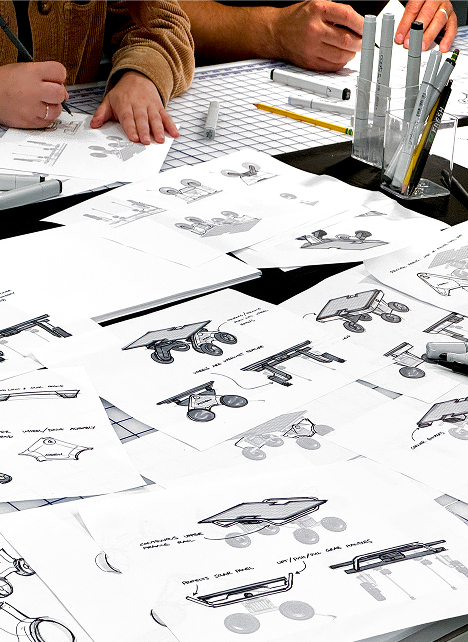
As we began sketching, we audited the existing configuration to ensure our refresh was grounded in real-world performance, prioritizing both technical requirements and the grower’s operational needs. Initial design constraints focused on optimizing the robot’s profile for aerodynamic stability, narrowing the wind-facing area to keep the lightweight aluminum chassis grounded in open-row environments.
Fresh’s design team was instrumental in reducing complexity in the design. We moved toward a more approachable aesthetic by creating simple pill-shaped fairings and streamlining the exposed hardware. The forms not only modernize the robot’s visual identity but also serve as functional protective elements, simplifying field maintenance.
Building in flexibility for future robots
The design features a modular architecture that supports adjustable widths and double-wide configurations for diverse crops like cotton and soy. Assembly and manufacturing steps were simplified where possible, without sacrificing strength. This makes Element Gen 2 not just a one-off refresh, but a platform-ready architecture that can adapt to new crops, fields, and use cases over time.


AI vision system
Aigen developed Element’s AI vision system that identifies and targets weeds. Fresh updated the design to reduce inward-facing reflective surfaces. By minimizing glare and visual clutter around critical sensor zones, the design supported more reliable use in changing light and weather conditions.
A sustainable future
Each unit is 100% solar-powered with a 350W panel and onboard battery storage. Element robots work as a crew, operating on a mesh network to navigate fields. By combining autonomy, renewable energy, and precision mechanical action, Element redefines how weed management can be approached while removing chemical inputs and producing a healthier food supply.

1
Delivered 1 platform-ready redesign — moving Element from proof of concept to a commercially manufacturable second generation.
2X
Modular architecture now supports adjustable widths and double-wide configurations across crops like cotton and soy.

