Enterra
Custom test fixturing for a regulated medical device
Engineering proof that an implantable medical device won't fail
Background
Enterra Medical builds implantable devices that reduce the chronic nausea of gastroparesis, giving patients meaningful quality of life back. Devices like these carry a bottom line that overrides almost every other design decision: anything implanted in a human body has to be reliable. A failure isn’t a return or a warranty claim—it’s another surgery.
For its Ascent platform, Enterra needed a way to prove, board by board, that every PCBA had already been pushed past the infant-mortality zone before it advanced through the regulated device lifecycle. Fresh was enlisted to design and build the custom burn-in fixture that would generate that proof, matched to Enterra’s real oven workflow and built to hold up under regulatory scrutiny.
Challenges
- Support one specific DUT and a regulated test process—not just a generic board rack.
- Handle extended oven burn-in, maintain precise pogo-pin contact, and protect the DUT.
- Verify pulse behavior for every PCBA
- Meet strict medical device standards, with clear documentation and proof of performance, not just solid design.

Heat is the enemy of electronics
Every electronic component follows a predictable failure pattern that reliability engineers call the bathtub curve. Early in a component’s life, latent defects—a cold solder joint, a marginal connection, a part that was never quite right—surface quickly under stress. The early spike is called infant mortality.
Survive it, and the failure rate drops and holds steady for years, until the component eventually wears out. For a device that goes inside a patient’s body, an early spike is the difference between a device that quietly does its job for a decade and one that sends someone back into an operating room.
More than an off-the-shelf rack
In a regulated environment, “close enough” doesn’t survive an audit. Enterra couldn’t validate implantable hardware on a catalog rack and boilerplate documentation—they needed a fixture built around one specific board, one specific test method, and a clear trail of evidence behind it. Fresh was selected to engineer a custom fixture around Enterra’s exact board geometry, contact points, and validation flow, drawing on electrical, mechanical, and integration engineers working side by side to deliver a test-ready system.

Designing for repeatable burn-in at scale
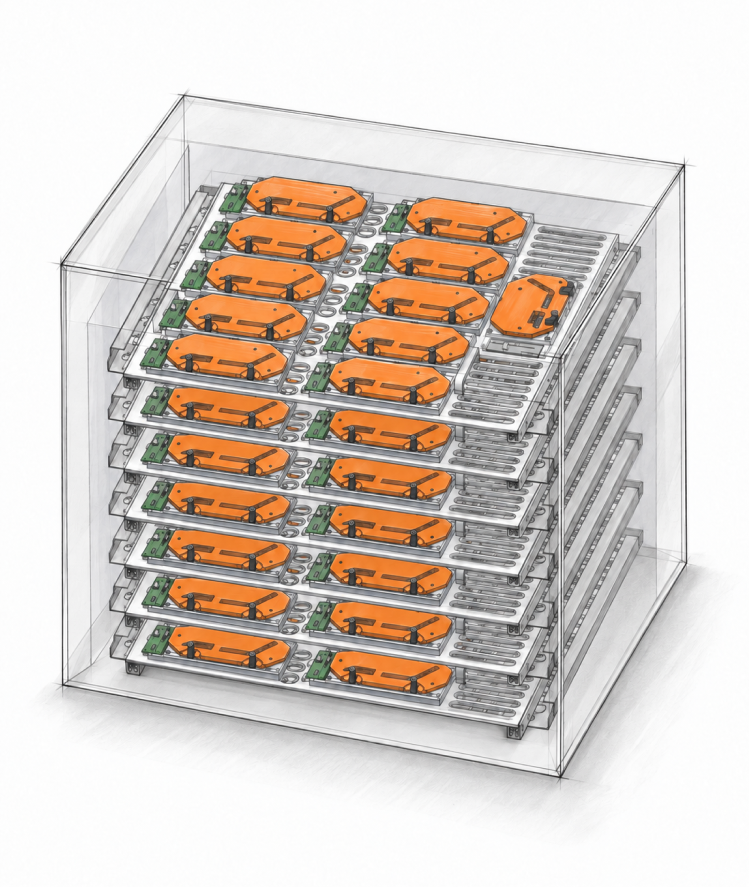
Proving reliability isn’t a one-time test. It’s a process that has to run the same way, correctly, every time a new batch of boards comes off the line. Fresh built the fixture around how Enterra’s team would actually use it: load DUTs securely, place shelf assemblies in the oven, and run an extended burn-in cycle before the next phase of testing.
Our solution holds 77 PCBAs at once, letting Enterra push a full production batch through a documented, repeatable 85°C thermal cycle that stands in for weeks of ordinary use, condensing the front end of the bathtub curve into a burn-in window short enough to fit a production schedule.

Pulse verification engineered for regulators
Every DUT is powered and pulse-tested individually inside the oven, so a defect that would otherwise show up as an infant-mortality failure out in the field gets caught here instead—on the bench, before the board is anywhere near a patient.
Fresh’s electrical engineers designed the custom circuit board, power architecture, and pogo-pin contact scheme needed to deliver power to each DUT and verify pulse-related functionality, while accounting for failure modes and fault isolation so the fixture itself could be validated and documented as part of Enterra’s test evidence.

Protecting boards that can’t afford a defect
Standard metal clamps or improvised brackets can scratch, bend, or misalign delicate medical hardware. The risk? Ruining both the part and the test, which is unacceptable for a part under test that may end up inside someone’s body. Fresh’s mechanical engineers designed a clamshell fixture that aligned each DUT, protected contact interfaces, and made loading practical at 85°C, while preserving repeatability from one cycle to the next.
- A hinged design with integrated spring support for easier loading
- Hold-downs, support areas, and alignment features to protect the DUT and pogo pins
- Materials chosen for long life inside a hot oven, cycle after cycle
Wire routing for scalable, maintainable testing
A fixture this dense only works if the wiring behind it is just as disciplined. Fresh’s technicians and engineers designed the wire routing and harnessing needed to bring power into the oven, distribute it across shelf assemblies, and support reliable operation across 77 DUTs running at once.
Treating wire routing as part of the system design — not an afterthought — produced harnessing that can be serviced and adapted as Enterra’s boards evolve, so test infrastructure doesn’t become the thing slowing down the next design change.

Turning test infrastructure into an essential asset
The fixture didn’t just run a burn-in cycle — it produced evidence. Boards with latent defects fail early, on the bench, inside Fresh’s fixture. Everything that survives carries a defensible reliability profile, having already been pushed past the steepest part of the bathtub curve before it ever reaches final assembly.
For a device implanted in a patient’s body, that’s the entire point: fewer failures in the field mean fewer patients who need a second surgery to replace a device that shouldn’t have failed in the first place.
77
PCBAs tested simultaneously
85
degrees celsius sustained oven temperature
100%
units pulse-verified before advancing

