Article
AI Consulting for Small Businesses: Your Guide to Creating Outsize Value

October 17, 2025 ...

The AI Imperative for Small Business Success
Specialized AI consulting for small businesses is critical, because across America, a not-so-silent transformation is underway.
Everywhere you look, the lightning-speed proliferation of AI is in the headlines.
From the LA Times (regarding corporate partnerships to power the AI boom)
Recently, OpenAI (creator of ChatGPT, one of the leading large language models, or LLMs) signed a multiyear partnership with Broadcom to co-develop custom chips and networking hardware, aiming to expand AI data center capacity by 10 gigawatts—roughly equivalent to powering 8 million US homes.
From TechCrunch (regarding investments in AI infrastructure)
Nvidia CEO Jensen Huang forecasts $3–4 trillion will be spent on AI infrastructure by 2030, highlighting an accelerating global push toward developing high-capacity computing power to fuel this emerging technology boom.
And that’s just two headlines in the last few weeks. Suffice it to say, a worldwide shift toward scaling up artificial intelligence initiatives and infrastructure is well underway.
What’s mentioned less often, however—what you might call a “silent transformation”—is how AI is impacting the small businesses and mid-markets that find strategic ways to embrace it. Practical guidelines, focused on the specific strategies small businesses and mid-markets can consider to adopt AI in ways that will lead to measurable impact, are vital to helping these organizations invest in the right initiatives aligned to organizational priorities and key business objectives.
AI adoption is no longer a distant ambition—now, it’s a competitive imperative for small businesses seeking outsize value in a fast-evolving marketplace.
In this guide, we’ll cover:
- The current state of AI adoption amongst small businesses
- How small businesses benefit from AI consulting and the value AI creates
- The critical role of AI consulting for small businesses
- Examples of AI adoption across industries
- Strategies for overcoming adoption barriers and ways to measure success

What is the current state of AI adoption for small businesses?
Defining a “small business”—and forecasts for AI adoption
While the US Small Business Administration’s definition varies depending on the industry, the SBA generally defines a small business as “a corporate entity with less than $41.5m in annual revenue and fewer than 1,500 total employees.”
AI in the small business segment is forecasted to expand from $194 million in 2024 to $567 million by 2032—a CAGR of 14.3%. According to research from the US Chamber of Commerce, 58% of small businesses say they already use generative AI—up from 40% in 2024 and more than double the adoption rate in 2023.
Adoption statistics & trends
2025 marks a tipping point for small businesses and AI. According to research from Salesforce, 75% of SMBs (small and medium-sized businesses) are now experimenting with various AI solutions, with 78% saying it will be a game-changer for their company. The same research indicates 87% report that AI helps in scaling operations, and 86% see improved margins as a result of their investments.
From Generative AI and AI agent development to computer vision and data engineering, a critical mass of small and medium-sized businesses are open to AI, and many that have invested are already seeing results.
The value of doing so? According to AmplifyAI, organizations that close the experimentation-to-implementation gap can expect 3.7% ROI for every dollar spent on AI initiatives.
Key benefits of AI consulting for small businesses
Small businesses can benefit from AI by unlocking faster growth, greater efficiency, and smarter decision-making. Yielding benefits such as workflow automation, data insights, and personalized customer engagement, AI empowers small businesses to do more with less while improving productivity and profitability.
Research indicates that embracing AI is increasingly essential for remaining competitive and resilient in today’s evolving marketplace.
The expertise gap and consulting advantage
Despite growing openness to AI among SMB leaders, the promise of undertaking AI initiatives is often at odds with the actual expertise needed to launch projects from proofs of concept (POCs) to fully mature organizational initiatives.
In the healthcare field, research from Bessemer Venture Partners’ Healthcare AI Adoption Index illustrates the gap between experimentation and full-scale production: “Many organizations are running dozens of GenAI POC projects at once, but only 30% of completed POCs have made it into production.”
Healthcare executives stuck in the “experimentation phase” cited security concerns, a lack of in-house expertise, costly integrations, and challenges around cleaning and preparing data as barriers standing in the way of bringing experimental solutions to scale.
According to a recent global survey conducted by TeamViewer, only one in three SMB leaders use AI daily, and just 16% apply it at least weekly. 28% of SMB leaders failing to adopt AI effectively report higher operational costs due to missed opportunities for automation. Yet 72% believe AI will spark the greatest productivity surge of the century, and 76% view it as essential to improving business performance.
5 ways AI consulting for small businesses creates outsize value
While most SMBs recognize AI’s transformative power, they face barriers moving from early adoption to everyday integration. Specialized AI consulting for small businesses helps bridge this gap—from staff augmentation to solve the in-house expertise challenge to regulatory guidance and data engineering support.
In our experience, the journey to meaningful AI value for most SMBs does not begin with developing cutting-edge algorithms—it starts with strategic consulting.
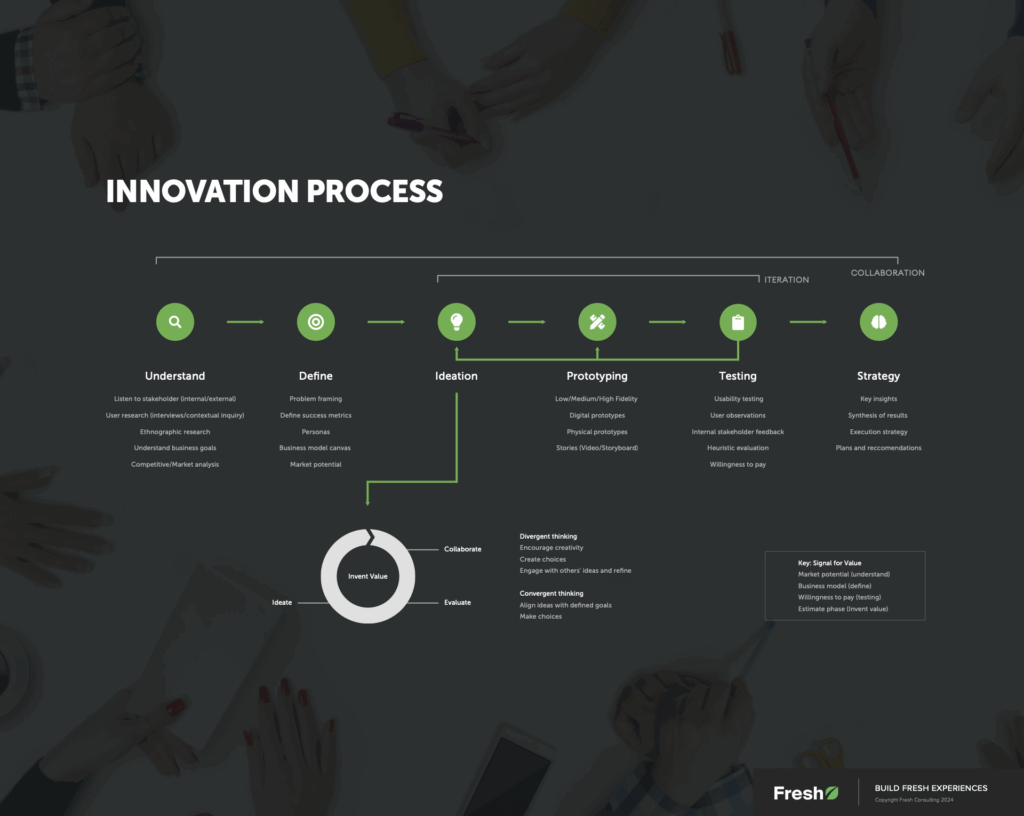
At Fresh, we’ve supported organizations with new technology adoption and integration in various ways, but ultimately, the efforts can be aggregated into 5 clear-cut focuses.
#1: AI Strategy
An AI consultancy should necessarily provide robust AI strategy services.
Your business challenges are unique. Even if you operate in a field where AI initiatives are omnipresent (such as finance), a bespoke approach to identifying and solving real business problems—and not just chasing the latest trends and tools—is critical.
“Problem-first roadmaps” should supersede “tool-first biases,” and skilled AI consultants must align proposals with your unique business objectives to ensure that every AI investment is driven by practicality and value.
#2: AI Technology Infrastructure and Data Strategy
Building a rigorous data strategy tailored to your organization should precede any technical implementation of AI.
Fresh’s AI consultants assess current capabilities, uncovering gaps in data quality, data lineage (i.e., documenting the full life cycle of data), and data security—the bare minimum musts for sustainable artificial intelligence integration.
The Fresh team adds additional value. By evaluating legacy system compatibility, advising on “build-or-buy” decisions, and supporting vendor selection regarding AI technology infrastructure and data strategy, we deliver pragmatic solutions. From cloud-based platform to subscription models, our provides integral expertise to help organizations control costs and simplify scalability.
#3: AI Implementation and Risk Management
AI consulting for small businesses handles everything from MLOps frameworks (machine learning operations) to compliance guardrails, ensuring responsible AI deployment that is aware of evolving regulations across industries.
At Fresh, risk mitigation is built into every project, protecting the small businesses we partner with from data breaches, regulatory missteps, and operational inefficiencies.
#4: AI Change Management
Meaningful AI transformation requires more than new platforms and algorithms—it depends on skilled professionals who know how to use AI effectively and continue scaling initiatives as needed.
At Fresh, our AI consultants design staff training and upskilling programs with the objective of building an organizational culture of innovation, thus ensuring your team is capable of owning (or sharing) ongoing AI optimization.
Cultural transformation is the invisible scaffold of AI success. Education and training are too often overlooked in favor of chasing the latest technologies, but a change management game plan is essential to enabling impactful adoption.
#5: Right-Sized AI Initiatives with Room to Scale
Our consultants spend time on the front end truly understanding your business needs, but we also create strategic roadmaps to break down ambitious objectives into quick, attainable wins that demonstrate the value of AI early.
Tracking measurable key performance indicators across implementation and deployment phases provides robust feedback loops and unlocks scalable growth, in addition to winning stakeholder and decision-maker confidence in ongoing AI adoption.

How do AI consultants help small businesses adopt and implement AI?
The following elements of AI adoption provide a sense for how the value AI consultants provide manifests at a tactical level.
Starting with AI Strategy development
Fresh works with you to pinpoint the ways AI can help your business grow faster and run more smoothly. Together, we find the opportunities that can give you an edge and create a plan that’s realistic today and built to last for the future.
- Evaluation of your business’s readiness for AI
- Spot the best quick-win opportunities based on your needs
- Build a clear AI roadmap leading to real results
- Co-create an organizational vision, from first pilot to full rollout
- Explicitly tie every element of your AI strategy development to organizational goals and KPIs
Developing a plan for sustainable implementation
We turn strategy into action with customized step-by-step plans that make AI adoption simple, even for small teams. As we help organizations pilot new tools, we provide recommendations for adapting and scaling based on what works.
- Map AI strategy to practical, priority-driven implementation and deployment steps
- Help you choose the right AI tools and applications to accomplish your goals
- Set up strong internal practices, helping your team leverage data and measure progress
- Launch and review pilot projects, assisting with iteration and ongoing refinement
Navigating cultural and organizational readiness
Success with AI depends on your team’s capabilities and how ready your business is to embrace change. With specialized AI consulting for small businesses, the Fresh team makes sure your people are prepared, building trust and making AI an asset everyone in your organization can support.
- Assess how ready your team and workflows are for AI
- Plan for change to minimize disruption during deployment
- Create a culture of innovation that embraces new tools suitable for workflows
- Keep communication open to make the transition smooth

What does AI implementation look like for different industries?
Healthcare: Balancing Innovation with Compliance
From 2024 to 2034, Precedence Research anticipates the artificial intelligence in healthcare market will grow from $26B to $613B, with a CAGR of 36.84%.
In research conducted by the Journal of the American Medical Informatics Association, 100% of respondents reported AI adoption activities, and 53% reported high success using AI for clinical documentation, specifically.
The use cases for AI in healthcare are myriad. How smaller healthcare organizations can adopt AI:
- Generative AI and large language models for clinical documentation
- NLP (natural language processing) powered documentation
- Smart scheduling assistants and chatbots
- Predictive analytics for patient risk management
- AI-powered medical image interpretation
- Automated billing solutions
Financial Services: Navigating Regulation with AI
In the financial services industry, overall AI adoption rates stand between 72% to 78%.
In his article on the power of AI in fintech, Fresh’s Digital Latam Managing Director, Gerardo Aranda discussed the importance of guiding organizations through strategic adoption, writing:
“Strategic innovation will require thinking about technology ecosystems rather than one-off implementations. The most powerful artificial intelligence fintech solutions will encompass other technologies such as machine learning, deep learning, big data, and cloud infrastructure.”
AI consultants help financial organizations navigate regulatory complexity, build suitable AI governance plans for transparency and risk management, and create customer-centric solutions designed to foster trust and enhance customer engagement.
Regional banks, credit unions, and smaller financial institutions can adopt AI in numerous ways, including:
- AI-powered fraud detection, alerts, and regulatory compliance monitoring
- NLP (natural language processing) and large language models
- Smart chatbots to enhance customer service
- Customer sentiment analysis and intelligence tools
- Data-driven risk assessment with predictive analytics
- Predictive analytics for credit decisions
- Seamless AI integration with core banking tech stacks
Manufacturing: Operational Excellence Through AI
AI has the potential to boost operational sophistication in manufacturing via predictive maintenance, quality control automation, computer vision, and supply chain optimization. Key considerations include reduced downtime, improved overall equipment effectiveness, transparency into complex systems for non-SMEs, and faster lead times.
Specialized AI consulting for small businesses in manufacturing often focuses on:
- Predictive analytics and maintenance for equipment uptime
- AI-based quality control with computer vision
- Tools to optimize supply chain intelligence and inventory management
- Production scheduling and demand forecasting
- Automated energy consumption analytics
- Data-driven process automation to streamline operational efficiency
Architecture, Engineering, and Construction: Safety and Efficiency Gains
BuiltWorld’s 2025 Annual AI Benchmarking Report shows that nearly two-thirds of construction firms rate their AI maturity as “average” or higher. Streamlined operational efficiency is the top driver behind AI investment, cited by nearly 100% of survey respondents.
AEC businesses can adopt AI via:
- AI-powered construction site safety monitoring
- Automated project scheduling and resource allocation
- Predictive maintenance for building equipment
- NLP (natural language processing) analysis of safety reports
- Generative design for streamlined planning
- AI-driven cost estimation and budgeting
- Automated document management
Aviation, Transportation, and Logistics: Smarter Operations
Fortune Business Insights reports that Aviation AI is projected to grow from $7.4 billion to $27 billion by 2032 (20.2% CAGR). Route optimization, predictive MRO (Maintenance, Repair, and Operations), and passenger flow solutions are three obvious implementations.
The use cases span far beyond those three, however. Small transportation businesses can adopt AI in numerous ways, including:
- AI-powered fleet optimization
- Cargo flow analysis solutions
- Automated shipment tracking
- Data-driven dynamic pricing
- Real-time scheduling and dispatch automation
- Security monitoring with AI and machine learning
Cross-Industry AI Agent Patterns for SMBs
With pertinent use cases across almost any industry, Agentic AI (i.e. artificial intelligence-powered agents engineered to undertake autonomous business functions) is critical for automating time-intensive workflows and freeing workforces to do higher-value tasks.
Common examples of Agentic AI include:
- Planning agents for forecasting
- AI workflow orchestrators to automate manual workflows
- Compliance agents for regulatory monitoring
Whether automating passenger check-in at airports or enabling streamlined document management for hospitals, this is one area of AI with the lowest barrier of entry and the most immediate return on investment.

How does AI consulting for small businesses help with overcoming implementation barriers?
Budget and ROI Concerns
Small businesses can navigate budget and ROI concerns by mitigating AI costs through affordable cloud and subscription services, starting with small, budget-friendly development projects, and tracking results to learn and pivot as needed.
Identifying and celebrating early wins builds confidence, earning trust from decision makers that future investments in AI will be worthwhile.
Skills Gap and Resource Constraints
Working with consultants who can provide AI-based education, training, and support programs helps teams quickly build the skills they need. With strategic partnerships and established processes for training, support, and on-the-job learning, small businesses can allow their staff to grow into new roles while AI solutions mature and evolve.
Fresh specializes in “end-to-end” AI consulting for small businesses, from building a pilot to training your team to launch polished products and own future maintenance and development with confidence.
Technology Integration Challenges
In many cases, consultants can connect new AI tools with your existing systems and provide recommendations for additional tech stack integration. Specialized AI consulting for small businesses pivots the focus from building solutions completely from scratch, as many businesses can modernize and enhance the legacy systems they have in place faster, with less risk, and with less upfront investment. Optimization, rather than building new custom systems from the ground up, is not only a cost-friendly solution, but also a way to prove the value of AI before overinvesting.
Change Management and Adoption
Keeping employees involved and informed makes AI adoption less stressful and improves sentiments regarding change. Fresh can help you communicate AI’s complexity in easy-to-understand language, identify success stories about your employees’ and customers’ experiences, communicate their value, and gather feedback to bring your team together and maintain momentum as new tools take hold.

How can small businesses measure the ROI of AI initiatives?
Key performance indicators for artificial intelligence
Smart small businesses typically track AI success across three core areas, all of which directly impact their bottom line.
- Operational metrics reveal time savings and automation rates—showing exactly how much faster work gets done.
- Financial indicators track cost reduction, revenue growth, and profit margin improvements that justify AI investments.
- Customer metrics measure satisfaction scores, response times, and engagement levels that show how AI enhances customer experiences.
Best practices for successful implementation
The businesses getting the best results from AI follow proven best practices such as setting realistic development timelines, building processes for ongoing development and implementation, tracking progress to plan for scalability, and building scaffolds for ongoing optimization.
For many organizations, AI initiative success depends on:
- Starting small, with a vision for growth
- Driving toward clear wins now, that led to bigger wins in the future
- Expanding systematically as teams become more comfortable with new tools and processes
Long-term Value Creation
Beyond immediate ROI, AI must create a lasting competitive advantage. Small businesses that view AI as a strategic investment—not just a cost-cutting tool—position themselves to compete effectively as markets evolve and customer expectations continue to rise.
While it’s important to consider the long game, as mentioned above, measure value now is equally critical. And with the right AI consultant supporting your organization, you can implement right-sized solutions that pay dividends.

Your path to AI success starts here
The momentum behind AI adoption is undeniable. For small businesses, the question is no longer if you’ll adopt AI, but how quickly you’ll move to capture the competitive advantage it offers.
The data is clear: organizations that successfully implement AI see measurable improvements in efficiency, profitability, and customer satisfaction. Businesses that delay adoption risk falling behind competitors who are already automating workflows, extracting insights from data, and delivering enhanced customer experiences.
But success requires more than enthusiasm—it demands strategic planning, technical expertise, and organizational readiness.
That’s where partnering with specialists in AI consulting for small businesses becomes essential.
Fresh Consulting brings proven expertise in:
- Developing AI strategies aligned to your business goals
- Building data infrastructure that powers intelligent solutions
- Implementing AI systems, digital platforms, and applications with measurable ROI
- Training your team to own and optimize AI initiatives
- Navigating industry-specific compliance and integration challenges
We’ve helped organizations across healthcare, financial services, manufacturing, and beyond transform AI pilots into production systems that deliver outsize value.

Ready to tap into the value of AI consulting?
We’d love to schedule an introductory call to discuss your goals, needs, and roadblocks. Contact us to begin your journey toward intelligent automation, data-driven decision-making, and sustainable competitive advantage.